
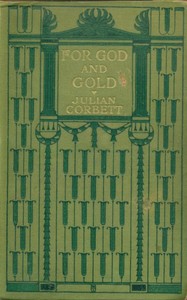
For God and Gold by Julian Stafford Corbett
So, what's this book actually about? Let's break it down.
The Story
For God and Gold zooms in on a crucial century for England, from the reign of Elizabeth I through the early 1600s. Spain is the superpower, its empire swollen with silver and gold from the Americas. England is the underdog, a Protestant nation viewed with suspicion and hostility by Catholic Europe. The book follows the rise of English sea power, not through official royal navies at first, but through a wild mix of private explorers, sanctioned pirates (called privateers), and ambitious merchants.
Corbett tracks famous figures like Sir Francis Drake, whose raids on Spanish treasure ships were both patriotic duty and hugely profitable business. He shows how voyages meant for exploration, like those of Sir Walter Raleigh, were also desperate attempts to find new sources of wealth to compete with Spain. The legendary defeat of the Spanish Armada in 1588 is a major event, but Corbett frames it as the climax of a long, simmering economic and religious war, not a standalone battle. The story is about how the pursuit of treasure and the defense of the Protestant faith became completely tangled together, creating the drive for an empire.
Why You Should Read It
Here’s what I loved: Corbett makes you feel the stakes. This isn't a dry list of dates and treaties. You get the sense of England as a nation betting its entire future on the daring of a few sea captains. The tension between the lofty ideal of a 'Protestant crusade' and the gritty reality of plunder for profit is fascinating. Were these men heroes, pirates, or both? The book doesn't give easy answers, which makes it so much better.
It also completely reshapes how you see this period. We often learn about the Armada and the explorers as separate stories. Corbett brilliantly weaves them into one narrative, showing how the need for gold funded the ships that defended the faith. It’s a masterclass in how history really works—messy, motivated by money and belief, and driven by personalities willing to take huge risks.
Final Verdict
This book is perfect for anyone who enjoys big, sweeping history that reads like an adventure. If you liked books like Nathaniel's Nutmeg or Empire of the Deep, you'll feel right at home. It’s especially great for readers who want to look past the simplified myths of 'good vs. evil' and understand the complex, often contradictory, forces that actually build nations. A word of caution: it was written in the late 1800s, so the prose is elegant but denser than a modern pop history book. Stick with it for the first chapter, and you'll be hooked. This is the real story of how England found its destiny on the waves.
No rights are reserved for this publication. Access is open to everyone around the world.
Paul Flores
1 year agoAmazing book.








Paul Gonzalez
7 months agoGiven the current trends in this field, the cross-referencing of different chapters makes it a great study tool. Finally, a source that prioritizes accuracy over hype.