
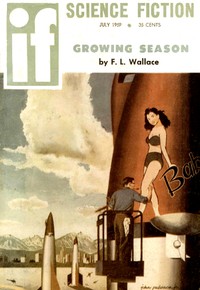
Growing Season by F. L. Wallace
F. L. Wallace's 'Growing Season' is a classic sci-fi gem that feels surprisingly fresh. Published in the 1950s, it trades ray guns and space battles for a slower, more thoughtful kind of wonder—and dread.
The Story
The plot follows a small scientific team on the planet Khalia. Their job is straightforward: catalog the flora and fauna. They quickly find that Khalia's plant life is incredibly advanced, forming complex, interconnected systems. The lead botanist, Sam, makes the breakthrough: these plants aren't just biologically sophisticated; they possess a form of intelligence and can communicate chemically and through root networks. As the team's experiments continue, the forest responds. It starts to grow in specific patterns around their base, 'offers' them unfamiliar fruits, and seems to manipulate local animal life. The situation turns from fascinating to frightening when the environment itself appears to become an active participant, challenging human control and understanding at every turn.
Why You Should Read It
What I love about this book is its patience. Wallace builds tension not with monsters, but with ideas. The real conflict is a clash of consciousness. We're used to thinking of intelligence as something that walks and talks. 'Growing Season' asks what it would mean to share a world with a mind that is utterly alien, patient, and rooted in the land itself. Sam's journey from detached scientist to someone who realizes he's in a two-way relationship with his subject is compelling. The book is less about action and more about that slow, chilling realization that you are not the top of the food chain, or even the intellectual hierarchy.
Final Verdict
This one is perfect for readers who enjoy classic science fiction with big ideas—fans of Arthur C. Clarke's quieter work or the ecological themes of Frank Herbert's 'Dune.' It's also a great pick if you're tired of fast-paced plots and want a story that simmers. You won't get explosive climaxes, but you'll get a profound sense of awe and a lingering unease. It's a short, smart read that proves sometimes the most alien thing in the universe isn't a creature, but an entire way of being.
Legal analysis indicates this work is in the public domain. It is available for public use and education.
Ava Allen
2 months agoI had low expectations initially, however it creates a vivid world that you simply do not want to leave. Don't hesitate to start reading.
Melissa Davis
2 years agoEnjoyed every page.
Barbara Flores
2 years agoI didn't expect much, but the emotional weight of the story is balanced perfectly. Absolutely essential reading.
Elizabeth King
5 months agoI was skeptical at first, but the arguments are well-supported by credible references. Exceeded all my expectations.
Paul Johnson
1 year agoThis is one of those stories where the content flows smoothly from one chapter to the next. Absolutely essential reading.