
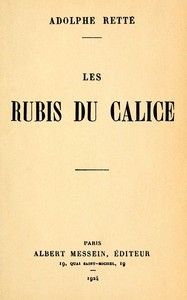
Les rubis du calice by Adolphe Retté
So, what's the deal with 'Les rubis du calice'? It's a classic fin-de-siècle novel, which means it's dripping with that late-1800s atmosphere of spiritual anxiety and decadence. The author, Adolphe Retté, was a fascinating guy himself—he started out as a Symbolist poet and anarchist before a dramatic conversion to Catholicism. You can feel that personal struggle all through this book.
The Story
The plot follows André, a disillusioned young man who comes into possession of an ornate, ruby-studded chalice. On the surface, it's a solution to his financial problems. But the chalice is no ordinary heirloom. It acts as a trigger, plunging André into a series of intense, disorienting visions. These aren't just dreams; they're spiritual confrontations that force him to question everything he believes about himself and the world. The central conflict isn't with a villain, but with his own growing sense of emptiness and the unsettling pull of a divine presence he can't ignore. The story is a slow, internal unraveling, as the weight of the sacred object cracks open his cynical shell.
Why You Should Read It
I loved this book for its mood. It’s a masterclass in building psychological tension. Retté isn't writing a fast-paced thriller; he's painting a portrait of a soul in torment. The prose is rich and descriptive, pulling you into André's confused and haunted headspace. The chalice itself is a brilliant symbol—it represents both material temptation and spiritual awakening, and you're never quite sure if it's a blessing or a curse. Reading it feels like watching a slow-motion car crash of someone's worldview. You keep turning the pages not for a chase scene, but to see if André will break, surrender, or find some kind of peace.
Final Verdict
This book won't be for everyone. If you need constant plot twists and clear-cut heroes, you might find it slow. But if you're a reader who enjoys Gothic atmosphere, psychological depth, and historical literary curiosities, it's a gem. It's perfect for fans of Joris-Karl Huysmans' 'À rebours' (Against Nature) or the introspective, spiritual struggles found in some of Dostoevsky's work. Think of it as a philosophical ghost story where the haunted house is a man's own mind. A truly unique and absorbing read from a turbulent and fascinating period in literary history.
You are viewing a work that belongs to the global public domain. Share knowledge freely with the world.
Elijah Moore
1 year agoSurprisingly enough, the character development leaves a lasting impact. Absolutely essential reading.
Oliver Johnson
9 months agoAfter finishing this book, it creates a vivid world that you simply do not want to leave. Absolutely essential reading.






Nancy Sanchez
1 year agoA bit long but worth it.