
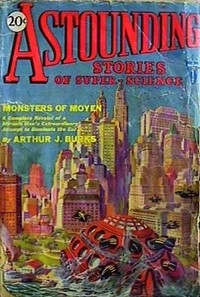
Astounding Stories of Super-Science April 1930 by Anthony Pelcher
Let's clear something up first: this isn't a novel by a guy named Anthony Pelcher. 'Anthony Pelcher' was a made-up name editors slapped on the cover of this issue of Astounding Stories of Super-Science, a famous pulp magazine. What you're getting is a snapshot of science fiction from 1930, packed with several short stories by different writers of the era.
The Story
There isn't one plot. Instead, you jump from one adventure to the next. You might start with a story about a genius who builds a matter transmitter, only to accidentally bring a terrifying alien creature into his lab. Then, you're whisked away to a war between Earth and Mars, fought with glowing energy beams and bulky spaceships. Another tale could follow a daring explorer discovering a lost civilization inside a hollow Earth. The science is... creative (think breathable air on the moon and Venus being a swampy jungle world). The characters are often brilliant, bold scientists or square-jawed heroes, and the stakes are always sky-high—save the Earth, conquer the unknown, or prevent the ultimate disaster.
Why You Should Read It
I loved this for the sheer, unfiltered joy of it. These writers weren't worried about quantum physics or gritty realism. They were making it up as they went along, and their excitement is contagious. You can see the raw DNA of every sci-fi movie and book you love today being formed right on the page. Yes, some dialogue is stiff and the gender roles are painfully dated, but that's part of the historical charm. Reading this feels like discovering the blueprint for a genre. It's a reminder that at its heart, science fiction is about wonder and asking, 'What if?' even if the answer involves a bug-eyed monster and a disintegration ray.
Final Verdict
This is a must for science fiction fans who are curious about the genre's roots. It's like visiting a museum for pop culture. It's also great for anyone who appreciates vintage Americana or just wants a dose of fast-paced, imaginative escapism. If you need hard science and complex characters, you might find it silly. But if you can embrace the earnest pulp spirit, you'll have a blast. Think of it less as a book and more as a thrilling, slightly dusty portal to the future as seen from 1930.
This title is part of the public domain archive. It serves as a testament to our shared literary heritage.








Kenneth Perez
1 year agoAmazing book.