
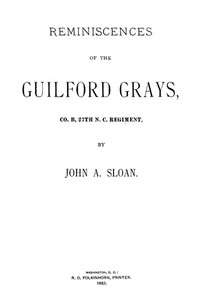
Reminiscences of the Guilford Grays, Co. B., 27th N.C. Regiment by John A. Sloan
John A. Sloan’s Reminiscences of the Guilford Grays is exactly what the title promises: a collection of memories. There’s no traditional plot with a beginning, middle, and end. Instead, Sloan, who served in Company B of the 27th North Carolina Infantry, walks us through his experience of the American Civil War. He starts with the patriotic fervor of enlistment in his hometown of Guilford County and follows his unit through training and into the chaos of major battles like Gettysburg, where his regiment faced devastating losses. The "story" is the day-to-day life of a Confederate soldier—the long marches, the struggle to find decent rations, the terror of combat, and the bonds formed with fellow "Grays." It ends with the war's conclusion, his capture, and his reflection on the entire, life-altering journey.
Why You Should Read It
You should read this because it strips away the myth and gets down to the mud, hunger, and humanity. History books give you the "what"; Sloan gives you the "how it felt." His writing is straightforward and surprisingly vivid. You feel the exhaustion of a forced march, the shock of seeing a friend fall, and the dark humor soldiers used to cope. There’s no political grandstanding here. It’s a deeply personal record. What struck me most was the normalcy he tries to hold onto—the memories of home, the simple pleasure of a good meal—amidst the absurd horror of war. It makes the history feel immediate and real, not like something in a dusty old tome.
Final Verdict
This book is perfect for anyone who loves personal history, Civil War enthusiasts who want to move beyond battle maps, and readers who enjoy authentic diaries and memoirs. It’s not a flashy, dramatic novel, so if you’re looking for a fast-paced plot, this isn’t it. But if you want to spend time in the company of a thoughtful, observant man recounting the defining chapter of his youth, Reminiscences of the Guilford Grays is a quiet, powerful, and essential read. It’s a voice from the past that still has a lot to say.
This publication is available for unrestricted use. You can copy, modify, and distribute it freely.
Elizabeth Brown
11 months agoMy first impression was quite positive because the visual layout and supporting data make the reading experience very smooth. This has become my go-to guide for this specific topic.
Kimberly Martin
5 months agoIf you're tired of surface-level information, the insights into future trends are particularly thought-provoking. A rare gem in a sea of mediocre content.
Linda Lopez
1 year agoComparing this to other titles in the same genre, the author’s unique perspective adds a fresh layer to the discussion. This adds significant depth to my understanding of the field.
Sarah Lopez
2 months agoI decided to give this a try based on a colleague's recommendation, the transition between theoretical knowledge and practical application is seamless. Well worth the time invested in reading it.

William Harris
2 years agoExtremely helpful for my current research project.