1

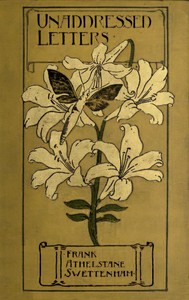
Unaddressed Letters — Story, Setting & Ideas
(0 User reviews)
252
Project Gutenberg
2014
Not confirmed
English letters -- 19th century
Readers of public-domain and historical texts
Project Gutenberg digital edition
en
Edition facts
Words
72,541
Reading time
316 min
Text sections
8
The catalog record for Unaddressed Letters — Story, Setting & Ideas provides practical reading context through 72,541 words, 5 hr 16 min estimated reading time, and 8 detected text sections.
The text analysis averages about 25.2 words per sentence, while the detected sections provide another way to judge how the source is divided.
Project Gutenberg metadata also associates the work with “English letters -- 19th century,” connecting these edition facts with the source record’s subject description.
Source:
Project Gutenberg record #47420
A collection of letters, edited by Sir Frank Swettenham, from an anonymous diplomat-writer. The preface frames them as posthumous confidences, blending travel, sentiment, and sharp social observation. Excerpts show a narrator sketching a soldier's grave and recalling country-house customs, with an Eastern atmosphere and a wry, reflective tone.
Editorial Edition Score
4.7/5
★★★★★
★★★★★
Calculated from edition completeness, EPUB availability, text structure and catalogue metadata. Not a user rating.
How this score is calculated
- Description quality20 pts
- Title & short description10 pts
- Source metadata20 pts
- Text length15 pts
- Chapters / structure15 pts
- EPUB file integrity20 pts
Total of 100 points, scaled to a 2.5-5.0 range. Editions with an empty description or a missing EPUB file are not scored.
Edition quality
Read the Text
rries me back to another evening when you were also here. It had rained heavily, and the sun had almost set when we started to ride down the hill, across the river, and out into the fast-darkening road that strikes through the grass-covered plain, and leads to the distant hills. The strangely fascinating transformation of day into night, as commonly seen from that road, cannot fail to arrest the attention and awaken the admiration of the most casual observer; but for us, I think, it possessed the special charm which comes from the contemplation of nature in harmony with the mood of the spectator,--or seen, as with one sight, by two persons in absolute sympathy of body and soul. Then nothing is lost--no incident, no change of colour, no momentary effect of light or shade; the scene is absorbed through the eyes, and when the sensation caused finds expression through the voice of one, the heart of the other responds without the need of words.
I see the picture now; a string of waggons, the patient oxen standing waiting for their drivers, picturesquely grouped before a wayside booth; a quaintly fashioned temple, with its faint altar-light shining like a star from out the deep gloom within the portal; tall, feathery palms, whose stems cast long, sharp shadows across the dark-red road; on either side a grass-covered, undulating plain, disappearing into narrow valleys between the deep blue hills; behind all, the grey, mist-enshrouded mountains, half hidden in the deepening twilight.
The last gleams of colour were dying out of the sky as we left the main road, and, turning sharp to the left, urged our horses through the gathering darkness. At last we were obliged to pull up, uncertain of our bearings, and even doubtful, in the now absolute blackness of tropical night, whether we were in the right way. Carefully avoiding the deep ditches, more by the instinct of the horses than any guidance of ours, we struck into another road and set our faces homewards. It was still intensely dark, but growing clearer as the stars shone out, and we gradually became more accustomed to the gloom; dark yet delightful, and we agreed that this was the time of all others to really enjoy the East, with a good horse under you and a sympathetic companion to share the fascination of the hour.
Riding through the groves of trees that lined both sides of the road, we caught occasional glimpses of illuminated buildings, crowning the steep hill which forms one side of the valley. Traversing the outskirts of the town, we crossed a river and came out on a narrow plain, above which rose the hill. I shall never forget the vision which then rose before us. How we exclaimed with delight! and yet there was such an air of glamour about the scene, such unrealness, such a savour of magic and enchantment as tied our tongues for a while.
The heights rose in a succession of terraces till they seemed to almost pierce the clouds, each terrace a maze of brilliantly illuminated buildings to which the commanding position, the environment, the style of architecture, and the soft, hazy atmosphere lent an imposing grandeur.
The buildings which crowned the summit of the spur, lined the terraces, and seemed to be connected by a long flight of picturesque stone steps, were all of a dazzling whiteness. Low-reaching eaves, supported on white pillars, formed wide verandahs, whose outer edges were bordered by heavy balustrades. Every principal feature of every building, each door and window, each verandah, balustrade, and step, was outlined by innumerable yellow lights that shone like great stars against the soft dark background of sky and hill. It is impossible to imagine the beauty of the general effect: this succession of snow-white walls, rising from foot to summit of a mist-enveloped hill, suggested the palace-crowned heights of Futtepur Síkri, illuminated for some brilliant festival. The effect of splendour and enchantment was intensified by the graceful but indistinct outlines of a vast building, standing in unrelieved darkness by the bank of the river we had just crossed. In the gloom it was only possible to note the immense size of this nearer palace, and to realise its towers and domes, its pillars and arches, and the consistently Moorish style of its architecture.
The preface to Unaddressed Letters presents the volume as a posthumous packet of manuscript, left by a friend who was “by trade, a diplomatist; by inclination, a sportsman with literary and artistic tastes.” The editor, Sir Frank Swettenham, admits he cannot tell whether the letters were ever sent or written to real or imaginary people. This deliberate ambiguity sets up a reading experience that hovers between confession and performance.
The catalog subject “English letters -- 19th century” accurately describes the form, but the excerpts reveal a work less concerned with epistolary convention than with the writer’s own voice—wry, observant, and occasionally theatrical. In one letter, he describes drawing a sketch of a soldier’s grave and composing a sympathetic note to the widow, only to learn it arrived on her remarriage day. The anecdote is offered as proof of “the quaintness of coincidences.”
The Editor’s Frame and the Anonymous Voice
The preface does more than introduce; it shapes how the letters are read. Swettenham reports showing the manuscript to a friend, who warned that critics would find “too much scenery, too much sentiment,” but advised leaving the letters as they were because “sunsets are commoner than murders.” This editorial note becomes part of the work’s texture, inviting readers to treat the letters as artifacts rather than straightforward correspondence.
The anonymous writer is described as a student of many characters and “in some sense a cynic.” The excerpts bear this out: his account of the soldier’s grave is laced with self-awareness, noting his own “artistic instincts” and “compelling sense of my responsibilities.” He is both participant and observer, a stance that recurs throughout the letters.
Scenes of Social Observation
Letter XXII, “Of a Country-House Custom,” shifts to a different register. The writer recalls visiting a celebrated female novelist who locked her door when talking to a man—a practice he finds “unconventional, though innocent enough.” He then describes a winter stay at an English country house, where the hostess was “wayward (an added charm)” and guests came and went. The scene is rendered with sensory detail: “the hard earth was full of ‘bone,’ the waters icebound,” and the walk home over frozen snow.
These passages show the writer’s eye for social nuance and his willingness to dwell on atmosphere. The letter does not argue for or against the custom; it simply presents the pleasure of the thing, noting that a century earlier such intimacy was common on the Continent. The tone is conversational, amused, and slightly detached.
The Eastern Atmosphere and the Traveller’s Perspective
The preface mentions that the writer “knew a good deal of Europe, a little of America, much of India and the further East,” and that “there is an Eastern atmosphere about many of the letters.” The excerpts do not directly depict Eastern settings, but the writer’s perspective is shaped by travel. The soldier’s grave anecdote takes place in “wild places” with no post-office, and the letter’s delay is blamed on “the general unhingedness of things.”
This offhand reference suggests a world beyond England, where postal systems are unreliable and coincidences abound. The writer’s fascination with “the glamour of the lands of sunshine” is mentioned but not demonstrated in the provided text. Readers should expect the Eastern atmosphere to emerge more fully in later letters, as the preface promises.
The excerpts offer only a partial view of Unaddressed Letters, but they reveal a writer who is both a sharp social observer and a self-conscious storyteller. The editor’s preface frames the collection as an intimate revelation, yet the letters themselves seem crafted for an audience. Readers may find it useful to treat each letter as a discrete performance, noting shifts in tone, setting, and addressee. The work rewards attention to its layered voice—diplomatic, sentimental, and wry by turns.
That collection of unaddressed letters stayed with me like a half-finished conversation, especially the way it lingers over quiet, forgotten places—a soldier’s grave, a drafty hall. It made me think of how we imagine futures, too. There’s something similarly wistful in Aeolus; or, the future of the flying machine — Edition Insights, as if we’re always writing letters to a world we won’t quite see.
There are no reviews for this eBook.
There are no comments for this eBook.
Reader reflection
Before you leave, reflect on the book
Use these questions to collect your thoughts before moving on.
Your progress
0
/
10
2
Did this book hold your interest?
3
Would you encourage someone else to read it?
4
How much effort did this book require?
5
How personally connected did you feel to the book?
6
Was the book what you thought it would be?
7
How valuable was this book for your own interests?
8
Did the book offer a fresh perspective?
9
What changed or sharpened your thinking?
10


![Cover of Pebbles on the shore [by] Alpha of the plough — Reading Companion](https://eommi.com/storage/media/covers/pg10675.jpg)