1

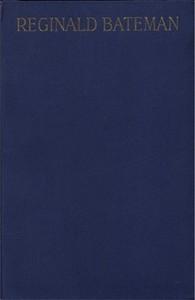
Reginald Bateman, Teacher and Soldier A Memorial Volume of Selections from His Lectures and Other Writings — Inside the Classic
(0 User reviews)
1480
Project Gutenberg
2019
Not confirmed
World War, 1914-1918; English literature -- History and criticism; Bateman, Reginald, 1884?-1918
Readers of public-domain and historical texts
Project Gutenberg digital edition
en
Edition facts
Words
41,979
Reading time
183 min
Text sections
4
The source record for Reginald Bateman, Teacher and Soldier A Memorial Volume of Selections from His Lectures and Other Writings — Inside the Classic measures this digital text at 41,979 words, 3 hr 3 min estimated reading time, and 4 detected text sections.
The text analysis averages about 24.9 words per sentence, while the detected sections provide another way to judge how the source is divided.
Project Gutenberg metadata also associates the work with “World War, 1914-1918,” connecting these edition facts with the source record’s subject description.
Source:
Project Gutenberg record #59891
A memorial collection of lectures and writings by Reginald Bateman, first English professor at the University of Saskatchewan, killed in WWI. The volume juxtaposes literary criticism, notably on Wordsworth and Browning, with personal poems, revealing a teacher's mind at work.
Editorial Edition Score
4.6/5
★★★★★
★★★★★
Calculated from edition completeness, EPUB availability, text structure and catalogue metadata. Not a user rating.
How this score is calculated
- Description quality20 pts
- Title & short description10 pts
- Source metadata20 pts
- Text length15 pts
- Chapters / structure15 pts
- EPUB file integrity20 pts
Total of 100 points, scaled to a 2.5-5.0 range. Editions with an empty description or a missing EPUB file are not scored.
Edition quality
Read the Text
Meynell had introduced Thompson to his own family. His wife, Alice Meynell, the poetess, became the saint of Thompson's adoration, two of the children, Monica and Madeline, were revelations to him of the beauty of girlhood; and he repaid the sheltering care and attention shown him by the family by conferring on them all he had to give, the best fruits of his genius.
To Mrs. Meynell he addressed the beautiful poems of his first volume, entitled _Love in Dian's Lap_; to Monica Meynell several of the best poems in that volume; and to Monica and Madeline his second volume entitled _Sister Songs_. His affection for Wilfrid Meynell is expressed in a few lines entitled _To W. M._
O Tree of many branches! One thou hast Thou barest not, but graftedst on thee. Now Should all men's thunders break on thee, and leave Thee reft of bough and blossom, that one branch Shall cling to thee, my Father, Brother, Friend, Shall cling to thee unto the end of end.
Thompson's verses were all he had to give in return for the Meynells' kindness, and to my mind they were a rich recompense for the continual trouble, anxiety, and petty annoyances which he dealt out to his friends with lavish hands.
In the ordinary intercourse and business of daily life, Francis Thompson was not only deficient, he was impossible. The practice of the elementary habits of order and method, which to other men are the necessities and commonplaces of daily life, was to Thompson an insurmountable difficulty. His life is one long record of broken promises, unkept appointments, and other trials of the patience and tempers of all who had to do with him. He would keep an appointment anywhere from an hour or more to two or three days late, and be full of contrition, excuses, and explanations. The inherent sweetness and loveableness of the man atoned for much, but still we cannot but praise the Meynells for their unwavering kindness to this difficult genius. Wilfrid Meynell had to act continually as a buffer between Thompson and irate landladies, impatient editors, exasperated publishers, and disappointed interviewers. He had to see that the poet's rent was paid, and that he had the wherewithal to clothe and feed himself.
Thompson's incurable shabbiness and eccentricities made it difficult to introduce him into polite society, even if he had been capable of arriving in time for any social function; and though a brilliant talker when _tête-à-tête_ with a sympathetic listener, in ordinary conversation he was more remarkable for the futility of his endless repetitions than for anything else. And yet he was never uncouth or awkward. His manners were gentle; his speech was that of a polished gentleman; his worn face could light up with beautiful ardour, and his frail body never lost its essential dignity. His laugh, too, was always ready at the slightest pleasantry.
He made a wildly picturesque figure as he wandered through the London streets in these latter days, generally completely unconscious of his surroundings, and with a continual muttered soliloquy. With his old brown cape, which he wore in the hottest weather, "his disastrous hat," his old satchel for review books slung over his shoulder, and his wild worn face, he looked like some picturesque pedlar who had just stepped out of a romance of the Middle Ages. In all the countless times that Everard Meynell met Thompson in the streets of London he never once surprised him in a conscious moment. That Thompson ever took the right turning or found his way home safely is a fact for which his friends could offer no adequate explanation. Mr. Lewis Hind, editor of _The Academy_ while Thompson was a contributor, says: "In memory I see him one miserable November afternoon, communing with the Seraphim and frolicking with the young-eyed Cherubim in Chancery Lane. The roads were ankle-deep in slush; a thin icy rain was falling; the yellow fog enwrapped the pedestrians squelching down the lane, and going through them in a narrow path, I saw Francis Thompson, wet and mud-spattered. But he was not unhappy. What is a day of unpleasant weather to one who lives in eternity? His lips were moving, his head was raised, for above the roof of the Chancery Lane Safe Deposit Company, in the murk of the fog, he saw beatific visions."
Reginald Bateman, the first Professor of English at the University of Saskatchewan, was killed in the Great War at age thirty-eight. This memorial volume, published in 1922 by the university, collects lectures and essays he delivered to popular audiences and literary gatherings, along with a few poems found among his papers. The editors emphasize that these pieces were never intended for publication as formal academic criticism; they were hurriedly prepared during a busy college session. Yet the selections aim to capture what was “most characteristic of the man and teacher.”
A Teacher’s Voice in the Lecture Hall
Bateman’s lectures reveal a direct, conversational style aimed at listeners rather than readers. In his discussion of Wordsworth, he moves fluidly between the poet’s sublime lines—quoting “The haunt and the main region of my song” from The Prelude—and the “odd effects of incongruity” in poems like The Idiot Boy. He does not shy from judgment, calling the doctor’s reply in that poem “grumbling” and noting that “even to us it is evident that Wordsworth in them is not at his best.” The lecture balances admiration for Wordsworth’s philosophical poetry with a frank assessment of his failures, a pedagogical tactic that invites the audience to think critically rather than passively accept.
Juxtaposing Wordsworth and Browning
Bateman structures his argument by comparing Wordsworth’s treatment of common subjects with Browning’s. He observes that both poets tackle “the most common things in life,” but Browning succeeds where Wordsworth falters. In The Spanish Cloister, Browning takes “the mean and petty jealousy of one commonplace monk for another” and makes it compelling. Bateman quotes Browning’s Bishop Blougram’s Apology at length, letting the cynical bishop’s voice dominate: “So, you despise me, Mr. Gigadibs.” The contrast is pointed: Wordsworth’s theory of simplicity often produced “incongruity,” while Browning’s dramatic monologues transform the sordid into art. Bateman’s own voice remains clear, guiding the listener through these comparisons without losing the thread of his argument.
The Man Behind the Lectures
The prefatory note sketches Bateman’s biography: born in Ireland, educated at Portora Royal School and Trinity College Dublin, where he combined “distinction in scholarship” with “prominence in athletics.” He was one of the original four professors who, with President Murray, launched the University of Saskatchewan in 1909. The editors note that the war “takes heavy toll of the promise and latent greatness of a nation,” and Bateman was “cut off in his prime.” The poems included—though not excerpted here—are described as “found among his papers,” adding a personal dimension to the critical prose. This framing turns the volume into both a critical anthology and a memorial, inviting readers to see the teacher in his words.
Readers approaching this volume should expect not a polished critical treatise but a series of lively, opinionated talks by a professor who clearly relished engaging his audience. Bateman’s willingness to call out Wordsworth’s missteps while praising his greatness, and to set Browning as a corrective, makes these lectures valuable as documents of early twentieth-century literary pedagogy. The poems, though few, offer a glimpse of the private man behind the public teacher.
Where Bateman’s pages hold a soldier-lecturer’s care for direct, earnest words, there is a quieter brother in Chimney-Pot Papers — Inside the Classic — its own tweedy patience with the ordinary. Both feel like friendly study-lamps left on, their margins carrying the same unassuming warmth of someone who loved reading enough to share it gently.
There are no reviews for this eBook.
There are no comments for this eBook.
Reader reflection
How did this book work for you?
Your answers remain private and are stored only in this browser.
Your progress
0
/
10
2
Did this book hold your interest?
3
Would you pass this book on to a friend?
4
What was the reading difficulty like?
5
Did the story or argument move comfortably?
6
How strongly did the book affect you emotionally?
7
How original did the book feel?
8
Did the book give you something worth debating?
9
In one sentence, what did you learn?
10


![Cover of Pebbles on the shore [by] Alpha of the plough — Reading Companion](https://eommi.com/storage/media/covers/pg10675.jpg)