1

Roosevelt in the Kansas City Star: War-time Editorials — Key Ideas to Explore
(0 User reviews)
296
Project Gutenberg
2022
Not confirmed
World War, 1914-1918 -- United States; United States -- Politics and government -- 1913-1921; Kansas City star (Kansas City, Mo. : 1885)
Readers of public-domain and historical texts
Project Gutenberg digital edition
en
Edition facts
Words
89,636
Reading time
390 min
Text sections
124
Roosevelt in the Kansas City Star: War-time Editorials — Key Ideas to Explore can be approached with a clearer sense of reading commitment from its source measurements: 89,636 words, 6 hr 30 min estimated reading time, and 124 detected text sections.
The text analysis averages about 25.7 words per sentence, while the detected sections provide another way to judge how the source is divided.
Project Gutenberg metadata also associates the work with “World War, 1914-1918 -- United States,” connecting these edition facts with the source record’s subject description.
Source:
Project Gutenberg record #67811
Theodore Roosevelt's wartime editorials for the Kansas City Star (1917-1919) reveal his unsparing critique of President Wilson, his advocacy for total victory, and his moral framing of the war as a struggle for civilization, with recurring themes of duty, sacrifice, and preparedness.
Editorial Edition Score
4.9/5
★★★★★
★★★★★
Calculated from edition completeness, EPUB availability, text structure and catalogue metadata. Not a user rating.
How this score is calculated
- Description quality20 pts
- Title & short description10 pts
- Source metadata20 pts
- Text length15 pts
- Chapters / structure15 pts
- EPUB file integrity20 pts
Total of 100 points, scaled to a 2.5-5.0 range. Editions with an empty description or a missing EPUB file are not scored.
Edition quality
Read the Text
controversy in true Roosevelt fashion. The same day Mr. Nelson sent this telegram to the President:
It is quite worth while to have a real President of the United States.
The next day this reply came from the President:
It is even better worth while to have a real editor of just the right kind of paper.
The Star supported Taft in the campaign of 1908 because it had faith that he would carry out the Roosevelt policies. Events early in the Taft Administration weakened that faith; the Winona speech withered it. Mr. Nelson had had no correspondence with Colonel Roosevelt while he was hunting in Africa. Two letters came from the ex-President, one March 12, 1910, from the White Nile saying he expected to return in June; another from Porto Maurizio, a month later, saying, “I know you will understand how delicate my position is,” and asking for an early conference with Mr. Nelson on his return to this country. Mr. Nelson’s final, open break with President Taft was “more in sorrow than in anger”; there was never bitterness of feeling, solely regret at a mistake in believing Mr. Taft stood for principles which events early in his administration showed convincingly he did not stand for.
Writing to Colonel Roosevelt, in 1910, after his return from Africa, Mr. Nelson referred to the Winona speech and the Ballinger case, concluding: “I have wondered whether sooner or later there would not have to be a new party of the Square Deal.”
The succeeding two years there were frequent conferences and interchange of letters between Colonel Roosevelt and Mr. Nelson. The latter had absolute confidence and abiding faith in Roosevelt. Late in 1910 the Colonel’s enemies were seeking to torment him from many angles. Mr. Nelson wrote him:
It has occurred to me that the opposition will constantly be prodding you and lying about you with the evident purpose of getting you angry and so putting you to a disadvantage. That is the only hope on earth they have of stopping you.
Your comment on Wm. Barnes was fine. It recalled to me an incident connected with Governor Tilden, who was the wisest politician I ever knew. As a young man I was his manager in Indiana. After the defeat of Lucius Robinson, whom he was backing for Governor of New York, I went East at his invitation to confer with him. He asked me to see Kelly, Clarkson, Potter, Dorsheimer, and Sam Cox, and some of the other men who had been fighting him, to get their views. “What shall I tell them about your position if they ask me?” I said. “Oh, tell them,” he said, “that I am very amiable.” In my adventures since that time I have often had occasion to remember that as sound advice. Amiability is a great weapon at times.
But my point is that you never need to defend yourself at all. The people will take care of your defense. Besides, it is always a bad policy, in my opinion, to get to talking about the past. You are a Progressive. Your nose is to the front. The past doesn’t interest you. So I hope you will ignore the critics, no matter how exasperating they may be. And if you can’t ignore them, laugh at them!
To this the Colonel replied:
I guess you are right; but it does make me flame with indignation when men who pretend to be especially the custodians of morals, and who sit in judgment from an Olympian height of virtue on the deeds of other men, themselves offend in a way that puts them on a level with the most corrupt scoundrel in a city government....
But this does not alter the fact that, as you say, my business is to pay no heed to the slanders of the past, but to keep my face steadily turned toward the future. Here in New York the outlook is rather dark. There are a great multitude of men, some of them nominally respectable, but timid or misled, who do certainly, although rather feebly, object to the domination of Barnes and his fellow bosses; but who do sincerely, but rather feebly, prefer clean politics to corrupt politics; but who, nevertheless, dread any interference with what they regard as the rights of big business, any assault on what I regard as an improperly arranged tariff, any effort to work for the betterment of social conditions in the spirit of Abraham Lincoln; who regard all assaults and efforts of this nature as being worse than the rule of small bosses and the petty corruption of local politicians.
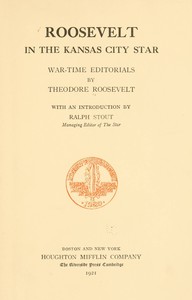
Roosevelt in the Kansas City Star collects 124 editorials written by Theodore Roosevelt between 1917 and 1919, originally published in the Kansas City Star. The collection opens with a striking declaration of independence: Roosevelt states he will support President Wilson only insofar as Wilson wages war efficiently and seeks 'the peace of overwhelming victory,' reserving the right to criticize him if he falters. This sets the tone for a volume that is less a record of news than a sustained argument about American duty, military preparedness, and the moral stakes of World War I. Readers should approach these pieces as political commentary shaped by Roosevelt's distinctive voice—blunt, repetitive, and fiercely patriotic—rather than as objective reporting.
A Voice of Unyielding Criticism
From the first editorial, Roosevelt establishes himself as a relentless critic of the Wilson administration. He writes that he spoke of the President 'truthfully and severely' in the past and will do so again if needed. His loyalty is 'due to the United States,' not to any public servant except insofar as they serve efficiently. This stance recurs throughout the collection: Roosevelt repeatedly attacks what he sees as hesitation, inefficiency, or lack of resolve. For example, he condemns those who advocate 'peace without victory' as unpatriotic, and he excoriates 'timid and unpatriotic and short-sighted men' who fail to support the war wholeheartedly. The editorials thus function as a running counterpoint to official policy, offering a view of the war from a former president who believed the nation was not fighting hard enough.
Moral Appeals and the Role of Women
Roosevelt frequently addresses the home front, especially the sacrifices of women. In an editorial from April 1918, he quotes a Kansas woman who gave her two sons to the war and expresses his admiration for such mothers, calling them 'the spiritual heirs of the mothers and wives of Washington’s Continentals.' He contrasts them with women who complain or seek 'peace without victory,' equating their attitude with that of 'slickers and slackers' in uniform. This moral binary—between self-sacrifice and selfish ease—is a hallmark of Roosevelt's rhetoric. He insists that 'the things that are best worth having in life must be paid for,' whether by toil or danger, and that both men and women must be willing to fight for the Republic. These passages reveal how Roosevelt used the editorial form to shape public sentiment around duty and honor.
Recurring Themes: Preparedness and Total Victory
Two themes dominate the collection: the need for military preparedness and the demand for total victory. Roosevelt repeatedly laments America's 'foolish failure to prepare our strength in efficient fashion' during the years before entering the war. He calls for universal military training and criticizes any suggestion of a negotiated peace. The title of one editorial, 'The Peace of Complete Victory,' encapsulates his position: anything less would betray the sacrifices made. He also targets specific groups—'Germanized Socialists,' pro-Germans, and those who oppose the Liberty Loan—as obstacles to the war effort. These editorials are not nuanced policy analyses but blunt instruments of persuasion, designed to rally readers to a single, uncompromising view of the conflict.
Structure and Style of the Editorials
Roosevelt's editorials follow a consistent pattern: a provocative opening, often a quotation or a direct challenge; a series of declarative sentences that build an argument through repetition; and a forceful conclusion that leaves no room for ambiguity. He uses rhetorical questions, biblical allusions (such as 'brayed in a mortar'), and stark contrasts between 'wise and good' people and their opposites. The language is personal and confrontational—he writes 'I' frequently, asserting his own judgment. The collection's arrangement by date allows readers to trace his responses to events as they unfolded, from the Liberty Loan campaign to the Lansdowne Letter. This structure gives the volume a sense of immediacy, as if one is reading the war through Roosevelt's eyes, week by week.
Readers will find that these editorials reward attention to Roosevelt's rhetorical strategies—his use of repetition, moral binaries, and personal authority. The collection is best approached not as a history of the war but as a primary document of American political discourse, revealing how one influential voice sought to shape public opinion during a national crisis. The introduction by Ralph Stout, managing editor of the Star, provides context for Roosevelt's role as a columnist, but the editorials themselves stand as a vivid record of his unflagging conviction.
Sometimes I think of Roosevelt’s fury in those Star editorials—his insistence that sacrifice meant something—and it reminds me of quieter mornings with Chimney-Pot Papers — Inside the Classic, where the same stubborn faith in small duties lingers. One echoes the other, somehow, across the years. I found myself smiling at that, and a little sad too.
There are no reviews for this eBook.
There are no comments for this eBook.
Reader reflection
What did you think of this book?
Answer a few questions and save a private reflection on this device.
Your progress
0
/
10
2
Did this book hold your interest?
3
How likely are you to recommend this book?
4
Did the language feel accessible?
5
Did it raise ideas you would like to talk about?
6
How did the reading compare with what you expected?
7
Would a second reading be valuable?
8
Which part made the strongest impression?
9
In one sentence, what did you learn?
10


![Cover of Pebbles on the shore [by] Alpha of the plough — Reading Companion](https://eommi.com/storage/media/covers/pg10675.jpg)