1

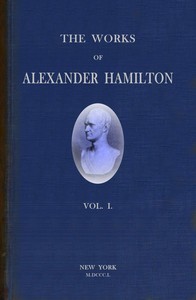
The works of Alexander Hamilton (vol. 1 of 7) — Background and Themes
(0 User reviews)
563
Project Gutenberg
2023
Not confirmed
United States -- Politics and government -- 1775-1783; United States -- Politics and government -- 1783-1809; Finance -- United States
Readers of public-domain and historical texts
Project Gutenberg digital edition
en
Edition facts
Words
169,789
Reading time
739 min
Text sections
306
For The works of Alexander Hamilton (vol. 1 of 7) — Background and Themes, the stored edition analysis reports 169,789 words, 12 hr 19 min estimated reading time, and 306 detected text sections.
The text analysis averages about 24.1 words per sentence, while the detected sections provide another way to judge how the source is divided.
Project Gutenberg metadata also associates the work with “United States -- Politics and government -- 1775-1783,” connecting these edition facts with the source record’s subject description.
Source:
Project Gutenberg record #71719
This first volume of Alexander Hamilton's collected works opens with his teenage letters from St. Croix, revealing a young man who 'wish[es] there was a war' and 'contemn[s] the grovelling condition of a clerk.' The editor, John C. Hamilton, draws from manuscripts deposited in the Department of State, presenting correspondence and political writings that show Hamilton's early ambition and his later detailed plans for national finance, including a proposed national bank and currency stabilization
Editorial Edition Score
4.9/5
★★★★★
★★★★★
Calculated from edition completeness, EPUB availability, text structure and catalogue metadata. Not a user rating.
How this score is calculated
- Description quality20 pts
- Title & short description10 pts
- Source metadata20 pts
- Text length15 pts
- Chapters / structure15 pts
- EPUB file integrity20 pts
Total of 100 points, scaled to a 2.5-5.0 range. Editions with an empty description or a missing EPUB file are not scored.
Edition quality
Read the Text
o you, with all speed; nor could any body have endeavored to promote it more than I have done: but the _ignorance_ of some, and the _design_ of others, have been almost insuperable obstacles. I am very unwell; but I shall not spare myself to get things immediately in a proper train; and for that purpose intend, unless I receive other orders from you, to continue with the troops in the progress of their march. As soon as I get General Poor’s brigade in march, I shall proceed to General Putnam’s at Peekskill.
I have, &c., Alex. Hamilton.
His Excellency, General Washington.
HAMILTON TO WASHINGTON.
New Windsor, November 12, 1777.
I have been detained here these two days by a fever, and violent rheumatic pains throughout my body. This has prevented my being active, in person, for promoting the purposes of my errand; but I have taken every other method in my power, in which Governor Clinton has obligingly given me all the aid he could. In answer to my pressing application to General Poor, for the immediate marching of his brigade, I was told they were under an operation for the itch; which made it impossible for them to proceed till the effects of it were over. By a letter, however, of yesterday, General Poor informs me, he would certainly march this morning. I must do him the justice to say, he appears solicitous to join you; and that I believe the past delay is not owing to any fault of his, but is wholly chargeable on General Putnam. Indeed, Sir, I owe it to the service to say, that every part of this gentleman’s conduct is marked with blunder and negligence, and gives general disgust.
Parsons’ brigade will join you, I hope, in five or six days from this. Learned’s may do the same. Poor’s will, I am persuaded, make all the haste they can for the future. And Glover’s may be expected at Fishkill to-night; whence they will be pressed forward as fast as I can have any influence to make them go. But I am sorry to say, the disposition for marching, in the officers and men in general, of these troops, does not keep pace with my wishes, or the exigency of the occasion. They have, unfortunately, imbibed an idea, that they have done their part of the business of the campaign, and are now entitled to repose. This, and the want of pay, make them averse to a long march at this advanced season.
* * * In a letter from General Putnam, just now received by Governor Clinton, he appears to have been, the 10th instant, at King’s Street, at the White Plains. I have had no answer to my last applications. The enemy appear to have stripped New-York very bare. The people there, that is, the tories, are in a great fright: this adds to my anxiety, that the reinforcements from this quarter to you are not in greater forwardness and more considerable.
I have written to General Gates, informing him of the accounts of the situation of New-York with respect to troops, and the probability of the force gone to Howe being greater than was at first expected; to try if this will not _extort_ from him a further reinforcement. I don’t, however, expect much from him; as he pretends to have in view an expedition against Ticonderoga, to be undertaken in the winter: and he knows that, under the sanction of this idea, calculated to catch the eastern people, he may, without censure, retain the troops. And as I shall be under a necessity of speaking plainly to your Excellency, when I have the pleasure of seeing you, I shall not hesitate to say, I doubt whether you would have had a man from the northern army, if the whole could have been kept at Albany with any decency. Perhaps you will think me blamable in not having exercised the powers you gave me, and given a positive order. Perhaps I have been so: but, deliberately weighing all circumstances, I did not, and do not, think it advisable to do it.
I have the honor to be, With unfeigned esteem and regard, Your Excellency’s most ob’t servant, A. Hamilton.
His Excellency General Washington.
Fishkill, November 12, 1777.
The volume begins not with a statesman's manifesto but with a teenager's confession. In a 1769 letter to Edward Stevens, the seventeen-year-old Hamilton writes from St. Croix that his 'ambition is prevalent' and he 'would willingly risk my life, though not my character, to exalt my station.' He admits to building 'castles in the air' and closes with a startling postscript: 'I wish there was a war.' This personal revelation, preserved among manuscripts deposited in the Department of State, sets the tone for a collection that juxtaposes youthful yearning with mature policy.
Edited by John C. Hamilton, the volume gathers correspondence and political writings exclusive of The Federalist. The catalog subjects—United States politics and government from 1775 to 1809, and finance—are borne out by later excerpts, but the early letters offer a more intimate entry point than those categories suggest.
From St. Croix Clerk to Congressional Architect
The earliest item in the volume, a 1769 letter, shows Hamilton as a clerk in the Danish West Indies. He tells his friend Ned that his 'fortune condemns me' to a 'grovelling condition,' yet he plans to 'prepare the way for futurity.' The editor, John C. Hamilton, includes this letter as the first in a correspondence section that spans decades. By the 1780s, the same writer is drafting articles for a national bank, specifying interest rates, loan amounts, and redemption schedules. The contrast is stark: the young man who feared being 'a clerk or the like' becomes the architect of fiscal institutions.
The excerpts do not reveal how Hamilton moved from St. Croix to the Continental Congress, but the shift in tone and subject is evident. The later writings are dense with numbered articles and remarks, such as Article XIII proposing a loan of 'one million, two hundred thousand pounds' at eight percent interest. The language shifts from personal ambition to institutional design.
The Mechanics of Finance in the 1780s
A substantial excerpt from the 1780s presents Hamilton's detailed plan for a national bank and currency reform. He writes of 'a stable currency' as 'an idea fundamental to all practicable schemes of finance.' The text includes specific proposals: the bank would lend Congress funds, redeem old paper money at a fixed ratio (forty to one for old currency), and pay interest over thirty years. Hamilton calculates the total specie value of existing paper at 'about fourteen millions of dollars' and proposes an annuity to discharge it.
These passages are technical, filled with percentages and schedules. They show Hamilton grappling with the practical problem of wartime inflation and credit. He warns against 'a second breach of faith, which would cause a violent death to all future credit.' The excerpts do not reveal whether these plans were adopted, but they demonstrate the granularity of his financial thinking.
Editorial Framework and Source Material
John C. Hamilton, the editor and author of The Life of Hamilton, states that the works are 'published from the original manuscripts deposited in the Department of State, by order of the Joint Library Committee of Congress.' The title page lists the committee members, including Jefferson Davis and Horace Mann. This official provenance frames the collection as a documentary record rather than a popular edition.
The excerpts include only the beginning of the correspondence and a later financial plan; the bulk of the volume's 169,789 words is not sampled. Readers should note that the editor's choices—what to include and how to arrange it—shape the portrait of Hamilton. The catalog subjects emphasize politics and finance, but the early letters add a personal dimension that those headings do not capture.
Readers approaching this volume should be prepared for abrupt shifts in register: from a teenager's private hopes to a financier's public calculations. The excerpts offer only a glimpse of the full range, which includes correspondence and official writings from the Revolutionary and early national periods. The editor's arrangement and the manuscript sources provide a framework, but the work rewards attention to the gaps between the young clerk and the mature statesman.
There’s something touching in that boy on St. Croix, aching for any war to escape the clerk’s ledger—how ambition outruns the life that holds it. It reminded me of the quiet margins in Collected writings of Clarence Edwin Flynn, first series — Reading Notes, where the same restless hunger seems to pause and breathe, content just to be set down in ink. I found myself missing that kind of earnestness.
There are no reviews for this eBook.
There are no comments for this eBook.
Reader reflection
How did this book work for you?
Your answers remain private and are stored only in this browser.
Your progress
0
/
10
2
Did this book hold your interest?
3
Would you pass this book on to a friend?
4
How much effort did this book require?
5
How would you describe its reading pace?
6
Did anything about the book feel genuinely new?
7
Did the book give you something worth debating?
8
Do you expect to return to this book?
9
In one sentence, what did you learn?
10


![Cover of Pebbles on the shore [by] Alpha of the plough — Reading Companion](https://eommi.com/storage/media/covers/pg10675.jpg)