1

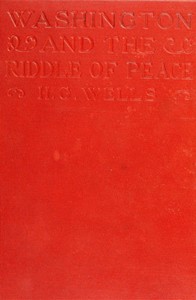
Washington and the Riddle of Peace — Themes and Context
(0 User reviews)
671
Project Gutenberg
2019
Not confirmed
World politics; Peace; Conference on the Limitation of Armament (1921-1922 : Washington, D.C.)
Readers of public-domain and historical texts
Project Gutenberg digital edition
en
Edition facts
Words
57,277
Reading time
250 min
Text sections
32
Before opening Washington and the Riddle of Peace — Themes and Context, the edition data offers a quick orientation: 57,277 words, 4 hr 10 min estimated reading time, and 32 detected text sections.
The text analysis averages about 25.3 words per sentence, while the detected sections provide another way to judge how the source is divided.
Project Gutenberg metadata also associates the work with “World politics,” connecting these edition facts with the source record’s subject description.
Source:
Project Gutenberg record #58877
H. G. Wells's 1922 dispatches from the Washington Conference blend on-the-ground reporting with sharp analysis of post-WWI diplomacy, using vivid contrasts between American abundance and European collapse to critique the 'Association of Nations' idea.
Editorial Edition Score
4.8/5
★★★★★
★★★★★
Calculated from edition completeness, EPUB availability, text structure and catalogue metadata. Not a user rating.
How this score is calculated
- Description quality20 pts
- Title & short description10 pts
- Source metadata20 pts
- Text length15 pts
- Chapters / structure15 pts
- EPUB file integrity20 pts
Total of 100 points, scaled to a 2.5-5.0 range. Editions with an empty description or a missing EPUB file are not scored.
Edition quality
Read the Text
e” the world. A visit to Versailles is part of one’s world education, a visit to the rather faded, rather pretentious magnificence of its terraces, to that Hall of Mirrors, all plastered over with little oblongs of looking-glass, which was once considered so wonderful, to the stuffy, secretive royal apartments with their convenient back stairs, to the poor foolishness of the Queen’s toy village, the Little Trianon. A century and a half ago the people of France, wasted and worn by incessant wars of aggression, weary of a Government that was an intolerable burden to them and a nuisance to all Europe, went to Versailles in a passion and dragged French Policy out of Versailles for a time.
Unhappily it went back there.
In 1871, when Germany struck down the tawdry imperialism of Napoleon III (who was also for setting up Emperors in the New World) the Germans had the excessive bad taste to proclaim a New German Empire in the Hall of Mirrors. So that Versailles became more than ever the symbol of the age-long, dreary, pitiful quarrel of the French and Germans for the inheritance of “the Empire” that has gone on ever since the death of Charlemagne. There the glory of France had shone; there the glory of France had been eclipsed. I visited Versailles one autumnal day in 1912, and it was then a rather mouldy, disheartened, empty, picturesque show place, pervaded by memories of flounces, furbelows, wigs and red heels and also by the stronger, less pleasant flavor of that later Prussian triumph.
It was surely the least propitious place in the whole world for the making of a world peace in 1919. It was inevitable that there the Rhine frontier should loom larger than all Asia and that the German people should be kept waiting outside to learn what vindictive punishment victorious France designed for them.
The Peace of Versailles was not a settlement of the world, it was the crowning of the French revanche. And since Russia had always been below the horizon of Versailles it was as inevitable that the Russian people, who had saved France from utter defeat in 1914, who had given far more dead to the war than France and America put together, and who had collapsed at last, utterly exhausted by their stupendous war efforts, should be considered merely as the defaulting debtors of France. Their Government had incurred vast liabilities chiefly in preparation for this very war which had restored France to her former glorious ascendancy over Germany. And now a new, ungracious Government in Russia not only declared it could not pay up but refused to pretend that it had ever meant to perform this impossible feat. There could be no dealing with such a Government. The German people and the Russian people alike had no voice at Versailles, and the affairs of the world were settled with a majestic disregard of these outcast and fallen powers.
They were settled so magnificently and badly that now the Washington Conference, whatever limitations it may propose to set upon itself, has in effect to review and, if it can, mend or replace that appalling settlement. The Washington conference has practically to revise the verdicts of Versailles, in a fresher air and with a wider outlook.
I do not know how near future historians may come to saying that the Washington conference was planned in imitation of that Versailles conference, but it certainly does start out with one most unfortunate resemblance. There seems to be the same tacit assumption that it is possible to come to some permanent settlement of the world’s affairs with no representation of either the German or the Russian people at the conference. The Japanese, the Italians, the French, the Americans and the British, assisted by modest suggestions from such small sections of humanity as China and Spanish America, are sitting down to arrangements that will amount practically to a settlement of the world’s affairs, and they are doing so without consulting these two great peoples, and quite without their consent and assistance. This surely runs counter to the fundamental principle of both American and British political life—that is to say, the principle of government with the consent of the governed—and it is indeed an altogether deplorable intention. In some form these two great peoples will have to be associated with any permanent settlement, and it will be much more difficult to secure their assent to any arrangement arrived at without even their formal co-operation.
It is necessary to remind ourselves of certain elementary facts about Germany and Russia and their position in the world today. They are facts within the knowledge of all, and yet they seem to be astonishingly forgotten in very much of the discussion of the Washington conference.
H. G. Wells opens his collection of twenty-nine newspaper articles with a frank admission: these are not a record of the Washington Conference but the 'impressions and fluctuating ideas of one visitor.' Dated and barely revised, the pieces track his shifting moods—enthusiasm, hope, doubt, depression, irritation—as he watches delegates grapple with the 'riddle of peace.' Wells frames the conference as a test of whether civilization can be 'rescued from the dangers that encompass it,' and he is unsparing in noting the gap between grand rhetoric and the triviality of the men involved.
The Observer's Unstable Mood
Wells does not pretend to objectivity. He records his own 'trough of the waves' and admits his confidence in the conference's outcome wanes as he writes. In one dispatch he confesses he is 'increasingly doubtful whether the conference will get as far in the direction of a stabilized Pacific as I hoped a few days ago.' This self-aware, diaristic tone is a deliberate structural choice: the reader watches a mind 'keenly set upon the idea of an organized world peace' encounter the inertia of realpolitik. Wells uses his own reactions as a barometer, making the book as much about the psychology of witnessing as about the events themselves.
Light and Darkness as Political Metaphor
Wells repeatedly contrasts the 'lavish light' of Washington—the Capitol 'shines all night like a full moon,' the Obelisk pours down 'an endless stream of light'—with the darkness of post-war Europe. He has seen 'the streets of one great European city in full daylight as dead and empty as a skull' and navigated another capital 'by means of a pocket electric torch.' This sensory opposition is not mere description; it becomes a structural argument. American abundance, Wells implies, blinds delegates to the 'progressive dissolution' of European civilization. The glittering receptions and 'hilarious barbecue' stand in stark moral contrast to the wreckage he carries in memory.
The Unseen Presence of Versailles
Though the Washington Conference is ostensibly about naval limitation and the Pacific, Wells insists that the 'trail of Versailles' haunts every discussion. He notes that two great powers are 'silent and absent,' and he repeatedly returns to the economic collapse of Europe—'the destruction of the monetary system under the burden of war expenditure and war debts'—as the real crisis. The conference's focus on arms reduction strikes him as a 'futility' if it ignores the financial chaos and the 'shadow that lies so dark over Petrograd' stretching 'as far as London.' Wells's analysis is relentlessly systemic: he sees the conference as treating symptoms while the disease spreads.
Diction of Disillusionment
Wells's vocabulary in these dispatches is deliberately blunt. He speaks of 'the possible breakdown of civilization' and compares the present decline to 'the decline and fall of the Roman Empire in the fourth and fifth centuries.' He calls the conference's catchphrase 'Security' a 'new and beautiful catchword'—the italics carrying a sneer. His sentences are often short and declarative: 'This is not the Europe of the diplomatists and publicists; it is the Europe of reality and the common man.' The effect is a tone of urgent, almost weary clarity, as if the writer is forcing himself to state the obvious because the delegates refuse to see it.
Readers should approach Washington and the Riddle of Peace as a series of snapshots, not a finished argument. Wells's mood shifts are part of the evidence; the book's value lies in its record of a contemporary mind struggling to reconcile hope with observation. Pay attention to the dates and the small details—the $10 note he does not bother to cash, the ox roasting on Thanksgiving—as much as to the policy analysis. They are the texture of a world on the edge.
I’ve often shelved Wells beside that quiet volume, Hortus Vitae Essays on the Gardening of Life — A Closer Reading, for both understood how nations, like gardens, need tending rather than mere architecture. His heavy conference rooms echo strangely with her patient weeding—a shared whisper that peace, too, must be cultivated, season after stubborn season.
There are no reviews for this eBook.
There are no comments for this eBook.
Reader reflection
How will you remember this book?
Save your reaction, strongest insight, and memorable passage.
Your progress
0
/
10
2
What was your overall reaction to the book?
3
Would you pass this book on to a friend?
4
How demanding did the text feel?
5
How did the reading compare with what you expected?
6
Did the book offer a fresh perspective?
7
How closely did the book connect with your experience?
8
Would a second reading be valuable?
9
What did this book teach you most?
10


![Cover of Pebbles on the shore [by] Alpha of the plough — Reading Companion](https://eommi.com/storage/media/covers/pg10675.jpg)