1

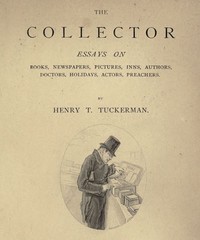
The Collector Essays on Books, Newspapers, Pictures, Inns, Authors, Doctors, Holidays, Actors, Preachers — A Reader’s Guide
(0 User reviews)
604
Project Gutenberg
2013
Not confirmed
Essays
Readers of public-domain and historical texts
Project Gutenberg digital edition
en
Edition facts
Words
118,700
Reading time
517 min
Text sections
13
Before opening The Collector Essays on Books, Newspapers, Pictures, Inns, Authors, Doctors, Holidays, Actors, Preachers — A Reader’s Guide, the edition data offers a quick orientation: 118,700 words, 8 hr 37 min estimated reading time, and 13 detected text sections.
The text analysis averages about 35.2 words per sentence, while the detected sections provide another way to judge how the source is divided.
Project Gutenberg metadata also associates the work with “Essays,” connecting these edition facts with the source record’s subject description.
Source:
Project Gutenberg record #43929
Henry T. Tuckerman's collection of essays moves from inns to bridges, using recurring imagery of travel and observation to link disparate subjects. The introduction by Dr. Doran frames the work as a 'freighted' volume carrying ideas across borders, while the essays themselves shift between American and European scenes, comparing professions and places through a collector's lens.
Editorial Edition Score
4.9/5
★★★★★
★★★★★
Calculated from edition completeness, EPUB availability, text structure and catalogue metadata. Not a user rating.
How this score is calculated
- Description quality20 pts
- Title & short description10 pts
- Source metadata20 pts
- Text length15 pts
- Chapters / structure15 pts
- EPUB file integrity20 pts
Total of 100 points, scaled to a 2.5-5.0 range. Editions with an empty description or a missing EPUB file are not scored.
Edition quality
Read the Text
Londoners were refreshed, while their purses were not so speedily lightened.
Jolly places they became again; but when they not only increased all over the town, but took to 'victualling,' as it was termed, as well as 'liquoring,' the authorities began to inquire into the matter. With the claret that was drunk, a corresponding amount of venison was eaten. At the same time the king's bucks began to disappear, and suspicion arose that gentlemen in taverns dined off his sacred majesty's deer! A watch was set to prevent such felonious fare being carried into London from any of the royal parks, chases, or forests. Still haunches smoked on the boards of those naughty victualling taverns, and haughty Cockneys, 'greatly daring, dined'! The stolen bucks were smuggled in over Bow Bridge; and not till that passage was occupied by representatives of legal authority did the venison intended for the court cease to find its way into the city.
The drama at this time lingered about Blackfriars and the Bankside. Bacchus emigrated westward, before Thespis. In 1633, in 'Convent Garden' and the 'little lane' adjacent, which had then just begun to be called Russell Street, there were not less than eight taverns and twenty alehouses. This was thought to be so much beyond the requirements of the public thirst, that an order was issued to reduce the number of taverns to two and the alehouses to four. The suburban public cried out against the drinking privileges of the city, where claret was tapped in taverns and ale ran from the spigot from before breakfast till after supper-time. The Council directed the attention of the Lord Mayor thereto, and in 1633 inquiry was made as to how many taverns had been newly opened since the year 1612. The reply was, 'sixty and one.' In the return it is pleasant to read of the 'Boar's Head,' as 'an ancient tavern.' Teetotallers will, perhaps, entertain due regard for 'Bagsishaw Ward,' as being the only one in the city described as having 'never a tavern within that ward.' But, then, Basing Hall, or Bagsishaw Ward, was of such small extent as to be rather contemptuously spoken of by Stowe himself, who calls it 'a small thing consisting of one street.'
An inhabitant of this ward had, therefore, only to step into the next street if he wanted a stoup of Bordeaux or a flagon of ale. If he swore over his liquor he was liable to the penalty of a shilling; and if he went on his way home noisily, with more claret under his belt than he well knew how to carry, he might be mulcted of a crown. These fines were distributed among the poor, so that the more drinking and profanity abounded, the better for those poor. To be blasphemous was to be on one of the blessed paths of charity. City chronicles tell of one Richard Dixon, who, having more of an eccentric compassion for the distressed than regard for propriety, swallowed his claret, swore a score of oaths, and deposited twenty shillings with the town clerk for London paupers.
Sober people in the city, however, complained of the increasing number of inns and taverns. Orders were issued accordingly, and a Boniface here and there took down his bush at the beginning of the week, but hung it up again before Saturday. The temperance party furnished a list of 211 taverns, new and old, in the city, in October, 1633. At that time Shakspeare's and Washington Irving's 'Boar's Head,' in Eastcheap, was kept by one William Leedes, 'not by any licence from the king's majesty,' but 'as a freeman.' Will Leedes may well have seen Shakspeare, who had not then been dead a score of years; and we may fancy mine host's guests discussing the second edition of the _Folio_, which had then been out of the press not much above twelve months.
In spite of the law for the suppression of certain taverns, these remained open, and new inns were built. The fashion and delicacy of Drury Lane were deeply affected by the threatened building of a tavern in that refined locality, in addition to eleven already existing there. The master of his majesty's tents, one Thomas Jones, resided in Drury Lane, and he petitioned the Council to prohibit the above building, as being to the great prejudice of the royal tent-master 'and other neighbours, being men of eminent quality.'
Dr. Doran's introduction to The Collector opens with a striking image: books, he writes, 'waft a sigh from Indus to the Pole,' and printed volumes 'carry thoughts that breathe and words that burn' across oceans. This metaphor of travel and transmission sets the tone for Henry T. Tuckerman's essays, which move from London inns to American courthouses, from statues to bridges, as if the author were a collector gathering scenes and observations. The volume's structure—thirteen essays on topics as varied as authors, doctors, actors, and preachers—invites the reader to follow a wandering eye rather than a linear argument.
Inns and the Architecture of Transit
The opening essay on inns grounds the collection in a specific historical moment: the transformation of London taverns after the death of James I. Dr. Doran recounts how King Charles granted licences to sell wine at any price, leading to a proliferation of taverns in 'fragrant Drury Lane and refined Convent Garden.' The essay dwells on the material details of these spaces—the price of claret, the disappearance of the king's deer—but also uses them as a stage for social observation. The inn becomes a microcosm of transit, where travelers, lawyers, and rogues converge. Tuckerman's method here is typical: he begins with a concrete place or object, then widens the lens to encompass cultural patterns. The reader is invited to see the inn not as a static setting but as a node in a network of movement—a threshold between the city and the road, the local and the foreign.
Lawyers and the Geography of Reputation
In the essay on lawyers, Tuckerman shifts from physical to professional geography. He compares the English bar's 'patient study' and 'common sense' with the eloquence of Irish and American lawyers, noting that 'the Bar of Boston, as a whole, is more English, that of the South more Irish, in its general merits.' This is not a dry taxonomy; it is a collector's catalog of regional character. The essay moves from London to Edinburgh to Boston, tracing how legal reputation is shaped by local conditions. A striking image recurs: the Parliament House in Edinburgh, once the seat of Scottish estates, is now a law court, and 'the general hour of breakfast in Edinburgh is determined by the time when the Courts open.' The profession, Tuckerman suggests, organizes time and space as much as it interprets law. The essay's structure mirrors this—it is a tour of legal cultures, not a treatise.
Pictures and the Collector's Eye
The essay on pictures returns to the theme of observation. Tuckerman does not offer a history of art but rather a meditation on how pictures are seen and valued. The collector's eye, he implies, is not passive; it selects, compares, and arranges. This is the same eye that moves from inns to lawyers to statues, finding connections across disparate domains. The essay's language is precise: it speaks of 'patient study' and 'complete learning' as qualities that distinguish the English lawyer, and these same qualities might apply to the connoisseur of paintings. The reader is left to infer that the act of collecting—whether of books, experiences, or observations—is itself a form of knowledge. Tuckerman's prose, like a well-hung gallery, invites the reader to pause before each subject and consider its place in a larger arrangement.
Bridges and the Movement Between Essays
The final essay on bridges brings the collection full circle. Bridges, like inns, are structures of transit; they connect places and enable movement. Tuckerman's interest in them is not engineering but symbolism: a bridge is a threshold, a point of passage. The essay's placement at the end of the volume suggests a deliberate architectural choice. Just as the introduction spoke of books carrying thoughts across oceans, the closing essay returns to the theme of connection. The reader, having traveled through inns, courts, galleries, and sepulchres, arrives at a structure that literally spans gaps. Tuckerman's essays, too, are bridges—between America and Europe, between professions and pastimes, between the concrete and the reflective. The collection's structure, with its thirteen discrete but linked essays, mirrors the bridges it describes: each span is independent, yet together they form a continuous path.
The Collector rewards a reading that attends to its movement between scenes. Tuckerman's essays are not arguments but observations, and their power lies in the juxtapositions he creates. The reader may find it useful to trace the recurring images of transit—inns, bridges, courts, galleries—and to note how each essay reframes the act of collecting. The volume is best approached not as a systematic treatise but as a series of invitations to look closely at the world, one subject at a time.
I remember sitting with The Collector Essays on a rainy afternoon, feeling its wandering observations settle like familiar luggage. That same quiet patience returned when I later opened The works of the Reverend George Whitefield, M.A., Vol. 5 (of 6) — Key Ideas to Explore—both books feel like old friends who speak slowly, carrying weight across time without hurry.
There are no reviews for this eBook.
There are no comments for this eBook.
Reader reflection
Record your reading impressions
A brief reflection can help important ideas stay with you longer.
Your progress
0
/
10
2
Did this book hold your interest?
3
How likely are you to recommend this book?
4
What was the reading difficulty like?
5
What was the strongest part of the book?
6
Was the book easy to understand?
7
Did you gain anything practical from the text?
8
Did the book deliver what you hoped for?
9
In one sentence, what did you learn?
10