1

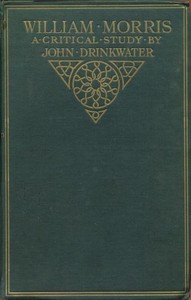
William Morris: A Critical Study — A Reader’s Guide
(0 User reviews)
692
Project Gutenberg
2020
Not confirmed
Middle Ages in literature; Morris, William, 1834-1896 -- Criticism and interpretation; Fantasy literature, English -- History and criticism; Medievalism -- England -- History -- 19th century
Readers of public-domain and historical texts
Project Gutenberg digital edition
en
Edition facts
Words
46,334
Reading time
202 min
Text sections
4
This digital edition of William Morris: A Critical Study — A Reader’s Guide is described by source-level measurements including 46,334 words, 3 hr 22 min estimated reading time, and 4 detected text sections.
The text analysis averages about 29.8 words per sentence, while the detected sections provide another way to judge how the source is divided.
Project Gutenberg metadata also associates the work with “Middle Ages in literature,” connecting these edition facts with the source record’s subject description.
Source:
Project Gutenberg record #63288
John Drinkwater's 1912 critical study examines William Morris's poetry, prose, and socialist writings, focusing on tensions between medievalism and modernity, craftsmanship and haste, and the architectural structure of works like The Earthly Paradise.
Editorial Edition Score
4.6/5
★★★★★
★★★★★
Calculated from edition completeness, EPUB availability, text structure and catalogue metadata. Not a user rating.
How this score is calculated
- Description quality20 pts
- Title & short description10 pts
- Source metadata20 pts
- Text length15 pts
- Chapters / structure15 pts
- EPUB file integrity20 pts
Total of 100 points, scaled to a 2.5-5.0 range. Editions with an empty description or a missing EPUB file are not scored.
Edition quality
Read the Text
Tennyson had established his reputation with the issue of the two volumes of "Poems" in 1842. Since then he had published "The Princess" in 1847, and "In Memoriam" in 1850, and was already generally acknowledged as a great new voice in poetry. Browning with "Pauline" in 1833, "Paracelsus" in 1835, "Strafford" in 1837, and the series of plays that followed, had proved his authenticity, but had not yet gained the general recognition that was to be brought a little nearer by the "Dramatic Lyrics" and "Dramatic Romances" of 1842 and 1845, and "Christmas Eve and Easter Day" in 1850. "Men and Women" was not yet published. Clough and Arnold had lately printed their first books, and seven years were to pass before Swinburne's name was to appear on a title-page. Rossetti's "Blessed Damozel" had been printed in the Pre-Raphaelite magazine, "The Germ," but save for a few contributions to the Oxford and Cambridge Magazine his poetry was to wait until 1870 before being given to the public. In prose the influence of the teachings of Carlyle and Ruskin was dominating criticism and æsthetic thought throughout the country, whilst the religious unrest and scientific revaluation, that were to leave their witness to posterity in the work of men so far removed from each other in temper as Newman and Darwin, and Arnold and Clough, were forcing a full share of men's attention to the consideration of abstract ideas.
John Drinkwater opens his 1912 study by insisting on the poet's isolation, a claim that immediately sets his approach apart from purely biographical or political readings of William Morris. Rather than celebrating Morris as a designer or socialist, Drinkwater foregrounds the creative loneliness that he believes underlies all genuine poetic achievement. This emphasis on the solitary artist recurs throughout the book, shaping his judgments of Morris's narrative poems, translations, and late prose romances.
Drinkwater's method is deliberately critical, not hagiographic. He points out what he considers technical flaws—for instance, the 'unpleasing' rhyme of 'door' and 'board' in a passage from Morris—while simultaneously praising Morris's 'exquisite sense of word-values' and 'extraordinary power of visualization.' The study thus maintains a productive tension between admiration and analysis, refusing to treat Morris as an untouchable master.
Architectural Design in The Earthly Paradise
Drinkwater draws a sustained analogy between Morris's long poem The Earthly Paradise and a Gothic cathedral, specifically Amiens. He quotes at length from Morris's own description of Amiens in an early essay for The Oxford and Cambridge Magazine, noting how the poet dwells on 'the great mountainous roof,' 'the mighty army of the buttresses,' and 'the twined mystery of the great flamboyant rose window.' For Drinkwater, this architectural eye is not incidental: it reveals the structural principle of The Earthly Paradise itself.
The poem's scheme—alternating classic and romantic stories, arranged by months, framed by lyrical interludes—produces, in Drinkwater's view, 'a massive general effect' that must be seen whole before the individual tales can be fully appreciated. He implies that Morris's visual imagination, trained on medieval buildings, gave him a unique capacity for large-scale poetic composition. The critic does not claim that the poem is flawless, but he insists that its architecture is essential to its meaning.
This section of the study is notable for its refusal to treat The Earthly Paradise as a mere collection of narratives. Instead, Drinkwater asks readers to consider the work's total design, much as one would consider the plan of a cathedral before examining its carvings and windows.
Haste and Precision in Morris's Verse
Drinkwater is unafraid to identify moments of carelessness in Morris's poetry. In a passage from an unnamed poem, he points out that the rhyme of 'door' and 'board' with 'floor' and 'poor' is 'unpleasing' to the ear. This observation is not mere pedantry; it serves Drinkwater's larger argument that Morris's facility with verse sometimes led to 'hastiness of composition.' Yet the same passage, he notes, also demonstrates Morris's 'individuality' in handling a well-tried meter and his ability to convey 'atmospheric significance apart from his actual statement.'
The critic's willingness to balance fault and virtue is characteristic of his method. He does not present Morris as a flawless craftsman, but as a poet whose strengths—visual immediacy, emotional directness, metrical ease—occasionally came at the cost of finish. Drinkwater's analysis is grounded in specific textual evidence, not general praise. He shows how even in a moment of 'profound sorrow,' Morris describes the 'thing seen' with 'sweetness and naturalness,' making the tragic bearable and even memorable.
This dual attention to flaw and achievement gives the study a critical edge that many contemporary appreciations of Morris lacked. Drinkwater treats the poet as a working artist, subject to the same pressures and imperfections as any other.
The Medieval Lens and Modern Relevance
Drinkwater's study is deeply concerned with Morris's medievalism, but not as a mere historical curiosity. He examines how Morris's engagement with medieval art and literature shaped his poetic voice and his social vision. The extended quotation from Morris's description of Amiens Cathedral is not decorative; it is evidence of a way of seeing that Morris carried into his own creative work. Drinkwater argues that Morris's 'view of art' is illuminated by these early descriptive passages, which show a craftsman's joy in detail and structure.
At the same time, Drinkwater is aware that Morris's medievalism could be seen as a retreat from modernity. He addresses this tension directly in the introductory chapter, where he insists that the poet must not 'dissociate his art from the life of the world.' Morris, for Drinkwater, is not an escapist but a poet who used the medieval past to critique the present. The study does not develop this argument fully—the excerpts are incomplete—but it clearly frames Morris's work as engaged with contemporary concerns, not merely antiquarian.
Drinkwater's own position is that of a critic writing in 1912, at a moment when the 'new spirit which we call Democracy' was reshaping literature. His reading of Morris is thus inflected by early twentieth-century debates about art and society, making the study a document of its own time as well as a commentary on Morris.
Drinkwater's study rewards readers who are willing to follow a critic's eye for both strength and weakness. He does not offer a comprehensive survey of Morris's life or a summary of every major work; instead, he selects passages that reveal the poet's methods and preoccupations. Readers coming to Morris for the first time may find Drinkwater's judgments provocative, while those already familiar with the poetry will encounter a sharp, informed perspective that challenges easy admiration. The book is best read alongside the poems and prose it discusses, as Drinkwater's arguments depend on close attention to the text.
That rainy afternoon, I kept returning to Drinkwater’s pages on Earthly Paradise, struck by how Morris’s patient craft turned waiting into something almost holy. Later, restless, I picked up another volume, Washington and the Riddle of Peace — Themes and Context, and found the same quiet architecture—not answer, but holding. Rain against glass, two books breathing together.
There are no reviews for this eBook.
There are no comments for this eBook.
Reader reflection
How did this book work for you?
Your answers remain private and are stored only in this browser.
Your progress
0
/
10
2
Did this book hold your interest?
3
Is this a title you would suggest to others?
4
How much effort did this book require?
5
How strongly did the book affect you emotionally?
6
Was the book easy to understand?
7
Would you start a conversation about this book?
8
Do you expect to return to this book?
9
What changed or sharpened your thinking?
10
![Cover of Pebbles on the shore [by] Alpha of the plough — Reading Companion](https://eommi.com/storage/media/covers/pg10675.jpg)