1

A letter addressed to the Right Honourable Lord Robert Grosvenor, M.P. explanatory of the object and design of the Chester Cambrian Society — Reading Notes
(0 User reviews)
518
Project Gutenberg
2020
Not confirmed
Chester Cambrian Society (Chester, England); Welsh -- England -- Chester; Societies -- England -- Chester
Readers of public-domain and historical texts
Project Gutenberg digital edition
en
Edition facts
Words
8,898
Reading time
39 min
Text sections
1
A letter addressed to the Right Honourable Lord Robert Grosvenor, M.P. explanatory of the object and design of the Chester Cambrian Society — Reading Notes can be approached with a clearer sense of reading commitment from its source measurements: 8,898 words, 39 min estimated reading time, and 1 detected text section.
The text analysis averages about 29.4 words per sentence, while the detected sections provide another way to judge how the source is divided.
Project Gutenberg metadata also associates the work with “Chester Cambrian Society (Chester, England),” connecting these edition facts with the source record’s subject description.
Source:
Project Gutenberg record #62158
Rev. Evan Evans's 1832 letter to Lord Robert Grosvenor argues for the Chester Cambrian Society, which provides Welsh-language religious instruction. Evans examines objections, citing the difficulty adults face learning English and the deep spiritual connection to Welsh, using vivid metaphors like a 'flag of truce' to a foe.
Editorial Edition Score
4.3/5
★★★★★
★★★★★
Calculated from edition completeness, EPUB availability, text structure and catalogue metadata. Not a user rating.
How this score is calculated
- Description quality20 pts
- Title & short description10 pts
- Source metadata20 pts
- Text length15 pts
- Chapters / structure15 pts
- EPUB file integrity20 pts
Total of 100 points, scaled to a 2.5-5.0 range. Editions with an empty description or a missing EPUB file are not scored.
Edition quality
Read the Text
Transcribed from the 1832 T. Griffith edition by David Price, email ccx074@pglaf.org
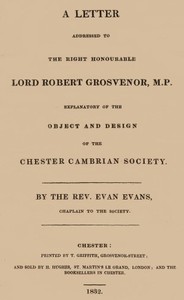
[Picture: Pamphlet cover]
A LETTER ADDRESSED TO THE RIGHT HONOURABLE LORD ROBERT GROSVENOR, M.P.
CHESTER CAMBRIAN SOCIETY.
BY THE REV. EVAN EVANS, CHAPLAIN TO THE SOCIETY.
CHESTER: PRINTED BY T. GRIFFITH, GROSVENOR-STREET; AND SOLD BY H. HUGHES, ST. MARTIN’S LE GRAND, LONDON; AND THE BOOKSELLERS IN CHESTER.
TO THE RIGHT HON. LORD R. GROSVENOR, M.P.
THE relation in which your Lordship stands to the City of Chester, as one of its Representatives, and the lively interest you always evince in every thing connected with its welfare, induce me to address your Lordship on behalf of the CAMBRIAN SOCIETY, established in this City, about six years ago, for the purpose of providing the Welsh residents with the means of religious instruction in their native language; and that in connexion with the Established Church. Though the success with which this Institution has been attended, has far exceeded the most sanguine expectations of its friends; and though the important benefits resulting from it, have been fully appreciated by those, for whom they were originally intended; yet, my Lord, some are still to be found, who entertain conscientious scruples respecting the propriety of supporting this Society—who are yet to be convinced of the expediency of providing the natives of Wales, who come to settle in the principal towns of England, with the means of vernacular religious instruction;—who are of opinion that the Welsh, thus situated, ought to learn the language of their neighbours, by which means they would have access to all their privileges: this, they contend, would supersede the necessity of all such institutions as are founded on the principle of the Chester Cambrian Society.
It is with a view of examining the practicability of this suggestion, that I beg to submit the following pages for your Lordship’s perusal. But, before I enter upon the subject, I trust it will not be considered an improper digression, to furnish your Lordship with a brief sketch of the circumstances which led to the formation of this Society.
A few years ago, a number of the natives of the Principality, resident in Chester, associated, and formed themselves into a body, under the denomination of the “Cymmrodorion Society.” Their original object did not extend beyond the common purposes of meeting together for social intercourse, and communicating with each other, in their native language, on subjects connected with the literature of the land of their fathers. But, after a lapse of time, and frequent interchanges of kindred sentiments, their attention was forcibly directed to the moral condition of the lower classes of their fellow-countrymen, residing in Chester.—They found, upon inquiry, that a considerable number of these, were so imperfectly acquainted with the English language, as to exclude the possibility of rendering it, to them, a proper medium of religious instruction. Nay, that not a small portion of them, especially of those who had lately emigrated from their native hills, were often, from their imperfect knowledge of it, deprived of advantageous situations, which, in every other respect, they were highly competent to fill. This naturally led to the conclusion, that if their ignorance of that language was such, as to incapacitate them for discharging the duties of their secular employments, how utterly incapable must it render them of performing the infinitely more important duties of religion?—Thus was the Society forcibly impressed with the conviction of their destitute condition.
Rev. Evan Evans opens his 1832 letter to Lord Robert Grosvenor with a direct appeal grounded in Grosvenor's role as a Chester representative. The letter defends the Chester Cambrian Society, which offers Welsh-language religious instruction within the Established Church. Evans immediately confronts a central objection: that Welsh residents in English towns should simply learn English. He does not dismiss this idea but instead scrutinizes its practicality, framing the entire work as an examination of that suggestion.
The Society's Origins and Shift in Purpose
Evans provides a concise history of the Society's formation. A group of Welsh residents in Chester initially organized as the "Cymmrodorion Society" for social and literary exchange in Welsh. Over time, their focus shifted to the moral condition of lower-class Welsh compatriots. This transition from cultural fellowship to religious instruction is presented as a natural evolution, driven by observed need rather than abstract principle. The authorial choice to begin with this narrative grounds the argument in lived experience, not theory.
The Practical Difficulty of Learning English
Evans challenges the assumption that Welsh adults can quickly acquire English for religious purposes. He cites daily experience and a Society report stating that while a "smattering of the tongue" may suffice for civil engagements, understanding sermons or joining worship in English remains impossible. He offers a concrete example: members of the Sunday evening congregation at St. Martin's Church, who have lived in England for years, still cannot "think in" English and must mentally translate every sentence. This evidence anchors his argument in specific, verifiable testimony.
Language as the Vessel of Faith and Memory
Evans deepens his case by portraying Welsh as the language of Christian education, moral precepts, and family advice. He writes that all good impressions were produced through its instrumentality, and that scripture texts, sorrows, and joys are treasured in it. The repeated phrase "in it" builds a rhythmic insistence: "they think in it, they pray in it, they read their Bibles in it, they praise their Maker in it." This rhetorical choice emphasizes that language is not merely a tool but the very medium of spiritual life.
The Peril of a Spiritual Interval
Evans employs a striking military metaphor to argue against any delay in providing Welsh-language ministry. Even a short interval without religious ordinances is "like holding out a flag of truce to a cruel and relentless foe," giving the enemy time to regroup. He warns that the Christian combatant may be "hurled back upon the world, with the loss of fame, and a blasted reputation." This vivid imagery, drawn from the excerpt, reveals Evans's rhetorical strategy: he frames the issue as a spiritual battle where the stakes are nothing less than the soul's health.
Evans's letter is a focused piece of advocacy, not a general treatise. Readers should attend to how he builds his case from specific local conditions—the testimony of St. Martin's congregants, the history of the Cymmrodorion Society—rather than abstract principles. His diction, from the measured opening to the urgent metaphors of combat, reveals a writer who sees language as inseparable from faith and identity.
Reading Evans’s plea for Welsh, I recalled my grandfather’s worn hymnbook — how the words felt like home even when I couldn’t translate them. That quiet ache surfaced again in Prose Fancies — Text and Context, where language becomes a held breath rather than a tool. Some books simply let you remember what it is to belong to a sound.
There are no reviews for this eBook.
There are no comments for this eBook.
Reader reflection
How will you remember this book?
Save your reaction, strongest insight, and memorable passage.
Your progress
0
/
10
2
Was reading this book enjoyable?
3
Is this a title you would suggest to others?
4
How demanding did the text feel?
5
How would you describe its reading pace?
6
How understandable was the text?
7
Did any part of the book feel personally relevant?
8
How useful were the ideas in this book?
9
Which lesson or insight stayed with you?
10