1

Atlantic Classics — Text and Context
(0 User reviews)
669
Project Gutenberg
2011
Not confirmed
American essays
Readers of public-domain and historical texts
Project Gutenberg digital edition
en
Edition facts
Words
71,059
Reading time
309 min
Text sections
6
For Atlantic Classics — Text and Context, the stored edition analysis reports 71,059 words, 5 hr 9 min estimated reading time, and 6 detected text sections.
The text analysis averages about 21.3 words per sentence, while the detected sections provide another way to judge how the source is divided.
Project Gutenberg metadata also associates the work with “American essays,” connecting these edition facts with the source record’s subject description.
Source:
Project Gutenberg record #37758
Sixteen essays from the Atlantic Monthly, selected by editor Ellery Sedgwick for their enduring appeal. The collection spans personal reflection, social commentary, and nature writing, with contributions from Owen Wister, Agnes Repplier, and others. A sample of early 20th-century American essayistic voice.
Editorial Edition Score
4.7/5
★★★★★
★★★★★
Calculated from edition completeness, EPUB availability, text structure and catalogue metadata. Not a user rating.
How this score is calculated
- Description quality20 pts
- Title & short description10 pts
- Source metadata20 pts
- Text length15 pts
- Chapters / structure15 pts
- EPUB file integrity20 pts
Total of 100 points, scaled to a 2.5-5.0 range. Editions with an empty description or a missing EPUB file are not scored.
Edition quality
Read the Text
re only five minutes in which to catch the train; but in thirty seconds we had unearthed a genuine piece of chamber music. Hallelujah! it was the finale of the first Beethoven trio!
Suddenly the oil of joy curdled to mourning. The thing was an arrangement for piano solo! We left hurriedly when the proprietor began assuring us that the original effect would be secured if the piano was doubled in the treble by the violin and in the bass by the 'cello.
This piano solo was the nearest approach to chamber music that a thorough search and research revealed in the island of Trinacria. But afterwards, recollecting the misadventure in tranquility, we concluded that it was as absurd to look for chamber music in Sicily as to look for 'Die Wacht am Rhein' among the idylls of Theocritus.
SCENE: a city composed of one department store and three houses, on the forbidding shores of Newfoundland.
TIME: one of those times when a fellow needs a friend,--when he's in a stern, strange land on pleasure bent--and has to have a check cashed. I don't know why it is that one always runs out of ready money in Newfoundland. Perhaps because salmon flies are such fleeting creatures of a day that you must send many postal orders to St. Johns for more. Perhaps because the customs officials at Port au Basques make you deposit so much duty on your fishing tackle. At any rate, there I was penniless, with the burly storekeeper scowling in a savage manner at my check and not knowing at all whether to take a chance on it. Finally he thought he wouldn't, but conceded that I might spend a night under his roof, as there was really nowhere else to go.
At this pass something made me think of music. Perhaps it was the parlor piano which, when new, back in the stone age, had probably been in tune. I inquired whether there were any other instruments. The wreckage of a violin was produced. With two pieces of string and a table fork I set up the prostrate sound-post. I glued together the bridge and put it in position. The technique of the angler proved helpful in splicing together some strange-looking strings. The A was eked out with a piece of salmon leader, while an old mandolin yielded a wire E.
When all was at last ready, a fresh difficulty occurred to me. The violin was an instrument which I had never learned to play! But necessity is the mother of pretension. I thought of that check. And placing the small fiddle carefully between my knees, I pretended that it was a 'cello.
So the daughter of the house seated herself at the relic of the stone age, and we had a concert. Newfoundland appeared not to be over-finicky in the matter of pitch and tone-quality. And how it did enjoy music! As the audience was of Scotch-English-Irish descent, we rendered equal parts of 'Comin' Through the Rye,' 'God Save the King,' and 'Kathleen Mavourneen.' Then the proprietor requested the Sextette from _Lucia_. While it was forthcoming he toyed furtively with his bandana. When it ceased he encored it with all his might. Then he slipped out storewards and presently returned with the fattest, blackest, most formidable-looking cigar I ever saw, which he gravely proffered me.
'We like' he remarked in his quaint idiom, 'to hear music at scattered times.' He was trying to affect indifference. But his gruff voice shook, and I knew then that music hath charms to cash the savage check.
This essay has rambled on an unconscionable while. The shades of editorial night are already descending; and still I have not yet described one of those unexpected and perfect orgies of chamber music,--one of those little earthly paradises full of
Soul-satisfying strains--alas! too few,--
which true fiddlers errant hope to find in each new place they visit, but which usually keep well in advance of them, like the foot of the rainbow.
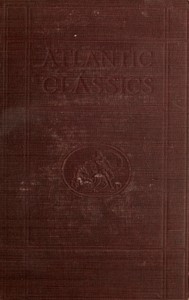
This volume collects sixteen essays that originally appeared in the Atlantic Monthly, chosen by editor Ellery Sedgwick because they “met with especial favor” and seemed to warrant a longer life than a magazine’s paper covers. The selection is explicitly not a “best of” but a sample meant to preserve the magazine’s flavor and character. Each contributor is represented by a single piece, and the editor notes that many other worthy essays were passed over for reasons of suitability, not quality.
The excerpts show a range of subjects and tones. One essayist describes his youthful ambition to join the “execrated company” of dissenters and cranks, while another reflects on the “Fatalism of the Multitude” as observed by James Bryce. The preface frames the collection as a response to requests from readers and teachers, aiming to create a kind of Atlantic Anthology for classroom use.
A Deliberate Anthology, Not a Retrospective
The preface makes clear that this is not a comprehensive retrospective but a curated sample. Sedgwick selected “a single contribution from each of sixteen characteristic Atlantic authors,” choosing material “not greatly affected by the interests of the moment.” This framing suggests the essays were valued for their enduring qualities rather than topicality. The editor also acknowledges that two or three pieces had already appeared in author collections, reprinted here with permission from Houghton Mifflin and Henry Holt. The volume is thus a deliberate construction, shaped by practical constraints and pedagogical aims.
Voices of Dissent and Civic Engagement
One excerpt presents a first-person narrator who “early formed a high resolve to strive for membership in this execrated company” of dissenters, protestants, and kickers. The passage references George W. Julian, a Free-Soil candidate and later Democrat, as a familiar figure in the narrator’s Indiana streets. The essay moves from local politics to national figures like Colonel Watterson of Kentucky, invoking “the star-eyed goddess.” Another passage engages with James Bryce’s concept of the “Fatalism of the Multitude,” arguing that Americans have grown less conscious of the mass’s crushing weight and more aware that “the individual counts.” The tone is wry and self-deprecating, as when the narrator notes being “chastened” by his fellow citizens’ “distrust of me with unmistakable emphasis.”
Recurring Motifs: Humor, Democracy, and the Individual
Throughout the excerpt, humor is presented as a touchstone: “All passes; humor alone is the touchstone of democracy.” The narrator finds delight in the Emporia Gazette and subscribes to the Charleston News and Courier, only to be “saddened by the tameness of its sentiments.” The essay’s structure moves from personal anecdote to broader political reflection, weaving in references to Matthew Arnold, Darwin, Spencer, and Huxley. The closing lines of the excerpt return to the theme of individual agency: “The pressure of the mass will yet be felt, but in spite of its persistence there a…” The incomplete sentence mirrors the fragmentary nature of the excerpts, leaving the reader to infer the full argument.
Readers approaching this collection should note that the essays are not arranged by theme or chronology but by the editor’s judgment of representativeness. The excerpts suggest a consistent interest in American identity, civic participation, and the role of the individual within the mass. The volume’s stated purpose—to serve as a classroom resource—implies that each essay can stand alone, yet the cumulative effect may reveal recurring preoccupations across the sixteen contributors.
Reading Sedgwick’s essays brought back an old train ride, pages fading in dusk light, that same unhurried trust in a voice. It reminded me of another quiet collection, Practicable Socialism, New Series — Text and Context, where earnest hope felt less like doctrine and more like a hand resting on a windowsill. Both books share that gentle, pragmatic patience.
There are no reviews for this eBook.
There are no comments for this eBook.
Reader reflection
Take a moment to reflect on this book
Create a short personal record of your experience with this book.
Your progress
0
/
10
2
How much did you enjoy the reading experience?
3
Would you pass this book on to a friend?
4
What was the reading difficulty like?
5
Was the book moving at the right speed?
6
Did the book deliver what you hoped for?
7
What did you appreciate most?
8
Did it raise ideas you would like to talk about?
9
What changed or sharpened your thinking?
10