1


Atlantic Classics, Second Series — Key Ideas to Explore
(0 User reviews)
1093
Project Gutenberg
2011
Not confirmed
American essays
Readers of public-domain and historical texts
Project Gutenberg digital edition
en
Edition facts
Words
79,887
Reading time
348 min
Text sections
7
The catalog record for Atlantic Classics, Second Series — Key Ideas to Explore provides practical reading context through 79,887 words, 5 hr 48 min estimated reading time, and 7 detected text sections.
The text analysis averages about 23.9 words per sentence, while the detected sections provide another way to judge how the source is divided.
Project Gutenberg metadata also associates the work with “American essays,” connecting these edition facts with the source record’s subject description.
Source:
Project Gutenberg record #38245
An editor-curated collection of early 20th-century Atlantic essays, blending personal reflection with social critique. The volume's preface frames it as a 'book to read, enjoy, and keep,' while essays like 'The College of Athletics' use vivid, critical language to dissect collegiate sports culture.
Editorial Edition Score
4.7/5
★★★★★
★★★★★
Calculated from edition completeness, EPUB availability, text structure and catalogue metadata. Not a user rating.
How this score is calculated
- Description quality20 pts
- Title & short description10 pts
- Source metadata20 pts
- Text length15 pts
- Chapters / structure15 pts
- EPUB file integrity20 pts
Total of 100 points, scaled to a 2.5-5.0 range. Editions with an empty description or a missing EPUB file are not scored.
Edition quality
Read the Text
Often had I heard of his civic deeds and of his well-directed charities, but my heart never quite warmed toward him until I learned that, with spectacles on nose and comb in hand, he had spent three laborious hours in painfully going over his spaniel, and eliminating those parasitic guests which sometimes infest the coat of the cleanest and most aristocratic dog. I am not ashamed to say that I have a confidence in his wisdom now which I did not have before, knowing that his head will never be allowed to tyrannize over his heart. His name should be recorded here, were it not that his modesty might be offended by the act. (Three letters would suffice to print it.)
In speaking of the dog as a kind of missionary in the household, I mean, it need hardly be said, something more than mere ownership of the animal. It will not suffice to pay a large sum for a dog of fashionable breed, equip him with a costly collar, and then relegate him to the stable or the kitchen. He should be one of the family, living on equal terms with the others, and their constant companion. The dog's life is short at the best, and every moment of it will be needed for his development. It is wonderful how, year by year, the household pet grows in intelligence, how many words he learns the meaning of, how quick he becomes in interpreting the look, the tone of voice, the mood of the person whom he loves. He is old at ten or eleven, and seldom lives beyond thirteen or fourteen. If he lived to be fifty, he would know so much that we should be uneasy, perhaps terrified, in his presence.
A certain amount of discipline is necessary for a dog. If left to his own devices, he is apt to become somewhat dissipated, to spend his evenings out, to scatter among many the affection which should be reserved for a few. But, on the other hand, a dog may easily receive too much discipline; he becomes like the child of a despotic father. A dog perfectly trained, from the martinet point of view,--one who never 'jumps up' on you, never lays an entreating paw on your arm, never gets into a chair, or enters the drawing-room,--such a dog is a sad sight to one who really knows and loves the animal. It is against his nature to be so repressed. Over-careful housewives, and persons who are burdened with costly surroundings, talk of injury to carpets and other furniture if the dog has a right of entry everywhere in the house. But what is furniture for? Is it for display, is it a guaranty of the wealth of the owners, or is it for use? Blessed are they whose furniture is so inexpensive or so shabby that children and dogs are not excluded from its sacred precincts. Perhaps the happiest household to which I ever had the honor of being admitted was one where it was sometimes a little difficult to find a comfortable vacant chair: the dogs always took the arm-chairs. Alas, where are those hospitable chairs now? Where the dogs that used to sit up in them, and wink and yawn, and give their paws in humorous embarrassment?
'The drawing-room was made for dogs, and not dogs for the drawing-room,' would be Lady Barnes's thesis, did she formulate it. It was this same Lady Barnes--Rhoda Broughton's--who once said, 'I have no belief in Eliza, the housemaid I leave in charge here. When last I came down from London the dogs were so unnaturally good that I felt sure she bullied them. I spoke very seriously to her, and this time, I am glad to say, they are as disobedient as ever, and have done even more mischief than when I am at home.' And she laughed with a delicate relish of her own folly.
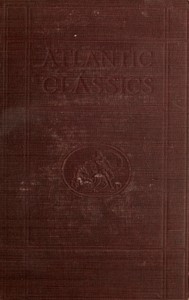
The preface to Atlantic Classics, Second Series explicitly positions the collection as a deliberate counter to ephemeral magazine content: the editor describes a 'residue' of essays that 'ought to have such length of days as the covers of a book can ensure.' This framing shapes the reader's expectation of durable, crafted prose. The essays themselves, however, vary markedly in voice and pace. William Trufant Foster's 'The College of Athletics,' for instance, adopts a forensic, almost prosecutorial tone, building a case against intercollegiate sports through accumulated, damning detail. His language is concrete and visceral: 'the maelstrom of college athletics,' 'canned enthusiasm,' and 'pathological nervous condition.' The essay's rhythm is relentless, piling example upon example, a stark contrast to the more meditative, lyrical pieces likely elsewhere in the volume.
The Editor's Intent and the Volume's Structure
The preface, signed by editor Ellery Sedgwick, reveals a clear curatorial purpose. Sedgwick notes that the first Atlantic Classics volume 'assumed a character quite unlooked for' by entering college curricula, and he expresses a desire that this second series be 'a book to read, enjoy, and keep.' He distinguishes his aim from that of a textbook compiler. The volume gathers essays from 1910–1917, a period of social and technological change, and the selection criteria—'topics of more than temporary interest'—suggest a deliberate mix of the timely and the timeless. The table of contents (not fully excerpted) includes contributors from diverse fields: Jane Addams (social reform), William Beebe (naturalist), and John Jay Chapman (essayist). This variety in authorial background likely produces a corresponding variety in narrative voice, from the analytical to the anecdotal.
A Case Study in Persuasive Rhythm: 'The College of Athletics'
Foster's essay, excerpted at length, demonstrates a distinctive rhetorical strategy. He opens with a hypothetical concession—'That this will seem a preposterous plan'—then systematically dismantles opposing views. His sentences grow longer and more complex as he catalogs abuses: 'the excesses of excitement create a pathological nervous condition which craves greater excesses.' The pace accelerates through a series of short, punchy indictments: 'A student who would not support his team by betting on it was regarded as deficient in spirit.' He uses specific, almost journalistic details—'bar-rooms of that city were not empty,' 'young men parading the streets in nightshirts'—to ground his argument in observable reality. The tone is one of controlled outrage, a voice that seeks to persuade through accumulation of evidence rather than emotional appeal.
Contrasting Voices: The Range of the Collection
While Foster's essay is the most extensively excerpted, the collection's range can be inferred from the list of contributors. Jane Addams, a noted pacifist and sociologist, likely brings a more empathetic, reform-minded voice. William Beebe, a naturalist, might offer descriptive, observational prose. John Jay Chapman, known for his vigorous, sometimes combative style, could provide a different kind of intensity. The editor's preface emphasizes 'contemporary expression' and 'living' literature, suggesting that the essays are not merely historical documents but works meant to engage a reader's present concerns. This variety in voice and pace—from Foster's rapid-fire indictment to what may be more leisurely reflections—is a key feature of the collection, inviting readers to move between different modes of thought and argument.
Readers approaching Atlantic Classics, Second Series should attend to the shifts in rhetorical temperature between essays. The preface's promise of a 'book' rather than a 'text' encourages a non-linear reading: one might start with a familiar author or a topic of personal interest. The collection rewards attention to how each writer constructs an argument or evokes a scene, making it a useful study in early 20th-century expository style.
There’s something about that old Atlantic Classics volume, the way its essays stay with you long after. The editor’s framing felt like a quiet invitation to linger. That same tender, reflective quality emerges in the piece on socialism and family life — it made me think of how homes carry our larger hopes. Socialism and the family — Background and Themes feels like a warm echo of those thoughts.
There are no reviews for this eBook.
There are no comments for this eBook.
Reader reflection
Record your reading impressions
A brief reflection can help important ideas stay with you longer.
Your progress
0
/
10
2
What was your overall reaction to the book?
3
How likely are you to recommend this book?
4
How easy was the book to follow?
5
Would a second reading be valuable?
6
How clear did the writing feel?
7
Did it raise ideas you would like to talk about?
8
Was the book what you thought it would be?
9
What is the main idea you are taking away?
10