1

Socialism and the family — Background and Themes
(0 User reviews)
1065
Project Gutenberg
2020
Not confirmed
Socialism; Families; Middle class
Readers of public-domain and historical texts
Project Gutenberg digital edition
en
Edition facts
Words
13,692
Reading time
60 min
Text sections
14
The catalog record for Socialism and the family — Background and Themes provides practical reading context through 13,692 words, 1 hr estimated reading time, and 14 detected text sections.
The text analysis averages about 23.5 words per sentence, while the detected sections provide another way to judge how the source is divided.
Project Gutenberg metadata also associates the work with “Socialism,” connecting these edition facts with the source record’s subject description.
Source:
Project Gutenberg record #61347
H. G. Wells argues that socialism must address middle-class family life, not just economics. He distinguishes his ideal of a planned society from the socialist movement's tactics, and critiques the Daily Express for conflating socialism with free love.
Editorial Edition Score
4.6/5
★★★★★
★★★★★
Calculated from edition completeness, EPUB availability, text structure and catalogue metadata. Not a user rating.
How this score is calculated
- Description quality20 pts
- Title & short description10 pts
- Source metadata20 pts
- Text length15 pts
- Chapters / structure15 pts
- EPUB file integrity20 pts
Total of 100 points, scaled to a 2.5-5.0 range. Editions with an empty description or a missing EPUB file are not scored.
Edition quality
Read the Text
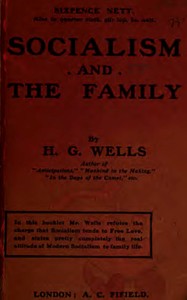
SOCIALISM AND THE FAMILY
THE PLATTNER STORY, AND OTHERS. TALES OF SPACE AND TIME. THE STOLEN BACILLUS AND OTHER STORIES. TWELVE STORIES AND A DREAM.
THE TIME MACHINE. THE ISLAND OF DR. MOREAU. THE WAR OF THE WORLDS. THE INVISIBLE MAN. THE FIRST MEN IN THE MOON. THE FOOD OF THE GODS. THE SEA LADY (Methuen). WHEN THE SLEEPER WAKES. IN THE DAYS OF THE COMET.
LOVE AND MR. LEWISHAM. KIPPS.
ANTICIPATIONS. MANKIND IN THE MAKING. A MODERN UTOPIA. THE FUTURE IN AMERICA.
------------------------------------------------------------------------
SOCIALISM AND THE FAMILY
_Author of “In the Days of the Comet,” “A Modern Utopia,” “Anticipations,” etc._
LONDON A. C. FIFIELD, 44, FLEET STREET, E.C. 1906
_All rights reserved_
------------------------------------------------------------------------
SOCIALISM AND THE FAMILY
_These are two papers written by Mr. H. G. Wells. The first was read to the Fabian Society in October, 1906, under the title of “Socialism and the Middle Classes.” The second appeared first in the “Independent Review.” Together they state pretty completely the attitude of Modern Socialism to family life._
In this paper I am anxious to define and discuss the relationship between three distinct things:
(1) Socialism, i.e. a large, a slowly elaborating conception of a sane and organized state and moral culture to replace our present chaotic way of living,
(2) the Socialist movement, and
(3) the Middle Classes.
The first is to me a very great thing indeed, the form and substance of my ideal life, and all the religion I possess. Let me make my confession plain and clear. I am, by a sort of predestination, a Socialist. I perceive, I cannot help talking and writing about Socialism, and shaping and forwarding Socialism. I am one of a succession—one of a growing multitude of witnesses, who will continue. It does not—in the larger sense—matter how many generations of us must toil and testify. It does not matter, except as our individual concern, how individually we succeed or fail, what blunders we make, what thwartings we encounter, what follies and inadequacies darken our private hopes and level our personal imaginations to the dust. We have the light. We know what we are for, and that the light that now glimmers so dimly through us must in the end prevail. To us Socialism is no piece of political strategy, no economic opposition of class to class; it is a plan for the reconstruction of human life, for the replacement of a disorder by order, for the making of a state in which mankind shall live bravely and beautifully beyond our present imagining.
So, largely, I conceive of Socialism. But Socialism and the Socialist movement are two very different things. The Socialist movement is an item in an altogether different scale.
H. G. Wells opens this 1906 Fabian Society paper by declaring himself a Socialist “by a sort of predestination,” framing socialism as a comprehensive plan for reconstructing human life rather than a mere political strategy. He immediately distinguishes between socialism as an ideal and the socialist movement as a practical, sometimes compromised, organization. The excerpts show Wells focusing on the middle classes—not the industrial proletariat—and insisting that socialism must engage with the intimate aspects of life, particularly family and marriage, to win over middle-class women and youth.
Socialism as a Moral and Religious Vocation
Wells presents socialism not as an economic doctrine but as “the form and substance of my ideal life, and all the religion I possess.” He speaks of a “growing multitude of witnesses” who will continue to testify, regardless of personal failure. This quasi-religious language sets his socialism apart from class-based politics. He explicitly rejects viewing socialism as “a piece of political strategy” or “economic opposition of class to class.” Instead, he envisions a state where “mankind shall live bravely and beautifully beyond our present imagining.” The excerpts do not reveal how this ideal would be implemented, but Wells’s tone is that of a prophet rather than a policy maker.
The Middle Classes as the Key Audience
Wells argues that socialists have been “silent or vague” about the “central tangle of life”—family and sexual relations. He believes that speaking plainly on these topics would “grip the middle-class woman and the middle-class youth of both sexes with an extraordinary new interest.” The excerpts do not specify what those plain words would be, but Wells clearly targets the middle class, not the working class. He criticizes the socialist movement for avoiding these intimate issues, implying that doing so limits its appeal. The catalog subject “Middle class” is thus central to Wells’s argument, though the excerpts do not define what he means by that class.
Distancing Socialism from Free Love Accusations
Wells recounts a Daily Express article that linked him and Keir Hardie to “teaching Free Love to respectable working men.” He calls this a “comical attempt” and insists that socialism’s proposals are “orderly.” He traces the confusion back to “Palaeo-Socialists” like Godwin, Mary Wollstonecraft, and Shelley, who mixed socialism with “uncovenanted freedom of action in sexual matters.” Wells distinguishes modern socialism from that older tradition, but the excerpts do not reveal his own positive proposals for marriage and the family. The reader is left to infer that Wells advocates some form of reform, but the text cuts off before detailing it.
Readers should note that this text consists of two separate papers: the first read to the Fabian Society in October 1906, the second from the Independent Review. The excerpts break off just as Wells begins to outline his positive vision for family life under socialism. The catalog subjects—Socialism, Families, Middle class—accurately reflect the content, but the excerpts focus more on Wells’s rhetorical positioning than on concrete proposals. Those seeking his practical recommendations will need to consult the full text.
Years among the stacks taught me that Wells’s quiet insistence on the family’s stubborn heart—its need for tenderness amidst planning—finds a whispered echo in the sturdy, slow-burning landscape of Rusticus — Story, Setting & Ideas. Both books seem to understand that change arrives not by blueprint alone, but through the patient, familiar earth of daily life.
There are no reviews for this eBook.
There are no comments for this eBook.
Reader reflection
What did you think of this book?
Answer a few questions and save a private reflection on this device.
Your progress
0
/
10
2
Did this book hold your interest?
3
Would you encourage someone else to read it?
4
How easy was the book to follow?
5
Would you start a conversation about this book?
6
How distinctive were its ideas or approach?
7
How strongly did the book affect you emotionally?
8
Was the book moving at the right speed?
9
In one sentence, what did you learn?
10