1

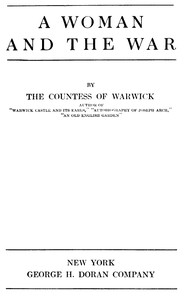
A Woman and the War — A Reader’s Guide
(0 User reviews)
753
Project Gutenberg
2020
Not confirmed
World War, 1914-1918; World War, 1914-1918 -- Women; Great Britain -- Social conditions -- 20th century
Readers of public-domain and historical texts
Project Gutenberg digital edition
en
Edition facts
Words
64,169
Reading time
279 min
Text sections
7
This digital edition of A Woman and the War — A Reader’s Guide is described by source-level measurements including 64,169 words, 4 hr 39 min estimated reading time, and 7 detected text sections.
The text analysis averages about 28.9 words per sentence, while the detected sections provide another way to judge how the source is divided.
Project Gutenberg metadata also associates the work with “World War, 1914-1918,” connecting these edition facts with the source record’s subject description.
Source:
Project Gutenberg record #63910
An editorial note on the Countess of Warwick's 1916 polemic, examining its urgent preface, the rhetorical use of a miner's wife, and the shift from protest to a vision of women's moral power.
Editorial Edition Score
4.7/5
★★★★★
★★★★★
Calculated from edition completeness, EPUB availability, text structure and catalogue metadata. Not a user rating.
How this score is calculated
- Description quality20 pts
- Title & short description10 pts
- Source metadata20 pts
- Text length15 pts
- Chapters / structure15 pts
- EPUB file integrity20 pts
Total of 100 points, scaled to a 2.5-5.0 range. Editions with an empty description or a missing EPUB file are not scored.
Edition quality
Read the Text
This was when I was a child, and I know I went many times, so her visits would probably have been frequent. On my writing-table is the silver and mother-of-pearl ornament that was her wedding present to me. Everybody respected the old Emperor William, and everybody admired the Crown Prince Frederick. When he married Queen Victoria's eldest daughter, the Princess Royal, who became, after the death of Princess Alice, King Edward's favourite sister, the relations between the two courts could hardly have been more amicable. Queen Victoria loved Germany and the Germans, she adored her grandson. In her eyes he could do no wrong, she even went so far as to hold him up to her eldest son as a model. On the other hand, the Princess of Wales, being a Dane, could not forget or forgive the theft of Schleswig Holstein; her sister the Russian Empress shared her suspicions of German intentions, but I never heard of one or the other originating or encouraging anti-German intrigues.
As the Kaiser grew up towards manhood his personality was hardly known; his father, the Crown Prince Frederick, a far more noble figure, monopolised attention. Beyond the fact that he was Queen Victoria's favourite grandson nothing was known about William II. Nobody thought that he would be called upon to rule before he was middle aged or elderly; his father's illness was unsuspected. But if there was no ill feeling at the English court, it is impossible to say the same of the court at Berlin. The presence of the Princess Royal was resented; many people believed, or affected to believe, that the marriage had been designed to make Germany politically subservient to Great Britain. As everybody knows, these feelings grew apace as soon as the old Emperor William had breathed his last, and when, a few months later, the Emperor Frederick passed away, the Anglophobia had spread throughout the Court circles and the young Kaiser had been tainted with the Court prejudice against his own mother. He did not treat her well; it is not too much to say that he treated her badly. She, naturally enough, complained to her brother, the Prince of Wales,--I have already said that she was now his best loved sister. He was angry on her account and spoke his mind. Relations between the young Kaiser and his uncle were already strained. I must turn back a little to explain why.
In the early days, when King Edward had arrived at man's estate and married, he sought to take a legitimate interest in state affairs. He was disposed to study and to learn, and sought, not without ample justification, to be admitted to the company of the little group of statesmen who advised the Queen and ruled the Empire. But Queen Victoria would have none of it. She practically refused her son access to the Councils of State, she instructed her Ministers to keep all state papers from him; within the compass of a limited monarchy she was determined to rule alone.
Her eldest son, finding that he was not to be accepted as a worker, decided to amuse himself. If he could not direct public policy he would at least direct fashion, if he could not assist the Foreign Office he could at least enable English Society to take rank among the smartest in Europe. So the Marlborough House set came into existence, and with its rise came the first beginnings of the Kaiser's criticism. There were two grounds for this.
In the first place King Edward's personal popularity was unbounded; wherever he went he charmed women and men, and it was quite clear that he would be a force to be reckoned with in diplomacy, when in the fullness of time he ascended the throne; on the other hand, the Kaiser lacked all the qualities that his uncle possessed in abundance. Hard-working and conscientious, he was petulant, exacting, and uncertain. Naturally, then, he found matter for grievance against the uncle who, seemingly without effort, swayed opinion and enjoyed esteem. Jealousy was the origin of disagreement.
The Countess of Warwick opens her preface with a blunt admission: these essays were written 'on the spur of vital moments.' The voice is that of an insider—an aristocrat who has chaired industrial congresses—yet she positions herself against authority, accusing the press of 'thinking for us' and government of making 'helpless puppets' of citizens. The prose is direct, impatient, and unafraid of contradiction: she praises the Christmas 1914 truce as 'pathetic' yet 'strong enough to testify to the brotherhood of man.' This is not a novel but a collection of arguments, and the narrative voice shifts between personal anecdote and sweeping political indictment.
A Preface That Sets the Terms
The preface is the most concentrated piece of writing in the excerpts. Warwick frames her book as a protest against 'the judgments of those who lead, and sometimes mislead us.' She singles out the newspaper press as 'the greatest distorting medium in the world,' and warns that citizens must not give rulers 'a blank cheque.' The tone is urgent, even apocalyptic: 'evolution must mend its paces or become revolution.' This opening establishes a rhythm of accusation and warning that carries into the later chapters. Notably, she admits her own opposition to authorities, claiming her 'ever-swelling letter-bag' confirms she speaks for many. The preface thus functions as both a credential and a call to arms, setting a pace of moral seriousness that the rest of the book must sustain.
The Miner's Wife: A Shift in Register
In chapter XV, 'Race Suicide,' Warwick shifts from general polemic to a specific encounter. She visits a miner's wife in the north of England, describing the woman's house as 'scrupulously clean' and her manner 'swift in thought and movement.' The detail is precise: the couple's books include John Stuart Mill, Ruskin, and William Morris. When Warwick remarks on the absence of children, the woman replies that 'sterility was the only protest' against capitalism. The language here is more restrained than in the preface—the woman 'smiled a little sadly,' and 'some faint lines about her mouth tightened and hardened.' This passage slows the pace, offering a concrete human cost for the abstract arguments. The woman's voice, reported in direct speech, carries an emotional weight that the author's own polemical tone does not.
From Protest to Prophecy
The closing excerpt moves from social critique to a visionary appeal. Warwick imagines a future when 'woman will speak to man in this wise, and he will listen because he must.' She argues that women must 'abjure her idols' and learn 'through bitter experience how great a curse war is.' The prose becomes more rhythmic and declarative: 'Love and not hate must rule the world.' Yet she also acknowledges that many women still 'praise war and magnify personal courage.' This tension—between hope and impatience—gives the conclusion a restless energy. The pace accelerates again, as she calls on women to 'rekindle the light' of the 1914 truce. The book ends not with a policy proposal but with a moral charge, leaving the reader with the sense that the argument is unfinished.
Readers should note that A Woman and the War is not a continuous narrative but a series of linked essays. The pace varies sharply: the preface is dense with accusation, the miner's wife scene slows to a near-stillness, and the final chapters rise to rhetorical prophecy. Pay attention to how Warwick uses reported speech—the miner's wife speaks in a different register than the author, and that contrast is central to the book's persuasive strategy. The excerpts suggest a work that is as much about the right to speak as about the war itself.
I keep thinking about that Countess’s preface, how she let a miner’s wife speak and suddenly the protest felt like something shared, not argued. It reminded me of the quiet way Rusticus — Story, Setting & Ideas lingers too—not in big statements, but in the spaces between voices. That sort of honesty stays with you longer than any conclusion.
There are no reviews for this eBook.
There are no comments for this eBook.
Reader reflection
Your personal reading reflection
Build a private reading journal entry for this title.
Your progress
0
/
10
2
How much did you enjoy the reading experience?
3
Is this a title you would suggest to others?
4
How much effort did this book require?
5
How personally connected did you feel to the book?
6
Was the book easy to understand?
7
Did you gain anything practical from the text?
8
What did you think about the pace?
9
In one sentence, what did you learn?
10