1

A year of prophesying — A Closer Reading
(0 User reviews)
1007
Project Gutenberg
2023
Not confirmed
Civilization, Modern -- 20th century; Europe -- History -- 20th century; Great Britain -- History -- 20th century
Readers of public-domain and historical texts
Project Gutenberg digital edition
en
Edition facts
Words
83,371
Reading time
363 min
Text sections
60
Before opening A year of prophesying — A Closer Reading, the edition data offers a quick orientation: 83,371 words, 6 hr 3 min estimated reading time, and 60 detected text sections.
The text analysis averages about 22.5 words per sentence, while the detected sections provide another way to judge how the source is divided.
Project Gutenberg metadata also associates the work with “Civilization, Modern -- 20th century,” connecting these edition facts with the source record’s subject description.
Source:
Project Gutenberg record #69752
A collection of 55 journalistic articles from 1924-1925, where H.G. Wells analyzes post-WWI geopolitics, the League of Nations, dictatorships, and economic policies, revealing his sharp critique of parliamentary democracy and advocacy for world federation.
Editorial Edition Score
4.9/5
★★★★★
★★★★★
Calculated from edition completeness, EPUB availability, text structure and catalogue metadata. Not a user rating.
How this score is calculated
- Description quality20 pts
- Title & short description10 pts
- Source metadata20 pts
- Text length15 pts
- Chapters / structure15 pts
- EPUB file integrity20 pts
Total of 100 points, scaled to a 2.5-5.0 range. Editions with an empty description or a missing EPUB file are not scored.
Edition quality
Read the Text
re is no going back to the top of the hill. France has got Germany by the throat, and such a level of hate and despair has been reached that _she dares not let go_.
Of course, M. Poincaré does not want to let go. But I believe the middling mass of Frenchmen, of whom Philippe Millet was so typical, a mass which, with the parties of the Left, probably constitutes a majority of the French, would welcome any outside help that would enable them to discontinue the strangulation and dismemberment of Central Europe. An American Government and a British Government united enough, understanding enough, and tactful enough, to intervene wisely and generously could swing all that central mass away from Poincaré. A foolish intervention might very easily throw it into a passion of patriotic fear. Its incalculable behaviour is a riddle all Europe is guessing at. The hope of European civilisation rests largely on this central body of French opinion getting to some sort of effective expression before it is too late. The French elections in 1924 will be a very crucial time in human history.
THE LAST OF THE VICTORIANS
Mr. Asquith is now, to use the phrase he coined for a contemporary, the last of the Victorian “giants.” He is the leader of some sort of Liberal Party in England, the oldest and the ripest, I am told, though I confess I am quite unable to make head or tail of these various Liberal parties in England nowadays, and he is always trying to lead his little band back to the nineteenth century, when there were ever so many “giants” in the land, not to mention the Grand Old Man, and when political life made up for its complete want of seriousness by a pompous solemnity and vast personal enthusiasms. Prime Ministers in those days loomed vast; they were none of your little chaps who can hide behind bull-dog pipes and say nuffin. Our Leaders, figures of Pantomimic size, filled the stage and said--_floods_. They were practically all that there was on the stage. The crumbling peace of Europe and the world, the conflict of labour and order with adventurous capital, were not staged in those days. At most one heard of these things in the Legislature as one sometimes catches a rumble of vans and cabs in a London theatre. In the House they dealt with only the thin shadows of great issues; with the Free Breakfast Table, Unsectarian Religious Teaching, Leasehold Enfranchisement, and the like.
One of the most pleasing traits of the Victorian giants was their tremendous scholarly evasion of all complete statement. The vulgarity of a plain assignment of a thing to its broad roots and general principles was never committed. In such matters Mr. Asquith is finely representative of his period. He has to perfection that ability to deal with a part of an issue as if it were the whole which was characteristic of the great Victorian scholars and gentlemen. If Mr. Asquith were a mechanic, and you asked him to make you an automobile, he would presently produce two wheels, a clutch, and a radiator with so perfect and dignified a manner that you would hardly realise that you had not the complete car until you stepped through it. You would feel it ungracious to complain. When Mr. Asquith drew the sword and threw away the scabbard, he did it with so fine a gesture that you scarcely noted that most of the sword wasn’t there. If Mr. Asquith were a domestic hen he would lay eggs consisting of about two-thirds of a shell and as much yolk as would cover a sixpence, but he would cluck so bravely that you would credit him with a complete omelette. I do not blame him, it was the style of his time; but his time has passed, and this is a world too urgent and dangerous for the ample deficiencies of those spaciously empty years.
These remarks are provoked by the fact that Mr. Asquith and his associated and rival Liberal leaders--I can never tell which is which--are now engaged in unfurling the Banner of Free Trade in Great Britain. Encumbered with an immense and growing burden of unemployed workmen Britain is thinking of all sorts of eleventh-hour expedients. Schemes of preference within the Empire, leading towards an Empire Zollverein, are very much to the fore. And in reply this old Free Trade, which figured so largely in the political history of Victorian times, is to be brought out of the shed again, and furbished up and sent round the country to see what it will do for Liberalism.
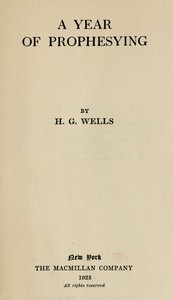
H.G. Wells's A Year of Prophesying collects fifty-five articles written for periodicals between 1924 and 1925, a period he describes as one of “journalistic writing.” The book opens with a foreword directing readers to the concluding article for any prefatory remarks, signaling a deliberate structure. Wells addresses topics from the League of Nations and the Singapore Arsenal to the rise of dictatorships and the gold standard, often blending geopolitical analysis with personal polemic.
The excerpts show Wells employing a conversational yet forceful voice, frequently using rhetorical questions and direct address. For instance, he asks, “Is there a ghost of a chance of a war with either the United States or Japan?” and later declares, “The more Parliament changes, I perceive, the more it is the same thing.” These passages reveal a writer deeply engaged with current events, skeptical of political institutions, and unafraid to name figures like Winston Churchill or Lloyd George.
Structure and Scope: A Year of Serial Commentary
The book’s table of contents lists fifty-five articles, each with a title and date, running from early 1924 into 1925. The excerpts include articles such as “The League of Nations and the Federation of Mankind,” “The Beauty of Flying,” “The Triumph of France,” and “Dictators or Politicians? The Dilemma of Civilisation.” This range indicates that Wells covered both broad ideological questions and specific policy debates. The articles are not arranged thematically but chronologically, preserving the sequence of their original publication. Wells’s foreword states that “all that ought to be said in the preface will be found in the concluding article,” suggesting a deliberate arc or summation. The excerpts do not include that final piece, so the overall argument remains partially inferred. However, the recurring focus on international governance, economic policy, and the shortcomings of parliamentary systems suggests a coherent critique of post-war political arrangements.
Voice and Rhetoric: Direct Address and Sharp Critique
Wells’s prose in these articles is direct and often combative. He uses rhetorical questions to engage the reader: “Why have all these dictatorships sprung up? Why has there been this decline of faith throughout the world in the Anglo-Saxon device of parliamentary government?” He also employs vivid metaphors, such as describing parliamentary democracy in Russia as “as suitable wear for that country at its present phase of education as a silk hat for a whale.” His criticism is pointed: he accuses politicians of being unable to “see beyond the division lobby and the dockyard vote,” and he contrasts the cost of cruisers with the lack of funding for education. Wells does not hesitate to name individuals, referring to “Mr. Amery” and “Mr. Ammon,” and he dismisses Hilaire Belloc’s views as “absurdly enough.” This style suggests a writer confident in his opinions and willing to provoke debate.
Thematic Threads: Internationalism and Domestic Politics
The excerpts reveal two intertwined concerns: the need for effective international cooperation and the failure of domestic political systems. Wells repeatedly returns to the League of Nations, the possibility of war with Japan, and the rise of dictatorships in Europe. He argues that “the drift towards dictatorships” stems from “the steady process of financial, social, and economic decay” and the perceived inadequacy of representative government. At the same time, he criticizes British policy, such as the decision to build cruisers while cutting education. He advocates for a “concentration of ad hoc powers in a single competent responsible person” as a “legitimate and most hopeful development of democratic method,” distinguishing this from outright dictatorship. The catalog subjects list “Civilization, Modern -- 20th century” and “Europe -- History -- 20th century,” which align with these themes, but the excerpts show that Wells’s focus is less on historical narrative than on immediate political advocacy and critique.
Readers approaching A Year of Prophesying should treat it as a primary source for Wells’s political thought in the mid-1920s, not as a systematic treatise. The articles reward attention to their original dates and contexts, as Wells responds to events as they unfold. His predictions—such as the possibility of conflict with Japan—are less important than his diagnosis of the tensions between nationalism, democracy, and internationalism. The book offers a vivid snapshot of a journalist-historian engaging with a world in flux.
Sitting with these 1924 prophecies, I remember my grandfather’s shelves—his worn copy of The Outline of History. Wells’ frustration with “parliamentary futility” feels startlingly current. Reading him, I thought of another quiet afternoon, the same sense of a mind wrestling with systems too big for one person, in Escape, and Other Essays — Themes and Context. It was less about solutions, more about the ache of looking clearly.
There are no reviews for this eBook.
There are no comments for this eBook.
Reader reflection
How did this book work for you?
Your answers remain private and are stored only in this browser.
Your progress
0
/
10
2
Did this book hold your interest?
3
Would you encourage someone else to read it?
4
Did the language feel accessible?
5
Would you start a conversation about this book?
6
Which aspect of the book did you value most?
7
Was the book what you thought it would be?
8
What was its emotional impact?
9
Which lesson or insight stayed with you?
10