1

Bedouins — Story, Setting & Ideas
(0 User reviews)
73
Project Gutenberg
2023
Not confirmed
Music -- History and criticism; Garden, Mary, 1874-1967; Sopranos (Singers)
Readers of public-domain and historical texts
Project Gutenberg digital edition
en
Edition facts
Words
66,705
Reading time
291 min
Text sections
32
This digital edition of Bedouins — Story, Setting & Ideas is described by source-level measurements including 66,705 words, 4 hr 51 min estimated reading time, and 32 detected text sections.
The text analysis averages about 16.4 words per sentence, while the detected sections provide another way to judge how the source is divided.
Project Gutenberg metadata also associates the work with “Music -- History and criticism,” connecting these edition facts with the source record’s subject description.
Source:
Project Gutenberg record #70254
James Huneker's 'Bedouins' (1920) collects essays on music, singers, and the arts, with a focus on soprano Mary Garden. The catalog subjects list music criticism and Garden, but the excerpts reveal a broader range: anecdotes about Caruso, polemics against vocal teaching frauds, and reflections on artistic temperament. The title's 'Bedouin' metaphor—drawn from Flaubert and Stevenson—suggests a free-roaming critical spirit.
Editorial Edition Score
4.9/5
★★★★★
★★★★★
Calculated from edition completeness, EPUB availability, text structure and catalogue metadata. Not a user rating.
How this score is calculated
- Description quality20 pts
- Title & short description10 pts
- Source metadata20 pts
- Text length15 pts
- Chapters / structure15 pts
- EPUB file integrity20 pts
Total of 100 points, scaled to a 2.5-5.0 range. Editions with an empty description or a missing EPUB file are not scored.
Edition quality
Read the Text
ame for much in this vale of tears; that is, if you are unlucky or lucky enough to be possessed of the seven devils of psychology.
Mary Garden was, no doubt, a naughty little girl in her time. That she climbed trees, fought boys twice her size, stuck out her tongue at pious folk, scandalized her parents, and tore from the heads of nice girls handfuls of hair, I am sure. Hedda Gabler thus treated gentle Thea Elvstad in the play. But was this demon Mary aware of her multiple personalities? Of her complexes? Her art fusion is such perfect synthesis. Subconscious is nowadays an excuse for the Original Sin with which we are saddled by theologians.
Well, one bad turn deserves another, and we may easily picture the wild Scottish thistle defiantly shrugging shoulders at law and order. She did not analyze her Will-to-Raise-Merry-Hell. No genius of her order ever does. There had been signs and omens. Her mother before her birth had dreamed wonderful dreams; dreamed and prayed that she might become a singer. But even maternal intuition could not have foreseen such a swan triumphantly swimming through the troubled waters of life. A swan, did I say? A condor, an eagle, a peacock, a nightingale, a panther, a society dame, a gallery of moving-pictures, a siren, an indomitable fighter, a human woman with a heart as big as a house, a lover of sport, an electric personality, and a canny Scotch lassie who can force from an operatic manager wails of anguish because of her close bargaining over a contract; in a word, a Superwoman.
My dear friend and master, the late Remy de Gourmont, wrote that man differs from his fellow animals--he didn’t say “lower”--because of the diversity of his aptitudes. Man is not the only organism that shows multiple personalities; even in plant life pigmentation and the power of developing new species prove that our vaunted superiorities are only relative. I may refer you to the experiments of Hugo de Vriès at the Botanical Gardens, Amsterdam, where the grand old Dutch scientist presented me with sixteen-leaf clover naturally developed, and grown between sunset and dawn; also an evening primrose--Æonthera Lamarckiana--which shoots into new flowers. Multiple personalities again. In the case of Mary Garden we call her artistic aptitudes “the gift of versatility.” All distinguished actresses have this serpent-like facility of shedding their skin and taking on a fresh one at will. She is Cleopatra--with “serpent and scarab for sign”--or Mélisande, Phryne, or Monna Vanna; as Thaïs she is both saint and courtesan, her Salome breeds horror; and in the simplicities of Jean the Juggler of Notre Dame a Mary Garden, hitherto submerged, appears: tender, boyish, sweet, fantastic; a ray of moonshine has entered his head and made of him an irresponsible yet irresistibly charming youth.
Not without warrant is Karma believed in by people whose imagination cannot be penned behind the bars of Now. Before to-day was yesterday, and to traverse that Eternal Corridor of Time has been the fate of mankind. The Eternal Return--rather say, the Eternal Recommencement--mad as it seems, is not to be made mock of. It is always the same pair of eyes that peer through windows opening on infinity. What the Karmas of Mary Garden? In spirit-land what avatars! Is she the reincarnation of that Phryne of the “splendid scarlet sins,” or the Faustine who crowded into a moment the madness of joy and crime; or the recrudescence of a Sapho who turned her back on the Leucadian promontory, turned from the too masculine Phaon and sought her Anactoria, sought and wooed her with lyric sighs; has she recaptured, this extraordinary Mary of Aberdeen, the soul of Aspasia, who beguiled Pericles and artistic Athens with the sinuous irony of the serpent; and Gismonda, Louise, and Violetta, all those subtle sonorous sinners--was she in her anterior existence any or all of them? Did she know the glory that was Greece, the grandeur that was Rome? Henry James has warned us not to ask of an author why he selects a particular subject for treatment. It is a dangerous question to put; the answer might prove disconcerting. And with Miss Garden the same argument holds. Her preference for certain characters is probably dictated by reasons obscure even to herself. With her the play-instinct is imperious; it dominates her daylight hours, it overflows into her dream-life. Again the sounding motive of multiple personalities, Karma, subconsciousness, the profound core of human nature. And on the palette of her art there is the entire gamut of tones, from passionate purple to the iridescent delicacies of iris-grey.
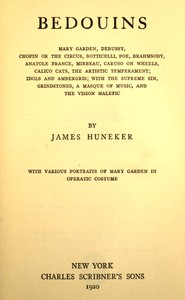
Despite catalog subjects that limit Bedouins to music history and soprano Mary Garden, the excerpts reveal a far more eclectic collection. Huneker’s opening dedication quotes Flaubert—“J’aime mieux le désert, je retourne chez les Bédouins qui sont libres”—and Stevenson, framing the book as a wandering through arts and personalities. The table of contents lists chapters on Debussy, Chopin, Botticelli, Poe, Anatole France, and even calico cats, alongside the Garden essays. The excerpts show Huneker moving from a train journey with Caruso to a polemic against fraudulent singing teachers, all in a conversational, opinionated voice.
The Caruso Anecdote and the Critical Persona
In the chapter “Caruso on Wheels,” Huneker recounts a day traveling with the tenor and other opera figures. The scene is deliberately anti-climactic: singers are “very human,” not “gloomy, grand, and peculiar.” Huneker describes Caruso whistling the Rataplan, the blond Ordynski wishing a Polish curse on Otto Weil, and the author flying home to Flatbush in a “trusty Glenn Curtiss hydro-aeroplane.” The tone is wry and self-deprecating, with Huneker positioning himself as an observer who punctures romantic notions of artistic life. This anecdote, though brief, exemplifies how the book mixes personal narrative with critical commentary, often undercutting the mystique of its subjects.
Polemic Against Vocal Teaching Fraud
The chapter “Sing and Grow Voiceless” opens with a blistering attack on fake singing teachers: “We have had over forty years’ experience in the fair land of song, a scarred battle-field strewn with the shards and wrecks of beautiful voices.” Huneker calls for legal protection against “vocal parasites,” comparing the lack of regulation in music teaching to the medical profession. He then pivots to the “comic side,” mocking pamphlets like “How to Be Happy Though Divorced.” This shift from outrage to absurdity is characteristic of Huneker’s style. The passage shows that the book is not solely celebratory; it includes sharp social criticism grounded in the author’s long observation of the music world.
Structure and the Bedouin Metaphor
The book’s structure—two parts, the first on Mary Garden and the second titled “Idols and Ambergris”—suggests a deliberate miscellany. The catalog subjects list only Garden and music criticism, but the excerpts include chapters on “Calico Cats,” “Grindstones,” and “The Vision Malefic.” The dedication’s Flaubert quote, “I prefer the desert, I return to the Bedouins who are free,” frames the collection as a refusal to be confined to a single topic. Huneker’s voice is that of a cultural wanderer, moving from soprano to circus, from Poe to Brahms. Readers expecting a focused study of Garden will find instead a series of essays linked by the author’s personality and his skeptical, erudite perspective.
Readers should approach Bedouins as a collection of occasional pieces rather than a unified work. The catalog subjects underrepresent the range of topics Huneker covers. The excerpts suggest that the book rewards browsing: the Caruso anecdote, the diatribe against vocal teachers, and the eclectic chapter titles all point to a writer more interested in the free play of ideas than in systematic analysis. Huneker’s critical persona—worldly, ironic, and opinionated—is the true subject.
Reading Huneker’s Bedouins, I kept thinking of wandering free spirits, and then my mind drifted to a quieter kind of restlessness—finding humor in worn-down corners of life. There’s a fondness in both, a gentle shrug at the world’s oddities. That same tender curiosity lives in The Works of Thomas Hood; Vol. 01 (of 11) Comic and Serious, in Prose and Verse, With All the Original Illustrations — Themes and Context, like an old friend’s familiar chuckle.
There are no reviews for this eBook.
There are no comments for this eBook.
Reader reflection
How did this book work for you?
Your answers remain private and are stored only in this browser.
Your progress
0
/
10
2
Was reading this book enjoyable?
3
How likely are you to recommend this book?
4
Did the language feel accessible?
5
Could you apply anything you learned?
6
Would you read this book again?
7
Did any part of the book feel personally relevant?
8
How original did the book feel?
9
What changed or sharpened your thinking?
10