1

Enfranchisement of women — A Closer Reading
(0 User reviews)
78
Project Gutenberg
2024
Not confirmed
Women -- Suffrage; Women's rights; Equality
Readers of public-domain and historical texts
Project Gutenberg digital edition
en
Edition facts
Words
13,746
Reading time
60 min
Text sections
5
The catalog record for Enfranchisement of women — A Closer Reading provides practical reading context through 13,746 words, 1 hr estimated reading time, and 5 detected text sections.
The text analysis averages about 31.2 words per sentence, while the detected sections provide another way to judge how the source is divided.
Project Gutenberg metadata also associates the work with “Women -- Suffrage,” connecting these edition facts with the source record’s subject description.
Source:
Project Gutenberg record #73404
Harriet Taylor Mill's 1851 essay reports on the first US women's rights conventions, arguing for full legal and political equality. The text combines detailed meeting observations with a critique of companionate marriage, asserting that men's intellectual decline stems from seeking sympathy from intellectual inferiors.
Editorial Edition Score
4.5/5
★★★★★
★★★★★
Calculated from edition completeness, EPUB availability, text structure and catalogue metadata. Not a user rating.
How this score is calculated
- Description quality20 pts
- Title & short description10 pts
- Source metadata20 pts
- Text length15 pts
- Chapters / structure15 pts
- EPUB file integrity20 pts
Total of 100 points, scaled to a 2.5-5.0 range. Editions with an empty description or a missing EPUB file are not scored.
Edition quality
Read the Text
This digitized version reproduces the full version of the Essay. Obvious typographical errors have been corrected. Bold are denoted by equals signs
Please note that two pages of advertising have not been reproduced.
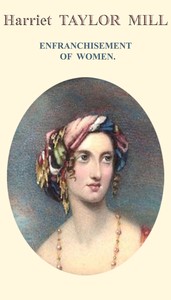
ENFRANCHISEMENT OF WOMEN.
MRS. JOHN STUART MILL.
WESTMINSTER AND FOREIGN QUARTERLY REVIEW,
Office of “THE REVOLUTION”
NO. 37 PARK ROW (ROOM 17)
ENFRANCHISEMENT OF WOMEN:
BY MRS. JOHN STUART MILL.
"WESTMINSTER AND FOREIGN QUARTERLY REVIEW,"
Most of our readers will probably learn from these pages, for the first time, that there has arisen in the United States, and in the most civilized and enlightened portion of them, an organized agitation on a new question,--new, not to thinkers, nor to any one by whom the principles of free and popular government are felt, as well as acknowledged, but new, and even unheard of, as a subject for public meetings and practical political action. This question is, the enfranchisement of women; their admission, in law, and in fact, to equality in all rights, political, civil and social, with the male citizens of the community.
It will add to the surprise with which many will receive this intelligence, that the agitation which has commenced is not a pleading by male writers and orators _for_ women, those who are professedly to be benefited remaining either indifferent or ostensibly hostile; it is a political movement, practical in its objects, carried on in a form which denotes an intention to persevere. And it is a movement not merely _for_ women, but _by_ them. Its first public manifestation appears to have been a convention of women, held in the State of New York, July, 1848. Of this meeting we have seen no report. On the 23d and 24th of October last, a succession of public meetings was held at Worcester, in Massachusetts, under the name of a "Women's Rights Convention," of which the president was a woman, and nearly all the chief speakers women; numerously reinforced, however, by men, among whom were some of the most distinguished leaders in the kindred cause of negro emancipation. A general and four special committees were nominated, for the purpose of carrying on the undertaking until the next annual meeting.
According to the report in the _New York Tribune_, above a thousand persons were present throughout, and, "if a larger place could have been had, many thousands more would have attended." The place was described as "crowded, from the beginning, with attentive and interested listeners." In regard to the quality of the speaking, the proceedings bear an advantageous comparison with those of any popular movement with which we are acquainted, either in this country or in America. Very rarely, in the oratory of public meetings, is the part of verbiage and declamation so small, that of calm good sense and reason so considerable. The result of the convention was, in every respect, encouraging to those by whom it was summoned; and it is probably destined to inaugurate one of the most important of the movements towards political and social reform, which are the best characteristic of the present age.
That the promoters of this new agitation take their stand on principles, and do not fear to declare these in their widest extent, without time-serving or compromise, will be seen from the resolutions adopted by the convention, part of which we transcribe:
_Resolved_, That every human being, of full age, and resident for a proper length of time on the soil of the nation, who is required to obey the law, is entitled to a voice in its enactment; that every such person, whose property or labor is taxed for the support of the government, is entitled to a direct share in such government. Therefore,
_Resolved_, That women are entitled to the right of suffrage, and to be considered eligible to office; and that every party, which claims to represent the humanity, the civilization, and the progress of the age, is bound to inscribe on its banners, equality before the law, without distinction of sex or color.
_Resolved_, That civil and political rights acknowledge no sex, and therefore the word "male" should be stricken from every state constitution.
_Resolved_, That, since the prospect of honorable and useful employment in after life is the best stimulus to the use of educational advantages, and since the best education is that we give ourselves, in the struggles, employments and discipline of life; therefore it is impossible that women should make full use of the instruction already accorded to them, or that their career should do justice to their faculties, until the avenues to the various civil and professional employments are thrown open to them.
_Resolved_, That every effort to educate women, without according to them their rights, and arousing their conscience by the weight of their responsibilities, is futile, and a waste of labor.
Harriet Taylor Mill's 1851 essay, reprinted from the Westminster and Foreign Quarterly Review, opens by reporting an organized agitation in the United States for the enfranchisement of women—a question she calls "new, not to thinkers, nor to any one by whom the principles of free and popular government are felt, as well as acknowledged, but new, and even unheard of, as a subject for public meetings and practical political action." The essay grounds its argument in a specific event: the Women's Rights Convention held at Worcester, Massachusetts, in October 1850, which she describes as "a political movement, practical in its objects, carried on in a form which denotes an intention to persevere."
A Convention as Evidence
The essay's first section functions as a report, drawing on the New York Tribune account to establish that over a thousand persons attended the Worcester convention, and that "if a larger place could have been had, many thousands more would have attended." Taylor Mill emphasizes the quality of the speaking, noting that "very rarely, in the oratory of public meetings, is the part of verbiage and declamation so small, that of calm good sense and reason so considerable." She identifies the convention as inaugurating "one of the most important of the movements towards political and social reform." This observational grounding is unusual for a philosophical essay; it treats the convention not as a distant curiosity but as a concrete demonstration that women's enfranchisement is a practical, not merely theoretical, question.
The Companionate Ideal Under Scrutiny
Taylor Mill directly challenges moderate reformers who advocate educating women to be better companions for cultivated men. She argues that such a program is "the reverse of improving" because it confines men to intellectual communion with those to whom they can "lay down the law." The essay contends that "the most eminent men cease to improve if they associate only with disciples" and that men who seek sympathy from inferiors in mental endowments suffer a "dissolvent influence on high faculties and aspirations." This argument inverts the common Victorian justification for women's education: rather than making women more agreeable, Taylor Mill insists that men need equals, not companions, to sustain their own intellectual growth.
Assimilation and the Fear of Feminization
A striking passage warns that men are "falling into the feebleness which they have so long cultivated in their companions" and that "in the present closeness of association between the sexes, men cannot retain manliness unless women acquire it." Taylor Mill does not argue for women adopting masculine traits; rather, she suggests that the current hierarchy degrades both sexes. She explicitly disclaims the belief that women are intellectually inferior, stating that "there are women who are the equals in intellect of any men who ever lived." The problem, she insists, lies not in women's faculties but in "the petty subjects and interests on which alone they are exercised." This section reveals the essay's deeper structure: it is not merely a demand for rights but a diagnosis of how inequality corrupts human character.
Readers should note that the essay's argument proceeds through a series of logical reversals: the convention proves women's capacity for public action; the demand for companions reveals men's need for equals; and the fear of feminization shows that men are already becoming what they feared. Taylor Mill's prose is direct and unsentimental, and her evidence is drawn from contemporary political events rather than abstract principles. The essay rewards attention to its rhetorical structure and its use of reported fact as a foundation for philosophical claim.
I keep thinking about how Harriet Taylor Mill noticed that men dull themselves by seeking only agreement, and that quieted something in me. There’s a strange comfort in that same honesty elsewhere, like when The works of the Reverend George Whitefield, M.A., Vol. 5 (of 6) — Key Ideas to Explore sits with doubt rather than rushing past it. Certain voices just linger, don’t they?
There are no reviews for this eBook.
There are no comments for this eBook.
Reader reflection
What did you think of this book?
Answer a few questions and save a private reflection on this device.
Your progress
0
/
10
2
How did the book work for you overall?
3
How likely are you to recommend this book?
4
How easy was the book to follow?
5
How would you rate its originality?
6
Would you like to discuss this book with someone?
7
What was the strongest part of the book?
8
Did any part of the book feel personally relevant?
9
In one sentence, what did you learn?
10