1

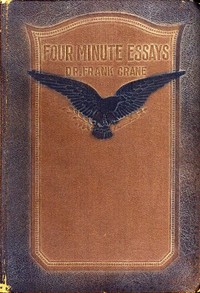
Four Minute Essays, Volume X — Reading Companion
(0 User reviews)
1132
Project Gutenberg
2020
Not confirmed
American essays -- 20th century
Readers of public-domain and historical texts
Project Gutenberg digital edition
en
Edition facts
Words
23,351
Reading time
102 min
Text sections
4
Before opening Four Minute Essays, Volume X — Reading Companion, the edition data offers a quick orientation: 23,351 words, 1 hr 42 min estimated reading time, and 4 detected text sections.
The text analysis averages about 19.3 words per sentence, while the detected sections provide another way to judge how the source is divided.
Project Gutenberg metadata also associates the work with “American essays -- 20th century,” connecting these edition facts with the source record’s subject description.
Source:
Project Gutenberg record #61152
Frank Crane's tenth volume of brief essays contrasts human resilience in suffering with petty annoyances, using vivid metaphors like 'human flies' and advocating for rest as essential to productivity.
Editorial Edition Score
4.6/5
★★★★★
★★★★★
Calculated from edition completeness, EPUB availability, text structure and catalogue metadata. Not a user rating.
How this score is calculated
- Description quality20 pts
- Title & short description10 pts
- Source metadata20 pts
- Text length15 pts
- Chapters / structure15 pts
- EPUB file integrity20 pts
Total of 100 points, scaled to a 2.5-5.0 range. Editions with an empty description or a missing EPUB file are not scored.
Edition quality
Read the Text
es, where men were the victims of the gods.
War is the colossal force of an ideal, patriotism, where the check of the humanities has been entirely cut off.
It is supposed to ennoble men and states. It has always been the preferred occupation of the noble class, kings and courtiers, because the contempt of personal feelings and the merciless sacrifice of the humanities have seemed grand and royal.
But by and by war must yield to the eternal humanities. Sheer human sympathies will abolish it.
The humanities are peculiarly of the common people. Therefore they find expression and come into political effect quickly in democracies. In the United States, for instance, the rule of a religious party or the program of patriotic militarism is impossible. We have too much red passion to permit the ascendency of white passions.
“Uncle Tom’s Cabin,” a book of red passion, sympathy for the negro, overthrew the “white” ideals of the slave oligarchy.
The cry of a starving mother, the protest of wronged workmen, can defeat the apparently resistless power of massed capital.
One drop of blood outweighs the most splendid scheme of the theorist.
The history of the world is the unceasing struggle of the humanities against great ideals which, crystallized into institutions, have become inhuman.
Precedent is solidified experience. In the realm of ideas it is canned goods.
It is very useful when fresh ideas are not to be had.
There are advantages in doing things just because they always have been done. You know what will happen. When you do new things you do not know what will happen.
Success implies not only sound reasoning, but also the variable factor of how a thing will work, which is found out only by trying it.
Hence, the surest road to success is to use a mixture of precedent and initiative. Just how much of each you will require is a matter for your judgment.
To go entirely by precedent you become a mossback. You are safe, as a setting hen or a hiving bee is safe. Each succeeding generation acts the same way. There is a level of efficiency, but no progress.
Boards, trustees, and institutions lay great stress upon precedent, as they fear responsibility. To do as our predecessors did shifts the burden of blame a bit from our shoulders.
The precedent is the haven of refuge for them that fear to decide.
Courts of law follow precedent, on the general theory that experience is more just than individual decision.
Precedent, however, tends to carry forward the ignorance and injustice of the past.
Mankind is constantly learning, getting new views of truth, seeing new values in social justice. Precedent clogs this advance. It fixes and perpetuates the wrongs of man as much as the rights of man.
Hence, while the many must trust to precedent, a few must always endeavor to break it, to make way for juster conclusions.
Precedent is the root, independent thinking is the branch of the human tree. Our decisions must conform to the sum of human experience, yet there must be also the fresh green leaf of present intelligence.
We cannot cut the root of the tree and expect it to live, neither can we lop off all the leafage of the tree and expect it to live.
The great jurist, such as Marshall, is one who not only knows what the law is, but what the law ought to be. That is, to his knowledge of precedent he adds his vision of right under present conditions.
Precedent is often the inertia of monstrous iniquity. War, for instance, is due to the evil custom of nations who go on in the habit of war-preparedness. The problem of the twentieth century is to batter down this precedent by the blows of reason, to overturn it by an upheaval of humanity.
Evil precedent also lurks in social conditions, in business, and in all relations of human rights. The past constantly operates to enslave the present.
We must correct the errors of our fathers if we would enable our children to correct ours.
Our reverence for the past must be continually qualified by our reverence for the future.
We are on our way to the Golden Age. The momentum of what has been must be supplemented by the steam of original conviction, and guided by the intelligence and courage of the present.
THERE IS NO LABORING CLASS
Frank Crane's Four Minute Essays, Volume X (1919) opens with a striking paradox: that humanity's finest qualities emerge under crushing adversity. In 'The Unconquerable,' he describes a paralyzed young man whose cheerfulness inspires others, arguing that the sickroom often becomes a family's spiritual center. Crane contrasts this with the bitterness found in houses of luxury, asserting that the world depends more on its 'blind, deaf, hunchbacked, and bedridden' than on its war lords and millionaires. This tension between material success and inner strength sets the tone for a collection that repeatedly questions conventional measures of value.
The Metaphor of the Human Fly
Crane devotes an entire essay to 'Human Flies,' a term he uses for people who specialize in petty annoyance. He catalogs them with dry humor: office flies who occupy your chair and buzz about trivial subjects, meeting flies who 'deblatterate' and keep the majority waiting, and even fly preachers whose only message is diatribe. The taxonomy extends to fly school-teachers, fly pupils, fly beggars, and fly neighbors. Crane's recurring image is that of a fly that cannot be swatted—polite society forbids kicking them out, poisoning them, or shooting them. He notes that the devil's name, Beelzebub, means 'Lord of Flies,' implying a cosmic dimension to these irritations. The essay's structure—a list of types followed by a punchline—mirrors the cumulative frustration such figures cause.
Productivity Through Rest
In 'Keep Fit,' Crane directly challenges the maxim 'Keeping everlastingly at it brings success,' calling it a 'lying motto' that leads to poor results and exhaustion. He cites Henry Ford's testimony that eight-hour days yield better work than ten, and argues that rest and recreation are the 'best parts of labor.' Crane advises readers to 'stay abed all day occasionally' and 'learn to be lazy,' claiming that the force of a blow depends on the height from which the hammer is lifted. He warns against artificial stimulants, quoting Stephen Crane's division of literature into 'whisky and opium' as a caution. The essay's blunt tone—'spare time ought to be wasted, not improved'—reflects a pragmatic, almost contrarian view of efficiency that recurs throughout the volume.
Contrasts in Human Worth
Across multiple essays, Crane sets up binary oppositions to probe what society truly values. In 'The Unconquerable,' the wealthy are 'bitter, bored, and snarling' while the afflicted radiate optimism. In 'Human Flies,' productive people are contrasted with those who 'never do anything' but annoy. Crane's method is to invert expected hierarchies: the weak become essential, the strong become dispensable. He writes that the world 'could get along without its war lords, millionaires, and big men' better than without its invalids. This pattern of reversal—where suffering confers value and success breeds hardness—is the collection's central argument. Crane does not soften the paradox; he states it bluntly, leaving readers to reconcile the tension between his praise of the crippled and his own evident vigor.
Crane's essays, each designed to be read in four minutes, rely on sharp contrasts and memorable metaphors rather than sustained argument. Readers will find that the volume's power lies not in systematic philosophy but in its ability to crystallize a single observation—whether about flies, rest, or the unconquerable spirit—into a compact, provocative form. The essays reward those who read them sequentially, as themes of resilience and irritation echo and build across the collection.
That gray afternoon, Crane’s “human flies” made me think of my own tiny irritations, buzzing around what truly ached. I set the book down, restless, and my hand found another volume instead—something quieter about what we choose to notice. The Pleasures of Ignorance — Context and Discussion felt like turning the page on that same thought, unhurried and wholly unbothered.
There are no reviews for this eBook.
There are no comments for this eBook.
Reader reflection
How will you remember this book?
Save your reaction, strongest insight, and memorable passage.
Your progress
0
/
10
2
How much did you enjoy the reading experience?
3
Would you recommend this book to another reader?
4
How easy was the book to follow?
5
What was its emotional impact?
6
How useful were the ideas in this book?
7
Did any part of the book feel personally relevant?
8
How would you describe its reading pace?
9
What is the main idea you are taking away?
10