1

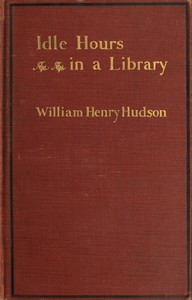
Idle Hours in a Library — Reading Companion
(0 User reviews)
1462
Project Gutenberg
2018
Not confirmed
London (England) -- Social life and customs; English literature -- History and criticism; Pepys, Samuel, 1633-1703; Shakespeare, William, 1564-1616 -- Contemporary England; Behn, Aphra, 1640-1689; Manley, Mrs. (Mary de la Rivière), 1663-1724; Murger, Henri, 1822-1861. Scènes de la vie de Bohême
Readers of public-domain and historical texts
Project Gutenberg digital edition
en
Edition facts
Words
54,240
Reading time
236 min
Text sections
11
The source record for Idle Hours in a Library — Reading Companion measures this digital text at 54,240 words, 3 hr 56 min estimated reading time, and 11 detected text sections.
The text analysis averages about 31.2 words per sentence, while the detected sections provide another way to judge how the source is divided.
Project Gutenberg metadata also associates the work with “London (England) -- Social life and customs,” connecting these edition facts with the source record’s subject description.
Source:
Project Gutenberg record #56659
Hudson's essays on Pepys, Shakespeare's London, Restoration novelists, and Bohemian life, written in a conversational, unacademic style that reflects his 'quiet but rather aimless browsing among books.'
Editorial Edition Score
4.8/5
★★★★★
★★★★★
Calculated from edition completeness, EPUB availability, text structure and catalogue metadata. Not a user rating.
How this score is calculated
- Description quality20 pts
- Title & short description10 pts
- Source metadata20 pts
- Text length15 pts
- Chapters / structure15 pts
- EPUB file integrity20 pts
Total of 100 points, scaled to a 2.5-5.0 range. Editions with an empty description or a missing EPUB file are not scored.
Edition quality
Read the Text
eth all the cities of the world; insomuch that it may be called the storehouse or mart of all Europe.” Yet we are most of us probably unable without much effort to realize how different was the English metropolis of Elizabeth’s time from the metropolis of the present day.
We have to remember, in the first place, that the London with which we are now concerned was a walled city, and that the territory which lay within the walls,—that is, the metropolis proper,—represented but a very small portion of what is now included within the civic area. Newgate, Ludgate, Aldgate, Bishopsgate, Cripplegate, and Aldersgate, still mark out and perpetuate by their names the narrow lines of those protecting walls which held snug and secure the mere handful of folk of which London was then composed. At nine o’clock in the evening, when Bow-bell rang, and the voices of the other city churches took up the curfew-strain, the gates were shut for the night, and the citizens retired to their dwellings under the protection of armed watchmen who guarded their slumbers along the walls. Westward from Fleet Street and Holborn, beyond which so much of modern London lies, the city had not then penetrated.
Within and about the walls there were many “fair churches for divine service,” with old St. Paul’s in their midst—the Gothic St. Paul’s of the days before the great fire; and many prisons to help the churches in their philanthropic work. Open spaces were very numerous; trees were everywhere to be seen; fields invaded the most sacred strongholds of commercial activity; conduits and brooks (whereof Lamb’s Conduit Street to-day carries a nominal reminiscence) flowed through every part of the town. The narrow, straggling streets ran hither and thither with no very marked definity of aim; for county councils had not as yet come into existence, and metropolitan improvements were still hidden in the womb of time; and so unsanitary were the general conditions that they were seldom free from epidemic disease. Cheap, with its old cross just opposite the entrance to Wood Street, was a famous spot for trading of all kinds; but there were other localities which had their specialized activities. St. Paul’s, for instance, was the acknowledged quarter for booksellers, as indeed it has continued to be down to the present time. Houndsditch, like the Houndsditch of to-day, and Long Lane in Smithfield, abounded in shops for second-hand clothing—_fripperies_, as they were called. “He shows like a walking frippery,” says one of the characters in “The City Madam”; while it was in the latter place that Mistress Birdlime in “Westward Ho” speaks of “hiring three liveries.” In St. Martin’s-le-Grand clustered the foreign handicraftsmen of doubtful character, who manufactured copper lace and imitation jewellery; and Watling Street and Birchin Lane were the haunts of the tailors. Then, again, it was in Bucklersbury that the grocers and druggists most did congregate. “Go to Bucklersbury and fetch me two ounces of preserved melons,” says Mistress Tenterhook in “Westward Ho.” Fleet Lane and Pie Corner were so famous for their cook-shops that Anne in “The City Madam” might well exclaim, when the porters enter with their baskets of provisions, that they smell unmistakably of these localities; while to Panyer Alley repaired all true lovers of tripe. Even religious opinions had their special homes. Bloomsbury and Drury Lane, for example, were favorite haunts of Catholics; and the Puritans were particularly strong in Blackfriars. This explains the words put by Webster into the mouth of one of his characters: “We are as pure about the heart as if we dwelt amongst ’em in Blackfriars,” and Doll Common’s description of Face, in “The Alchemist,” as—
“A rascal, upstart, apocryphal captain, Whom not a Puritan in Blackfriars will trust.”
William Henry Hudson, a professor of English Literature at Stanford, opens his collection with a disarmingly modest preface. He describes the essays as 'holiday tasks' and 'the results of many hours of quiet but rather aimless browsing among books,' explicitly distancing them from 'special investigations' or 'definite scholastic ends.' This framing sets the tone for a volume that values personal enjoyment over academic rigor. Hudson’s voice is that of a genial guide, not a pedant; he hopes his essays 'may renew for some readers the charm of old associations' or send others 'for the first time to the works themselves.' The title Idle Hours in a Library is thus both descriptive and deliberately understated, inviting the reader into a space of leisurely intellectual discovery.
A Conversational Voice and Unacademic Intent
Hudson’s prose is notably free of the jargon and dense citation typical of late-nineteenth-century literary scholarship. He writes in the preface that the essays are 'completely unacademic in style and intention,' a claim borne out by the excerpts. His sentences are long but clear, and he often addresses the reader directly with phrases like 'Suffice it for us now to remark.' He is not afraid to offer personal judgments: he calls the Restoration dramatists’ plays 'little more than the passing amusement of the idle and demoralized fashionable world' and dismisses the works of Mrs. Behn and Mrs. Manley as 'lucubrations' that most readers would be 'quite as well off if they leave... alone.' Such candid opinions, delivered without footnotes or hedging, give the essays the feel of a conversation with a well-read friend rather than a formal lecture.
Shifts in Pace: From Browsing to Argument
The pace of Hudson’s writing changes markedly between sections. In the preface, he moves slowly, savoring the metaphor of 'aimless browsing.' But when he turns to literary history—for instance, in his account of the decline of drama and the rise of the novel—his sentences become more compressed and argumentative. He writes of 'the causes which combined to bring about the decline of the drama and the rise of the modern novel' as 'varied in character and intricate in their outworkings,' then abruptly declares that 'the change is not to be regarded as a mere matter of shifting literary taste.' This acceleration from reflective to assertive prose mirrors the shift from idle reading to critical analysis. Hudson also varies his pace by inserting brief, vivid images: the theatre of Shakespeare is 'the flower and fruitage of a period of intense national vigor,' while Restoration drama is 'sapped at its foundations.' Such metaphors act as resting points within denser paragraphs.
Recurring Details: The Library as a Physical and Mental Space
Throughout the excerpts, Hudson returns to the idea of the library as a place of both physical books and mental exploration. He mentions 'library shelves' and 'London bookstalls' as concrete locations where literary history unfolds. The phrase 'upon our library shelves' appears in the discussion of the novel’s rise, linking the abstract growth of a genre to the tangible presence of books. Hudson also uses spatial language to describe his own method: he 'jot[s] down' references and allusions as he 'light[s] upon them,' and he speaks of having 'gathered a good deal of miscellaneous material.' This language of collection and arrangement mirrors the librarian’s or collector’s impulse. Even his critical judgments are framed spatially: the Restoration drama 'lack[s] that breadth of horizon' that would give it 'permanent value.' The library, for Hudson, is not just a setting but a way of thinking—a place where one can move from idle browsing to focused argument and back again.
Hudson’s essays reward a reader who is willing to follow his digressions. He does not provide a systematic survey of his topics; instead, he offers a series of personal, sometimes opinionated reflections. To get the most from Idle Hours in a Library, read it as Hudson wrote it—leisurely, with time to pause over his judgments and to follow up on the books he mentions. His voice is that of a companionable scholar, and his aim is not to instruct but to share the pleasure he has found in his reading.
I found myself drifting back to Hudson’s gentle, unhurried browsing—his quiet fondness for the odd corners of literary London—and somehow that led me to Thomas Hood, whose playful melancholy feels like the same warm lamplight. There’s a comfort in these forgotten voices, a sense of sitting beside them. The Works of Thomas Hood; Vol. 02 (of 11) Comic and Serious, in Prose and Verse, With All the Original Illustrations — Inside the Classic holds that same unassuming charm, waiting quietly on the shelf.
There are no reviews for this eBook.
There are no comments for this eBook.
Reader reflection
Record your reading impressions
A brief reflection can help important ideas stay with you longer.
Your progress
0
/
10
2
Did this book hold your interest?
3
Is this a title you would suggest to others?
4
How demanding did the text feel?
5
Did the book give you something worth debating?
6
How strongly did the book affect you emotionally?
7
Which aspect of the book did you value most?
8
Did any part of the book feel personally relevant?
9
What did this book teach you most?
10