1

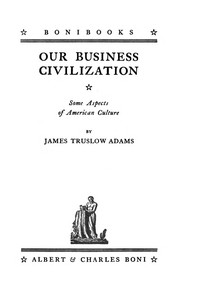
Our business civilization — Edition Insights
(0 User reviews)
129
Project Gutenberg
2025
Not confirmed
National characteristics, American; United States -- Civilization -- 1918-1945; United States -- Social conditions -- 1918-1932
Readers of public-domain and historical texts
Project Gutenberg digital edition
en
Edition facts
Words
82,625
Reading time
360 min
Text sections
18
This digital edition of Our business civilization — Edition Insights is described by source-level measurements including 82,625 words, 6 hr estimated reading time, and 18 detected text sections.
The text analysis averages about 26.5 words per sentence, while the detected sections provide another way to judge how the source is divided.
Project Gutenberg metadata also associates the work with “National characteristics, American,” connecting these edition facts with the source record’s subject description.
Source:
Project Gutenberg record #76007
James Truslow Adams dissects 1920s American culture through essays on business dominance, education, law, and the tension between 'being' and 'doing.' Drawing on letters, historical figures, and contemporary events, he argues that commercial values corrode intellectual life and civic virtue. A pointed, essayistic critique from a historian who helped popularize the term 'American Dream.'
Editorial Edition Score
4.8/5
★★★★★
★★★★★
Calculated from edition completeness, EPUB availability, text structure and catalogue metadata. Not a user rating.
How this score is calculated
- Description quality20 pts
- Title & short description10 pts
- Source metadata20 pts
- Text length15 pts
- Chapters / structure15 pts
- EPUB file integrity20 pts
Total of 100 points, scaled to a 2.5-5.0 range. Editions with an empty description or a missing EPUB file are not scored.
Edition quality
Read the Text
me social grade, or fifteen times the old cost, whereas the ordinary income has less than trebled.
The increased cost of living from these and other causes is having marked effects. It is, for one thing, largely destroying the old idea of thrift and saving in the classes with which we are here concerned. In the first place, there is the natural human desire to possess many of the new things available for their own sakes, and often because Mrs. Jones has them, and they belong to the new standard. But there are more insidious forces at work. Mass-production requires an enormous and steady output to be profitable. There is a saturation point for nearly every article. Fresh vegetables are eaten up in a day or two, but clothes or cars may last several years. There is no reason why many of the mechanical contrivances we buy should not in themselves last many years. From the standpoint of the producer there is always the danger that the consumer may have enough of any particular article unless he is made to want more. This is accomplished in several ways in the technic which has been developed by psychologically trained sales experts. The consumer is cleverly induced to want an article that he had thought he could do without or could not afford. If he has already owned one, as an automobile, the slogan becomes that every self-respecting family should have two. The model is changed every year and social vanity is played upon; or an appeal is made to the powerful motives of fear, shame, and pride. In selling many of the mechanical contrivances a more brutal method is employed. Manufacturers stop making essential parts so as to require the owner to buy an entirely new and perhaps only slightly altered model. Some years ago, for instance, I bought at a cost of $450 a certain instrument. It was good for a lifetime. I added steadily, as I could afford it, to the things that were to be used with it, and without which it was useless, until the whole investment was over $800. One day when I went to get more, I was told they no longer made anything for that “model,” I would have to get another and, of course, with a condescending tone that was almost a sneer, “I must want to have the latest.” The new model, differing only slightly from the old, cost, the salesman told me, as though it were a trifle, $750. To accumulate the same things to go with it that I had for the old would cost about $400 more. My old investment was rendered worthless, and the salesman made it evident that he had no interest in a person so cheap that he would not casually throw away $800 and spend $1,000 more on a toy. His company did not have the least glimmer of an idea of responsibility toward a public out of which it had made its money and which had made, in the aggregate, a colossal investment in its instruments. When other methods fail and you really have no money, the advantages of the partial payment plan are glowingly placed before you.
Again, we are told by leaders of the world of mass-production that thrift is out of date. One of the greatest manufacturers in the country recently wrote that “use” not “saving” should govern our ideas with respect to our national and other resources. In another remarkable pronouncement, this man, who is an idol of a large part of the people, said that no boy had ever succeeded or would succeed who saved money when he was young. Another leader writes that “one reason for America’s prosperity and one reason, in my opinion, why that prosperity will continue, is that we have committed ourselves to a standard of living far beyond our wildest pre-war dreams.... We cannot make good except by producing more wealth, and always a little ahead of us is advertising with its alluring images of still other good things that work will buy. Americans have passed out of the period where they care about petty economies. They want convenience. They want action. They want comfort and style. It is impossible to call Americans back to petty thrift, and I personally am glad of it.... I live now in New York where everybody expects to be overcharged and where nobody counts the dimes, much less the pennies.... We have ceased to count our pennies in America, and I certainly hope we never return to the days of the most graceless of all virtues, a niggardly and penny-pinching thrift.”
James Truslow Adams opens his preface with a defensive metaphor: a doctor who diagnoses a patient’s bad circulation and infected leg is not obliged to praise the patient’s good qualities. The analogy sets the tone for a collection that deliberately dwells on what Adams calls the “more sinister” aspects of American culture in the late 1920s. The essays, originally published in Harper’s Monthly, the Atlantic Monthly, and other magazines, have been revised and expanded for this volume. Adams warns readers not to expect a balanced survey; he is, as he puts it, “talking about prunes and cucumbers, not strawberries.”
A Doctor’s Diagnosis of the 1920s
Adams frames his project as a clinical examination rather than a comprehensive portrait. In the preface, he insists that criticism of his essays—that they ignore America’s virtues—misses the point: he has chosen to examine specific ailments. This rhetorical strategy recurs throughout the book. In Chapter I, “A Business Man’s Civilization,” he argues that business values have come to dominate not only the economy but also education, politics, and personal ideals. He contrasts this with earlier American figures like Jefferson, who valued learning and civic participation over commercial gain. Adams’s prose is direct and often sardonic, as when he notes that the “easy logic” of public schooling now operates “for the benefit of the unintelligent and not the intelligent.”
The Cost of Prosperity and Dissolving Ethics
Two chapters, “The Cost of Prosperity” and “Our Dissolving Ethics,” examine the moral and social price of the decade’s economic boom. Adams draws on specific evidence: a letter from a mother describing how her gifted daughter was stifled by a rigid, exam-driven rural school system. The mother’s account—the child reading Emerson at six, then losing interest under a “teacher unfitted for her work”—serves as a case study for Adams’s broader claim that mass education crushes intellectual curiosity. He also critiques the “cram before the examination” mentality, linking it to a culture that values measurable outcomes over genuine learning. In “Our Dissolving Ethics,” he traces how traditional moral codes have weakened under commercial pressures, though the excerpt does not reveal his full argument.
Jefferson, Hamilton, and the Lawless Heritage
Adams turns to political history in “Jefferson and Hamilton Today” and “Our Lawless Heritage.” He contrasts Jefferson’s ideal of an educated, independent citizenry with Hamilton’s vision of a centralized commercial republic, arguing that the latter has triumphed in the 1920s. The chapter “Our Lawless Heritage” suggests that American individualism has a dark side: a disregard for law that Adams sees as rooted in the nation’s frontier past. He does not celebrate this heritage but warns that it undermines social trust. The excerpts do not include his treatment of President Hoover in “Hoover and Law Observance,” but the table of contents indicates a sustained concern with the gap between legal ideals and actual behavior.
To “Be” or to “Do”: The Mucker Pose and Intellectual Production
Chapter VII, “To ‘Be’ or to ‘Do’,” poses a central dichotomy: American culture prizes action and achievement (“doing”) over reflection and character (“being”). Adams sees this imbalance as a threat to the “art of living,” the title of his final chapter. In “Mass Production and Intellectual Production,” he extends the critique to the realm of ideas, arguing that the same assembly-line logic that produces cars now threatens to standardize thought. “The Mucker Pose” (Chapter IX) attacks a perceived anti-intellectualism in American life—a willful coarseness that Adams labels “muckerism.” The term, now dated, reflects his concern that intellectual and artistic pursuits are dismissed as unmanly or elitist. Throughout, Adams relies on contrast: between past and present, Europe and America, the reflective life and the busy one.
Adams’s essays are best read as period documents that reveal the anxieties of an educated elite in the Jazz Age. His targets—commercialism, anti-intellectualism, educational standardization—will be familiar to readers of later cultural critics, but his voice is distinctive: blunt, anecdotal, and unafraid of unpopular positions. The book’s structure, moving from economic critique to moral diagnosis to historical analysis, rewards sequential reading. Readers should note that Adams explicitly limits his scope; the volume is a polemic, not a balanced account, and its value lies in the sharpness of its attack rather than in comprehensiveness.
Reading about how business seeped into every corner of Adams's America, I remembered sitting with my grandfather, who had dog-eared a copy of Thoughts Suggested by Mr. Froude's "Progress" — Reading Notes. He kept saying the same thing: that we had traded satisfaction for mere motion. Both books felt like someone quietly pressing a hand against your chest, asking if you were still there.
There are no reviews for this eBook.
There are no comments for this eBook.
Reader reflection
What did you think of this book?
Answer a few questions and save a private reflection on this device.
Your progress
0
/
10
2
How much did you enjoy the reading experience?
3
Would you pass this book on to a friend?
4
How easy was the book to follow?
5
What did you appreciate most?
6
How strong was your personal connection to the text?
7
How would you rate its originality?
8
Would a second reading be valuable?
9
In one sentence, what did you learn?
10