1

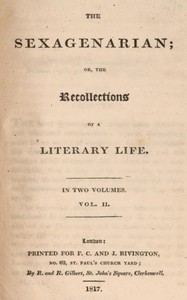
The sexagenarian; or, the recollections of a literary life (Volume 2 of 2) — Reading Notes
(0 User reviews)
635
Project Gutenberg
2023
Not confirmed
Authors, English; Beloe, William, 1756-1817; English literature -- Anecdotes
Readers of public-domain and historical texts
Project Gutenberg digital edition
en
Edition facts
Words
72,825
Reading time
317 min
Text sections
50
This digital edition of The sexagenarian; or, the recollections of a literary life (Volume 2 of 2) — Reading Notes is described by source-level measurements including 72,825 words, 5 hr 17 min estimated reading time, and 50 detected text sections.
The text analysis averages about 24.3 words per sentence, while the detected sections provide another way to judge how the source is divided.
Project Gutenberg metadata also associates the work with “Authors, English,” connecting these edition facts with the source record’s subject description.
Source:
Project Gutenberg record #72214
William Beloe's second volume of literary recollections offers character sketches of clergymen, bankers, and scholars, marked by sharp diction and ironic asides. The author's editorial choices—such as withholding names, embedding Latin mottoes, and juxtaposing rise-and-fall narratives—reveal a wry, moralizing voice that treats biography as a form of judgment.
Editorial Edition Score
4.8/5
★★★★★
★★★★★
Calculated from edition completeness, EPUB availability, text structure and catalogue metadata. Not a user rating.
How this score is calculated
- Description quality20 pts
- Title & short description10 pts
- Source metadata20 pts
- Text length15 pts
- Chapters / structure15 pts
- EPUB file integrity20 pts
Total of 100 points, scaled to a 2.5-5.0 range. Editions with an empty description or a missing EPUB file are not scored.
Edition quality
Read the Text
The next personage of whom some detached and mutilated memorandums present themselves, must be an object of conjecture, but the peculiarities concerning him are very striking, and the changes of his character and conduct so very considerable, that it may not be unamusing to some readers, to look back on the last twenty-five years, and endeavour to discover to whom they will apply.
The individual alluded to in our Manuscript, is mentioned as having been educated in the principles of the Dissenters, and to have officiated in earlier life as a clerk in some manufactory, or with some merchant, at Liverpool. It may be questioned, whether he ever entirely got rid of his former prejudices, but on some occasion or other, he chose to offer himself to the Bishop of Landaff as a candidate for orders. By him he was ordained, and he rendered himself so acceptable to the Bishop, that he made him his Chaplain. Preferment he had none to give him, at least no opportunity of making provision for his Chaplain presented itself, and the subject of this article was for a long series of years confined to a scanty income, obtained from laborious curacies, and from the not much more tolerable labour of pen-drudgery for booksellers.
With his entrance into holy orders, the spirit of orthodoxy and loyalty did not immediately accompany him. His more intimate associates were still those, who, on all occasions, avowed and practised hostility to the Established Church, and friendship for French principles; and he so far forgot himself, that for a time, at least, he was an active member of the famous, or rather infamous, Corresponding Society. His very particular friends were Mr. Stone, Helen Maria Williams, Mr. Holcroft, Mrs. Wolstoncroft, Dr. Priestley, Dr. Kippis—_et id genus omne_.
In this interval he published sermons, which were well received, some essays, rather heavy, but which indicated powers of thinking. He translated a very popular theological work, and this with so much success, that it introduced him to the notice of an excellent and venerable prelate, who has before been named, and who always eagerly sought opportunities of distinguishing and rewarding literary exertions, particularly such as promised to be useful to the Church.
Our gentleman had then the discretion to withdraw his name from the above-mentioned society, and demonstrated a little more circumspection, with respect to those with whom he associated. He however married a rigid Dissenter, to whom he eventually owed the prosperity, which attended his close of life.
By a concurrent series of fortunate circumstances, he was finally introduced to the Premier, and employed by him in some confidential services. The consequence of this was preferment so considerable as to secure a perfect independence.
His publications were very numerous, and he had obtained a sort of name among publishers, which occasioned many manuscripts of authors to be confided to him for revision and correction. Among others, he superintended the very popular work by Colonel Drinkwater, on the siege of Gibraltar. It is, however, to be apprehended, that he sometimes allowed his name to be prefixed, when he had not a great deal to do with the substance and body of the work.
And so much for Dr. ⸺.
His primum studium est ciere risum Ex re qualibet, et leves cachinnos Movere, et recitatione ficti Lingas nobilium excitare laudes. Norunt scommatibus placere salsis Et mordacibus irritare dictis Si quem simplicioribus notarunt Vitæ moribus esse, et institutis Aptant denique, punctum ad omne, frontem.
The vicissitudes of fortune, of principles, and of conduct, which characterised the individual above introduced, not improbably brought to the recollection of the Sexagenarian, another personage of still more eccentric and contradictory qualities. For immediately succeeding the above sketch, after the erasure of some lines, in which occur the words _inconsistency_, _unprincipled_, _uncommonly good luck_, we find the following observations:—
I have often regretted that on leaving his society, I did not constantly write down the good things said by JOHN WILKES. I transcribe from memory these few particulars concerning him, and I may perhaps hereafter increase the catalogue.
He was really a sad dog, but most delightfully amusing, facetious, witty, well-informed, and with much various, though not profound learning.
He was sometimes so intolerably sarcastic, and more particularly at the expence of his friends in the city, that the wonder is, how he could so long continue in their good graces. He never put any restraint upon himself, when in company, on the other side of Temple-bar, but indulged in all the satire of his wit, at the citizen’s expence. A few examples, among a hundred that could easily be given, may suffice.
Beloe opens this volume with a deliberately veiled portrait, introducing a figure through 'detached and mutilated memorandums' that challenge the reader to identify him. The author's diction—'object of conjecture,' 'very striking' peculiarities—signals a game of recognition, while the phrase 'it may not be unamusing to some readers' frames the anecdote as a shared puzzle. This coyness recurs throughout the work, as Beloe often withholds names or supplies only initials, forcing the reader to rely on contextual clues from the late eighteenth-century literary and clerical world.
Veiled Portraits and the Reader's Role
Beloe's method of introducing subjects without naming them is a deliberate structural choice. In the first chapter, he describes a man educated among Dissenters, later ordained by the Bishop of Landaff, who 'rendered himself so acceptable' as to become chaplain. The reader must piece together identity from hints: Liverpool commerce, the Corresponding Society, friendships with Helen Maria Williams and Mary Wollstonecraft. This technique transforms the memoir into a kind of literary detective work, rewarding those familiar with the period's figures while excluding the uninitiated.
The author's phrasing—'it may be questioned whether he ever entirely got rid of his former prejudices'—maintains a tone of skeptical appraisal. Beloe does not simply narrate; he judges, leaving room for ambiguity. The effect is a portrait gallery where each subject is both revealed and withheld, their moral standing implied through the slant of Beloe's prose.
The Motto as Moral: A Banker's Rise and Fall
One of the volume's most vivid episodes concerns a banker who, upon acquiring wealth, commissions a motto for his carriage. The parish parson supplies 'Quo mihi fortunam?'—'Why fortune to me?'—a phrase Beloe calls 'remarkable for the seeming spirit of prophecy.' When the banker's half-learned friends question the Latin, the parson retorts: 'Friend Roger, do you support your carriage, and I'll support the motto.' The banker's eventual failure, with debts of £600,000 and only £25,000 in notes, gives the anecdote a retrospective irony Beloe clearly savors.
The author's word choice—'whimsical anecdote,' 'eccentric character,' 'facetiousness and humour'—frames the clergyman as a wry moralist. The motto survives, the coach is gone: Beloe uses this emblem to condense a narrative of hubris and collapse. The banker's story is not merely reported but shaped into a parable, with the motto serving as a punchline that also delivers a judgment on worldly ambition.
Ecclesiastical Ascent: Merit or Patronage?
Beloe presents two clergymen as 'fortunate,' but his account of their rise is laced with ambiguity. The first, a humble Oxford student who becomes a curate, catches the eye of a nobleman who 'had the sagacity to distinguish merit, and, as it appeared from the consequences, had, also the liberality to assist and reward it.' The cautious phrasing—'as it appeared'—hints at skepticism. The curate's advancement from living to prebendal stall to deanery is described as a chain of preferments, each step enabled by the same patron.
Beloe insists that this was 'not the mere result of noble and powerful influence,' citing 'private virtues' and 'profound erudition.' Yet the structure of the sentence—a denial followed by a list of qualifications—leaves the reader wondering. The author's editorial hand is visible in this balancing act: he wants to praise merit while acknowledging the machinery of patronage that made such careers possible. The result is a portrait that feels both admiring and wary.
Diction and the Art of Implied Judgment
Throughout the volume, Beloe's word choices carry evaluative weight. He describes a subject's associates as 'et id genus omne'—'and all that sort'—a Latin tag that dismisses an entire circle with scholarly contempt. A man's sermons are 'well received,' his essays 'rather heavy, but which indicated powers of thinking.' The qualifier 'rather' undercuts the praise, while 'indicated' suggests potential rather than achievement. Such micro-judgments accumulate, building a portrait of the author as a discerning, slightly acerbic observer.
Beloe also uses contrast to imply character. The banker's 'half-learned friends' are set against the parson's genuine learning; the curate's 'humble curacy' is juxtaposed with his eventual bishopric. These oppositions are not merely descriptive but moral, aligning learning and humility with worth, and pretension with downfall. The reader is guided not by explicit verdicts but by the slant of Beloe's syntax and vocabulary.
Beloe's recollections reward a reader attentive to the spaces between his words—the withheld names, the Latin asides, the carefully hedged praise. This is not a straightforward memoir but a series of character studies shaped by a narrator who delights in implication. To read it well is to watch for the motto that outlasts the coach, the 'rather heavy' essay that hints at unfulfilled promise, and the friendships that damn by association. The pleasure lies in deciphering the judgments Beloe leaves half-said.
There’s something tender in how Beloe recalls old men with their quirks and quiet failings—he judges them, sure, but never without a strange affection. I kept thinking of that while reading The Works of Thomas Hood; Vol. 01 (of 11) Comic and Serious, in Prose and Verse, With All the Original Illustrations — Themes and Context, where the wryness feels like a hand on your shoulder, not a verdict. Both books stayed with me like a half-remembered laugh.
There are no reviews for this eBook.
There are no comments for this eBook.
Reader reflection
What did you think of this book?
Answer a few questions and save a private reflection on this device.
Your progress
0
/
10
2
How did the book work for you overall?
3
Would you pass this book on to a friend?
4
Did the language feel accessible?
5
Would you like to discuss this book with someone?
6
Could you follow the author’s main argument?
7
How did the pace of the book feel?
8
What was the strongest part of the book?
9
Which lesson or insight stayed with you?
10