1

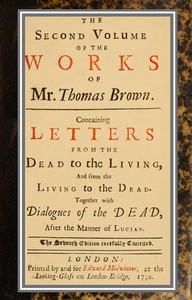
The works of Mr. Thomas Brown, serious and comical : in prose and verse, with his remains in four volumes compleat; vol. II — Themes and Context
(0 User reviews)
2696
Project Gutenberg
2022
Not confirmed
Erotic literature -- Early works to 1800; English wit and humor -- Early works to 1800; Latin literature -- Translations into English
Readers of public-domain and historical texts
Project Gutenberg digital edition
en
Edition facts
Words
137,975
Reading time
600 min
Text sections
15
This digital edition of The works of Mr. Thomas Brown, serious and comical : in prose and verse, with his remains in four volumes compleat; vol. II — Themes and Context is described by source-level measurements including 137,975 words, 10 hr estimated reading time, and 15 detected text sections.
The text analysis averages about 41.3 words per sentence, while the detected sections provide another way to judge how the source is divided.
Project Gutenberg metadata also associates the work with “Erotic literature -- Early works to 1800,” connecting these edition facts with the source record’s subject description.
Source:
Project Gutenberg record #69126
Thomas Brown's second volume collects satirical letters from the dead to the living, dialogues of the dead after Lucian, and verse, blending classical allusion with pointed commentary on Louis XIV, English politics, and literary rivalries.
Editorial Edition Score
4.9/5
★★★★★
★★★★★
Calculated from edition completeness, EPUB availability, text structure and catalogue metadata. Not a user rating.
How this score is calculated
- Description quality20 pts
- Title & short description10 pts
- Source metadata20 pts
- Text length15 pts
- Chapters / structure15 pts
- EPUB file integrity20 pts
Total of 100 points, scaled to a 2.5-5.0 range. Editions with an empty description or a missing EPUB file are not scored.
Edition quality
Read the Text
ack, and no man ever takes notice of it, but does the same thing in his turn: And for sincerity, women have as much: the women grow greater hypocrites than ever, lewder in their chamber practice, and more formal in publick; they rail at the vices they indulge; they forsake publick diversions, as plays, _&c._ to gain the reputation of virtue, to give a greater loose to the domestick diversions of a bottle and gallant; and hypocrisy heightens their pleasures. The mode now is not as of old, in all amorous encounters, every man to his woman, but like nuns in a cloyster, every female has her _privado_ of her own sex; and the honester part of men, must either fall in with the modish vice, or live chastly; to both which I find a great many extreamly averse. There has a terrible enemy arose to the stage, an abdicate divine, who when he had escaped the pillory for sedition, and reforming the state, set up for the reformation of the stage. The event was admirable, fanaticks presented the nonjuror, and misers and extortioners gave him bountiful rewards: one grave citizen, that had found the character too often on the stage, and famous for the ruin of some hundreds of poor under-tradesmen’s families, laid out threescore pounds in the impression, to distribute among the saints, that are zealous for God and mammon at the same time: Bullies and republicans quarrell’d for the _passive obedience_ spark; grave divines extoll’d his wit, and atheists his religion; the fanaticks his honesty, the hypocrite his zeal, and the ladies were of his side, because he was _for submitting to force_. There is yet a greater mischief befall’n the stage; here are societies set up for _reformation of manners_; troops of _informers_, who are maintain’d by perjury, serve God for gain, and ferret out whores for subsistence. This noble society consists of divines of both churches, fanatick as well as orthodox saints and sinners, knights of the post, and knights of the elbow, and they are not more unanimous against immorality in their informations, than for it in their practice; they avoid no sins in themselves, and will suffer none in any one else. The fanaticks, that never preached up morality in their pulpits, or knew it in their dealings, would seem to promote it in the ungodly. The churchmen, that would enjoy the pleasure of sinners, and the reputation of saints, are for punishing whores and drinking in all but themselves. In short, the motive that carries the Popish apostles to the richer continents, makes these gentlemen so busy in our reformation money. Nay, reformation is grown a staple commodity, and the dealers in it are suddenly to be made into a corporation, and their privileges peculiar are to be perjury without punishment, and lying with impunity. The whores have a tax laid on them towards their maintenance, in which they share with captain _W_----, and the justices of the peace; for _New-Prison_ knows them in all their turns, and twenty or thirty shillings gives them a license for whoring, till next pay-day; so that the effect of their punishment only raising the price of the sin, and the vices of the nation maintain the informers. Drinking, swearing and whoring are the manufactures they deal in; for should they stretch their zeal to _cozening, cheating, injury, extortion, oppression, defamation, secret adulteries, and fornication_, and a thousand other of these more crying immoralities, the city would rise against these invaders of their liberties, and the cuckolds one and all, for their own and their wives sakes, rise against the reformers. These worthy gentlemen, for promoting the interest of the _Crown Office_, and some such honest place, pick harmless words out of plays, to indict the players and squeeze twenty pound a week out of them, if they can, for their exposing pride, vanity, hypocrisy, usury, oppression, cheating, and the other darling vices of the master reformers, who owe them a grudge, not to be appeas’d without considerable offerings; for money in these cases wipes off all defects.
This volume opens with a series of letters from the dead to the living, a conceit that allows Thomas Brown to blend classical allusion with pointed contemporary satire. The first letter, purportedly from the comedian Joseph Haines, addresses his friends at Will's Coffee-House, setting a tone of irreverent wit that persists throughout. Brown's method is to inhabit historical and fictional voices—from Hannibal to Scarron, from Julian the Apostate to Nell Gwyn—and use them to critique the powerful, especially Louis XIV, whose policies and flatterers are repeatedly attacked. The excerpts show a writer unafraid of direct accusation: Marcellinus calls Louis's life "one continued series of rapines and murders." The volume also includes dialogues of the dead in the manner of Lucian, and a mix of prose and verse that ranges from bawdy to learned.
Voices from the Dead, Aimed at the Living
The central conceit of this collection is the letter from the dead to the living, a form that Brown uses to grant his speakers a license for frankness. The dead, having no worldly interests to protect, can speak truths that the living dare not utter. Thus, the Roman historian Marcellinus rebukes Boileau for flattering Louis XIV, while the French poet Scarron addresses the king himself with a mixture of deference and irony. The letters are not random; they form a network of accusation and reply. For instance, James II writes to Louis XIV, and the answer comes from a different hand, creating a dialectic. Brown also includes letters from the living to the dead, such as Beau Norton to the Beaux, which extends the satire to contemporary fops and fools. The effect is a kind of shadow parliament, where the deceased hold the living to account.
Satire as Historical Reckoning
Brown's satire is deeply historical, drawing on classical and recent events to score points against his targets. In the letter from Marcellinus to Boileau, the speaker compares Louis XIV unfavorably to Julian the Apostate, accusing the French king of greater cruelty and perfidy. He cites specific grievances: the St. Bartholomew's Day massacre, the support of the Turks, the destruction of images. This is not vague invective but a catalog of charges, each tied to a named event. Similarly, the letter from Catherine de Medici to the Duchess of Orleans invokes the memory of the Wars of Religion. Brown's method is to use the past as a mirror, forcing his readers to see contemporary figures in the light of historical villains. The dialogues of the dead, modeled on Lucian, serve a similar function, allowing figures from different eras to argue across time.
A Mix of Forms and Registers
The volume is heterogeneous in form, containing not only letters and dialogues but also verse, such as "The Mitred Hog" and "Beau Norton to the Beaux." The verse often shifts to a lower register, employing bawdy humor and direct insults. The prose letters, by contrast, can be elevated and learned, full of classical references and rhetorical flourishes. This variety reflects Brown's range as a writer and his willingness to move between high and low styles. The table of contents shows a deliberate ordering, with letters grouped by theme or correspondent. The inclusion of responses—many letters have an "Answer"—creates a sense of debate. Brown also includes pieces that are not strictly letters, such as the dialogue between Charon and Jack Catch, which blends mythology with contemporary crime. This formal diversity keeps the reader off balance, never sure what mode will come next.
Readers approaching this volume should be prepared for a work that demands familiarity with late 17th-century European politics, classical history, and literary rivalries. Brown assumes his audience knows who Boileau, Scarron, and the Duke of Alva are, and he expects them to catch allusions to events like the Powder Plot and the St. Bartholomew's Day massacre. The satire is partisan, aimed at Louis XIV and his court, but also at English targets like the Calves-Head Club. The letters reward slow reading, as each accusation and retort builds a case. Brown's voice is that of a learned provocateur, using the dead as his mouthpieces.
I remember shelving Brown's second volume and smiling at his dead folk, so sharp and chatty in the dark. It feels like the sort of conversation one has with a trusted old friend who knows when to stay quiet. The Invisible Censor — Reading Companion holds that same patient, watchful spirit, a gentle echo of the library hush itself.
There are no reviews for this eBook.
There are no comments for this eBook.
Reader reflection
What did you think of this book?
Answer a few questions and save a private reflection on this device.
Your progress
0
/
10
2
How did the book work for you overall?
3
Would you recommend this book to another reader?
4
Did the language feel accessible?
5
How did the pace of the book feel?
6
Do you expect to return to this book?
7
How clearly were the main ideas presented?
8
Was the book what you thought it would be?
9
In one sentence, what did you learn?
10