1

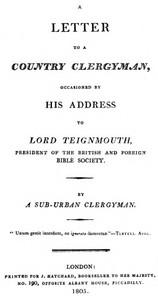
A letter to a country clergyman, occasioned by his address to Lord Teignmouth — Key Ideas to Explore
(0 User reviews)
633
Project Gutenberg
2020
Not confirmed
British and Foreign Bible Society; Teignmouth, John Shore, Baron, 1751-1834; Sikes, Thomas, 1765 or 1766-1834. Address to Lord Teignmouth
Readers of public-domain and historical texts
Project Gutenberg digital edition
en
Edition facts
Words
18,006
Reading time
79 min
Text sections
2
For A letter to a country clergyman, occasioned by his address to Lord Teignmouth — Key Ideas to Explore, the stored edition analysis reports 18,006 words, 1 hr 19 min estimated reading time, and 2 detected text sections.
The text analysis averages about 30.8 words per sentence, while the detected sections provide another way to judge how the source is divided.
Project Gutenberg metadata also associates the work with “British and Foreign Bible Society,” connecting these edition facts with the source record’s subject description.
Source:
Project Gutenberg record #62232
John Owen's 1805 open letter defends the British and Foreign Bible Society against a clergyman's attack, using satire and historical precedent to argue for interdenominational cooperation.
Editorial Edition Score
4.4/5
★★★★★
★★★★★
Calculated from edition completeness, EPUB availability, text structure and catalogue metadata. Not a user rating.
How this score is calculated
- Description quality20 pts
- Title & short description10 pts
- Source metadata20 pts
- Text length15 pts
- Chapters / structure15 pts
- EPUB file integrity20 pts
Total of 100 points, scaled to a 2.5-5.0 range. Editions with an empty description or a missing EPUB file are not scored.
Edition quality
Read the Text
ersons of every denomination, some country physician had stepped from his obscurity, and opened a smart attack upon them. Suppose him to have contended with all the gravity in the world, “that the object of a Society is not to be known from its public declaration in print;” {9b} that Societies which afterwards found their way “to the Old Bailey, or the Maidstone assizes,” had announced themselves to the world by “printed declarations of their reasons, objects, and principles;” {9c} and that for his own part, though he saw in their President a nobleman, “for whose head and heart he had the highest respect,” and among their supporters “many respectable names, with which he should be happy to place his own;” {10a} yet because they received guineas from quacks and empirics, as well as from regulars and licentiates in medicine, he considered the whole Society as a dangerous combination against the health of the community, and a conspiracy for effecting the diabolical design of poisoning his Majesty’s subjects. What, Sir, would you think of such a worthy gentleman? You would not question his sincerity, for no man who was not “horribly afraid” {10b} would intimate suspicions for which he was likely to gain so little credit among mankind: but I think you would feel yourself at liberty to question something about him, which if it did not provoke your resentment, might deservedly enough excite your compassion.
I am glad to find, as I advance farther into your pages, that things are not quite so bad as I had apprehended. “Far be it from me to say,” you tell his Lordship, “that you preside over an association of men combined for designs altogether bad; that you patronize and protect a Society, whose objects and principles are wilfully nefarious.” {10c} Now though this apology for insinuations which might as well have been withheld, is not wholly purged from bile, yet I confess it gives me pleasure to see it made at all; because it delivers _me_ from the logical difficulty of proving a negative, and _you_ from the logical disgrace of requiring it.
At present then it seems, that the majority of this Society, though weak and deceivable, are not Jacobinical or designing men. It is not within their _present_ intention to “pursue an object of an evil tendency in a close and clandestine manner, under favour of a public declaration of different, and” even “a contrary character.” {11a} Nay, so little are they suspected of being _as yet_ “wilfully nefarious,” that if his Lordship can give you such a security as you require, for the maintenance of its original intentions, you think the Society “will be what it proposes,” and you “shall be proud to rank” your “name, and make exertion under his protection.” {11b}
I do assure you, Sir, that my jealousies on this particular are quite as much alive as yours can be. I know how apt Societies are to depart from the principles upon which their original association was formed; and I am half inclined to think, that in this and other parts of your pamphlet you are reading a lesson to some Societies in the metropolis, that I could name. However, I do not absolutely affirm that such is your intention; for though I might take advantage of your own axiom, and suspect your “declaration in print” to be _one_ thing and your real object _another_, yet I should think it scarcely decorous to say so. Besides, it is very possible after all, that the whole may have been the result of accident; and that you had no design whatever of publishing the _actual_ state of one Society, when you were merely predicting the _future_ state of another.
John Owen, writing under the pseudonym 'A Sub-Urban Clergyman,' opens his 1805 letter with a theatrical confession: a friend's copy of the Country Clergyman's Address to Lord Teignmouth 'had almost as great' an effect on his nerves as the original circular had on the addressee. This ironic self-deprecation sets the tone for a polemic that is both learned and combative. Owen admits he had already lent his name and money to the Bible Society before reading the attack, and he now feels compelled to answer the charges. The letter is structured as a point-by-point rebuttal, but it also reaches for broader historical arguments about religious unity.
The Rhetoric of Alarm and the Challenge of Evidence
Owen seizes on the Country Clergyman's hyperbolic language, quoting his claim that the Bible Society's president had 'bestowed his patronage and protection upon every description of the church’s enemies.' Rather than dismiss the accusation outright, Owen plays along with the alarm, recounting his own 'first paroxysms of fear' and his impulse to withdraw from the Society. This mock-serious posture allows him to expose the weakness of the attack: the clergyman's 'frightful statement exhibited only one side of the case.' Owen then pivots to a direct challenge. When the Country Clergyman demands a historical precedent for dissenters uniting with the Church of England, Owen accepts the challenge and points to the recent volunteer movement of 1803, when Britons of all denominations rallied against invasion. He calls this 'a recent portion of history' that the clergyman has conveniently ignored.
A Precedent from the Volunteer Movement
Owen's central evidence is the voluntary creation of a national force in 1803, which he describes as a moment when subjects agreed 'to put away all rancour of religious dissension.' He invites the Country Clergyman to 'walk through the land' and see how many thousands joined the cause. This appeal to lived experience rather than abstract theology is a shrewd move. Owen notes that the danger was proclaimed by 'preachers of every denomination,' and that the union was both righteous and important. He then rebukes the clergyman for 'travelling back over a century and half of ground' to find accusations against fellow subjects. The politico-religious strife of the past, Owen argues, is not 'a sacred inheritance' that must be perpetuated. He urges the church to 'act up to the sweetness of her nature' and allow other denominations their voice.
The Limits of the Excerpts: What Remains Unseen
The two excerpts provided cover only the opening and a later section of the letter. The full work likely contains further rebuttals of specific charges against the Bible Society, as well as more extended theological argument. The excerpts show Owen's method: he quotes the opponent's words, then counters with historical examples and logical inference. His tone shifts from ironic self-deprecation to earnest exhortation. Notably, the excerpts do not reveal Owen's conclusion or any personal attack on the Country Clergyman. The letter remains a public defense of an institution, not a private quarrel. Readers should be aware that the complete text may include additional scriptural references, citations of church history, and responses to other objections not visible here.
Owen's letter is best read as a specimen of early nineteenth-century religious controversy, where satire and scholarship coexist. The excerpts show a writer who is willing to meet his opponent on his own ground—demanding evidence and offering it in return. The modern reader may find the specific dispute obscure, but the underlying question of how different Christian groups can cooperate for a common good remains pertinent. Pay attention to Owen's use of irony and his appeal to recent history; these are the tools of a controversialist who knows his audience.
I keep thinking about Owen’s stubborn faith in ordinary people reading scripture together, and how that quiet trust feels rarer now. Then I stumbled on Our business civilization — Edition Insights, and it made me wonder if we’ve traded that shared bookish conviction for something colder. Just a humbling thought, really, sitting with me longer than expected.
There are no reviews for this eBook.
There are no comments for this eBook.
Reader reflection
Your personal reading reflection
Build a private reading journal entry for this title.
Your progress
0
/
10
2
Did this book hold your interest?
3
Would you pass this book on to a friend?
4
What was the reading difficulty like?
5
Did you gain anything practical from the text?
6
Did the story or argument move comfortably?
7
How personally connected did you feel to the book?
8
Which element worked best for you?
9
What changed or sharpened your thinking?
10