1

A Sermon preached at St. George's Church, Bolton, on Sunday, 7th January, 1838 occasioned by the death of the Rev. William Thistlewaite — Context and Discussion
(0 User reviews)
87
Project Gutenberg
2021
Not confirmed
Church of England -- Sermons; Sermons, English -- 19th century; Funeral sermons; Thistlethwaite, William, -1837 or 1838
Readers of public-domain and historical texts
Project Gutenberg digital edition
en
Edition facts
Words
6,774
Reading time
30 min
Text sections
1
The catalog record for A Sermon preached at St. George's Church, Bolton, on Sunday, 7th January, 1838 occasioned by the death of the Rev. William Thistlewaite — Context and Discussion provides practical reading context through 6,774 words, 30 min estimated reading time, and 1 detected text section.
The text analysis averages about 28.7 words per sentence, while the detected sections provide another way to judge how the source is divided.
Project Gutenberg metadata also associates the work with “Church of England -- Sermons,” connecting these edition facts with the source record’s subject description.
Source:
Project Gutenberg record #67032
James Slade's 1838 funeral sermon for Rev. William Thistlethwaite uses Romans 14:8 to explore human pride, dependence on God, and the accountability of both minister and congregation, with vivid metaphors of mining and a watchman's trumpet.
Editorial Edition Score
4.3/5
★★★★★
★★★★★
Calculated from edition completeness, EPUB availability, text structure and catalogue metadata. Not a user rating.
How this score is calculated
- Description quality20 pts
- Title & short description10 pts
- Source metadata20 pts
- Text length15 pts
- Chapters / structure15 pts
- EPUB file integrity20 pts
Total of 100 points, scaled to a 2.5-5.0 range. Editions with an empty description or a missing EPUB file are not scored.
Edition quality
Read the Text
Transcribed from the 1838 John Heaton edition by David Price.
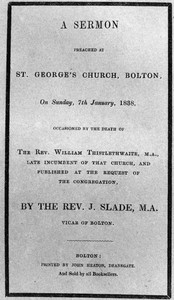
A SERMON PREACHED AT ST. GEORGE’S CHURCH, BOLTON, _On Sunday_, 7_th_ _January_, 1838,
OCCASIONED BY THE DEATH OF
THE REV. WILLIAM THISTLETHWAITE, M.A., LATE INCUMBENT OF THAT CHURCH, AND PUBLISHED AT THE REQUEST OF THE CONGREGATION,
BY THE REV. J. SLADE, M.A.
PRINTED BY JOHN HEATON, DEANSGATE.
And Sold by all Booksellers.
_For whether we live_, _we live unto the Lord_; _and whether we die_, _we die unto the Lord_: _whether we live therefore_, _or die_, _we are the Lord’s_.
THE text refers to the foregoing verse: “None of us liveth unto himself; and no man dieth to himself.” We are very apt to feel and act, as if we were independent creatures. Perhaps if examined, as to our particular creed, we should readily confess ourselves to be placed under the sovereignty of the Almighty; and to be accountable, as Christians, at the bar of Him, who will “judge both quick and dead.” But few are daily conscious, as they ought to be, either of their dependence or their responsibility. Their creed is not in their heart; they live chiefly and practically under a system of self-government; grievously forgetting the dominion of the Lord who created and redeemed them. A proud spirit is, as it has been from the beginning, the bane of man: he fell through impatience of his Maker’s mild yoke, and an intolerance of his Maker’s superiority: and the poison, thus whispered into his ear by the evil one, still lurks within him; corrupting his feeling and principle, and rendering him greatly insensible to the divine superintendence and blessing.
This pride and selfishness however the gospel is designed to humble and correct; and it does produce the mighty change in the heart of every sincere believer; of all who feel its vital power, “the power of God unto salvation.” Of all such it must be said, in the utmost latitude, in the most unqualified sense, “none of us liveth unto himself.” There is no true disciple of the Lord Jesus, who makes earthly interest, gain or pleasure, ambition or lust, his ruling and absorbing object. Such is the character of the degenerate and lost world: there is no fitter description of a worldly man than this, that he lives to gratify his own humour, and carry out the schemes of his own wilfulness, and promote his own prosperity during his little career: earth is his sphere of action, and all centres in self. But every follower of Christ is called out of the world, effectually called and chosen and delivered: he has another mind, another spirit, another view. He cannot live for himself: it is not merely against his conviction, his sense of propriety, his professed and deliberate principle, it is against his new nature: he is born of God, with new affections, new desires, new purposes, new prospects; the Spirit of the living God dwells within him; cleanses him from all fleshly corruption; and brings his will, brings all that he is, and all that he has, into subjection to the Godhead. This is the character, the certain and essential and distinguishing character of all who belong to Christ: they live not, in any regard or in any matter, for themselves.
Nor do they die unto themselves. They die not, either like the beasts that perish, or for their own disposal and glory; not to make bodily or earthly provisions; not to give orders for their funeral; not to hand down their name and style to posterity upon a blazoned escutcheon; not to bequeath their riches to others: “after all these things do the Gentiles seek.” But a grand and glorious change has been made by the gospel: the true nature of death stands now unfolded in all its awful and stupendous reality: it is a passage to another state of being: the disembodied soul flies and lives elsewhere: not, as on earth, for a few short years, but for eternity. And what may be thought or said of me, whether by the present or by future generations, whether by friends or foes; what may become of my property, baubles or possessions; what may be done with my corpse, whether meanly or superbly coffined, whether laid without winding-sheet or clothed with purple and fine linen,—all these are matters of minor note, of comparative indifference. I shall have been living and dying for another, an eternal world; and the great consideration is, where and what that world shall be.
James Slade's sermon, preached on 7 January 1838 at St. George's Church, Bolton, opens with a pointed diagnosis of human nature: 'We are very apt to feel and act, as if we were independent creatures.' The text, Romans 14:8, frames the entire address, but Slade immediately turns to the tension between professed belief and actual practice. He argues that while many would 'readily confess' divine sovereignty, few are 'daily conscious' of their dependence. This gap between creed and conduct becomes the sermon's central concern, not merely as a theological point but as a pastoral challenge to the congregation.
Pride as the Persistent Poison
Slade identifies pride as 'the bane of man,' tracing it back to the Fall: 'he fell through impatience of his Maker’s mild yoke.' The language is striking—pride is not just a sin but a 'poison' that 'still lurks within him, corrupting his feeling and principle.' This is not abstract doctrine; Slade insists that pride renders people 'greatly insensible to the divine superintendence and blessing.' The sermon thus sets up a stark contrast between the 'self-government' of the worldly and the 'new nature' of the believer, who 'cannot live for himself.' The repeated use of 'new'—affections, desires, purposes, prospects—emphasizes a complete transformation, yet Slade grounds this in the ongoing struggle against pride, not a once-for-all victory.
The Minister as Watchman and Miner
In the latter portion of the sermon, Slade shifts to the role of the deceased minister, William Thistlethwaite. He employs two vivid metaphors: Thistlethwaite 'dug deeply into that precious mine in the field of the word of God' and 'presented for your acceptance the treasures and the jewels.' The mining image suggests labor, depth, and value. The second metaphor is that of a watchman: 'the trumpet has sounded in your ears, long and loud; the clear, thrilling, evangelical trumpet.' Slade draws directly from Ezekiel 33 to underscore the minister's duty and the congregation's responsibility. The herald 'has done his duty,' but the hearers are accountable for their response. This dual imagery—mining for truth and warning with a trumpet—frames the minister's work as both offering and alarm.
The Sheep Known Only at the Last
Slade concludes with a striking pastoral reassurance: 'The world knows them not; the earthly shepherd himself may not have known them all: but “the Lord knoweth them that are His.”' This acknowledges the limits of human recognition—even a faithful minister cannot identify every true believer. The final hope is eschatological: the shepherd and flock will stand together before the eternal throne, and Christ will 'infallibly select them every one out of an assembled world.' The sermon ends with a personal prayer, 'Let me but die the death of the righteous,' which echoes Numbers 23:10. Slade thus turns from corporate exhortation to individual longing, leaving the congregation with a model of humble desire rather than confident assurance.
Readers should note that the sermon's structure moves from general human condition to specific ministerial example to final judgment, but the excerpts are incomplete; the full text may develop other themes or include more biographical detail about Thistlethwaite. Slade's prose is dense with biblical allusion and rhetorical repetition, rewarding careful reading. The tension between human pride and divine sovereignty, and between the minister's duty and the hearer's response, gives the sermon its driving force.
I found myself thinking about that old sermon's quiet tension—how easily we mistake our own footing for solid ground. It lingered like a half-remembered hymn. Something in the way it wrestled with dependence and pride reminded me of another piece, softer in tone but just as searching: Enfranchisement of women — A Closer Reading. I sat with it a while, and it felt like a gentle hand on my shoulder.
There are no reviews for this eBook.
There are no comments for this eBook.
Reader reflection
What did you think of this book?
Answer a few questions and save a private reflection on this device.
Your progress
0
/
10
2
Was reading this book enjoyable?
3
Would you recommend this book to another reader?
4
What was the reading difficulty like?
5
Did this book create an emotional response?
6
Did the book offer a fresh perspective?
7
Could you follow the author’s main argument?
8
Could you apply anything you learned?
9
What is the main idea you are taking away?
10