1

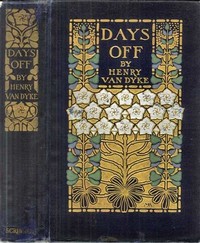
Days Off, and Other Digressions — A Closer Reading
(0 User reviews)
95
Project Gutenberg
2008
Not confirmed
Essays
Readers of public-domain and historical texts
Project Gutenberg digital edition
en
Edition facts
Words
61,020
Reading time
266 min
Text sections
7
This digital edition of Days Off, and Other Digressions — A Closer Reading is described by source-level measurements including 61,020 words, 4 hr 26 min estimated reading time, and 7 detected text sections.
The text analysis averages about 22.3 words per sentence, while the detected sections provide another way to judge how the source is divided.
Project Gutenberg metadata also associates the work with “Essays,” connecting these edition facts with the source record’s subject description.
Source:
Project Gutenberg record #24285
Henry Van Dyke's essay collection explores leisure, nature, and reflection through personal anecdotes and literary allusions, with a conversational frame of Uncle Peter's philosophy. Cataloged as Science Fiction & Utopias, the text instead offers meditative digressions on fishing, reading, and landscapes.
Editorial Edition Score
4.7/5
★★★★★
★★★★★
Calculated from edition completeness, EPUB availability, text structure and catalogue metadata. Not a user rating.
How this score is calculated
- Description quality20 pts
- Title & short description10 pts
- Source metadata20 pts
- Text length15 pts
- Chapters / structure15 pts
- EPUB file integrity20 pts
Total of 100 points, scaled to a 2.5-5.0 range. Editions with an empty description or a missing EPUB file are not scored.
Edition quality
Read the Text
were names to stir the fancy and paralyze the tongue. What a joy to follow one of these streams clear through its course and come out of the woods in our own craft--from Nicatöus to the sea!
It was perhaps something in the name, some wild generosity of alphabetical expenditure, that led us to the choice of the Kowahshiscook, or west branch of the Machias River. Or perhaps it was because neither of our guides had been down that stream, and so the whole voyage would be an exploration, with everybody on the same level of experience. An easy day's journey across the lake, and up Comb's Brook, where the trout were abundant, and by a two-mile carry into Horseshoe Lake, and then over a narrow hardwood ridge, brought us to Green Lake, where we camped for the night in a new log shanty.
Here we were at the topmost source--_fons et origo_--of our chosen river. This single spring, crystal-clear and ice-cold, gushing out of the hillside in a forest of spruce and yellow birch and sugar maple, gave us the clue that we must follow for a week through the wilderness.
But how changed was that transparent rivulet after it entered the lake. There the water was pale green, translucent but semi-opaque, for at a depth of two or three feet the bottom was hardly visible. The lake was filled, I believe, with some minute aquatic growth which in the course of a thousand years or so would transform it into a meadow. But meantime the mystical water was inhabited, especially around the mouth of the spring, by huge trout to whom tradition ascribed a singular and provoking disposition. They would take the bait, when the fancy moved them: but the fly they would always refuse, ignoring it with calm disdain, or slapping at it with their tails and shoving it out of their way as they played on the surface in the summer evenings. This was the mysterious reputation of the trout of Green Lake, handed down from generation to generation of anglers; and this spell we had come to break, by finding the particular fly that would be irresistible to those secret epicures and the psychological moment of the day when they could no longer resist temptation. We tried all the flies in our books; at sunset, in the twilight, by the light of the stars and the rising moon, at dawn and at sunrise. Not one trout did we capture with the fly in Green Lake. Nor could we solve the mystery of those reluctant fish. The boy made a scientific suggestion that they got plenty of food from the cloudy water, which served them as a kind of soup. My guess was that their sight was impaired so that they could not see the fly. But Sam said it was "jest pure cussedness." Many things in the world happen from that cause, and as a rule it is best not to fret over them.
The trail from Green Lake to Campbell Lake was easily found; it followed down the outlet about a mile. But it had been little used for many years and the undergrowth had almost obliterated it. Rain had been falling all the morning and the bushes were wetter than water. On such a carry travel is slow. We had three trips to make each way before we could get the stuff and the canoes over. Then a short voyage across the lake, and another mile of the same sort of portage, after which we came out with the last load, an hour before sundown, on the shore of the Big Sabeo. This lake was quite different from the others; wide and open, with smooth sand-beaches all around it. The little hills which encircled it had been burned over years ago; and the blueberry pickers had renewed the fire from year to year. The landscape was light green and yellow, beneath a low, cloudy sky; no forest in sight, except one big, black island far across the water.
Despite its catalog listing under Science Fiction & Utopias, Henry Van Dyke's Days Off, and Other Digressions is a collection of personal essays that never touches on speculative futures or ideal societies. The opening essay introduces Uncle Peter, who defines a day off as “a day that a man takes to himself,” and the ensuing dialogue sets a conversational, philosophical tone. The excerpts reveal a writer more concerned with the texture of a river journey, the fading blooms of lupins, and the green light filtering through forest canopies than with any utopian blueprint.
Uncle Peter’s Philosophy of Leisure
The first essay frames the collection through Uncle Peter’s deliberate pronouncements. He argues that a true day off must be shared: “if he takes it alone, it will be a heavy day, a chain-and-ball day.” This counterintuitive claim—that solitude is rarely enjoyed alone—sets up a pattern of gentle contradiction and elaboration. The narrator’s role is to provide “a little background of apparent misunderstanding,” prompting Uncle Peter to refine his meaning. The dialogue structure gives the prose a staged, almost Socratic quality, where wisdom emerges through back-and-forth rather than direct instruction.
The River as a Thread of Observation
In the later excerpt, Van Dyke describes a canoe journey down a river, noting the “faded remnants of the beauty with which the lupins had surrounded Watermouth.” He observes that the plants’ roots “reach down to the hidden waters,” a detail that resists drought. The prose shifts between precise natural history—naming trees like silver maple and black ash—and literary allusion, quoting Andrew Marvell’s “green thought in a green shade.” The river itself becomes a structuring device, carrying the narrator past lupins and laurels, through “diffused, tranquil green light,” and into a mood of enchantment where “Oberon and Titania might sleep.”
Literary Echoes and Botanical Names
Van Dyke frequently embeds literary references within his nature writing. He names shrubs after nymphs—Leucothoë and Andromeda—and cites Linnaeus’s description of Andromeda polifolia as “blood-red before they expand.” The essay weaves Marvell’s lines into the description of the forest, treating the poem as a natural extension of the scene. This technique blurs the boundary between observation and reading, suggesting that the landscape is already mediated by poetry. The catalog subject “Essays” fits this meditative, allusive mode far better than the assigned Science Fiction & Utopias label.
The Mismatch of Catalog Subjects
Project Gutenberg lists this work under Science Fiction & Utopias, yet the excerpts contain no speculative elements, no future societies, and no technological marvels. The dedication to Grover Cleveland—a former U.S. president—and the essays on fishing, books, and gulls point to a different tradition: the familiar essay of the early twentieth century. The catalog error may stem from the word “digressions” or from a broad interpretation of “utopia” as an ideal day off, but the text itself resists such classification. Readers expecting science fiction will find instead a leisurely, anecdotal collection rooted in the natural world and personal reflection.
The essays reward a patient, unhurried reading—one that matches the “days off” they describe. Van Dyke’s prose moves between dialogue, description, and quotation, often within a single paragraph. Pay attention to the way he uses literary references not as decoration but as a lens for seeing the landscape. The catalog subject may mislead, but the book itself is a coherent example of the early twentieth-century familiar essay, best approached as a companion for a quiet afternoon rather than a guide to utopia.
Reading about Uncle Peter’s unhurried mornings, I remembered my own father’s quiet Sundays, when the paper went unread and we simply watched the light shift across the yard. There was the same stillness in Days Off that Belloc once gave me, a sense that nothing needed finishing. On Nothing & Kindred Subjects — A Closer Reading feels like that old hammock — a place to rest, not arrive.
There are no reviews for this eBook.
There are no comments for this eBook.
Reader reflection
How did this book work for you?
Your answers remain private and are stored only in this browser.
Your progress
0
/
10
2
How did the book work for you overall?
3
Would you encourage someone else to read it?
4
What was the reading difficulty like?
5
How strongly did the book affect you emotionally?
6
Could you apply anything you learned?
7
How did the pace of the book feel?
8
Did any part of the book feel personally relevant?
9
In one sentence, what did you learn?
10