1

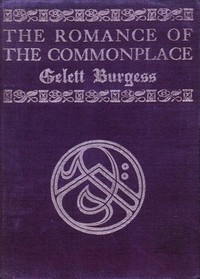
The Romance of the Commonplace — Edition Insights
(0 User reviews)
492
Project Gutenberg
2015
Not confirmed
American essays
Readers of public-domain and historical texts
Project Gutenberg digital edition
en
Edition facts
Words
46,896
Reading time
204 min
Text sections
7
The catalog record for The Romance of the Commonplace — Edition Insights provides practical reading context through 46,896 words, 3 hr 24 min estimated reading time, and 7 detected text sections.
The text analysis averages about 23.9 words per sentence, while the detected sections provide another way to judge how the source is divided.
Project Gutenberg metadata also associates the work with “American essays,” connecting these edition facts with the source record’s subject description.
Source:
Project Gutenberg record #49285
Gelett Burgess's 1902 essay collection uses everyday experiences—dining out, playing, slang, and more—to argue for finding romance in the ordinary, blending wit with a philosophy of optimism.
Editorial Edition Score
4.7/5
★★★★★
★★★★★
Calculated from edition completeness, EPUB availability, text structure and catalogue metadata. Not a user rating.
How this score is calculated
- Description quality20 pts
- Title & short description10 pts
- Source metadata20 pts
- Text length15 pts
- Chapters / structure15 pts
- EPUB file integrity20 pts
Total of 100 points, scaled to a 2.5-5.0 range. Editions with an empty description or a missing EPUB file are not scored.
Edition quality
Read the Text
begun in the April of my life, and though it is now well into mid-June, some of the glamour of the Spring yet inspires me, and I am still a-wondering. I have tried every charm to preserve my youth, and a drop of wine and a girl or two into the bargain, but the game is near played out.
But what boots marbles and tops when one is initiated into the mysteries of billiards and chess? It has taken me all these years to find that there is sport for every season, and the rules vary. To make a bold play at life, then, without cheating (which is due only to a false conception of the reward), and with the progress, rather than the particular stage reached, in mind, is my aim. So I have tossed overboard all my fears and regrets, and gone in for the higher problems of maturity.
Still, a few of the maxims I drew from my joys and sorrows in the few calmer moments of reverie persist; and these all strengthen me in the romantic view of life. A man must take his work or his art seriously, and pursue it with a single intent; he must fix upon the realities first of all, but there is room for imagination as well, and with this I have savoured my duties, as one puts sauce to pudding. Enough has been written upon the earnestness of motive, of sobriety and all the catalogue of virtues usually dignified with capital initials. I own allegiance to an empire beside all that--another Forest of Arden--the tinkle of whose laughter is a permanent sustained accompaniment to the more significant notes of man’s sober industries.
Must I be dubbed trifler then, because I make a game of life? Every man of spirit and imagination must, I think, be a true sportsman. It is in the blood of genius to love play for its own sake, and whether one uses one’s skill on thrones or women, swords or pens, gold or fame, the game’s the thing! Surely, it is not only the reward that makes it worth while, it is the problem--the study of each step on the way, the disentangling of the knotted cord of fate, the sequence and climax of move after move, the logical grasp of what is to come upon the chess-board. As it is in the great, then, may it not be in the small? To one of fancy and poetic vision, mere size is an accident, a personal element, a relative, not an absolute quality of things. The microscope reveals wonders to the scientist, as great and as important as does the telescope. To the poet, "a primrose by the river’s brim" has the beauty of the Infinite. And so nothing is commonplace, or to be taken for granted. One needs only the fresh eye, the eagerness of interest, and this Universe of workaday things which, with the animals, we get "for a penny, plain," may be coloured with the twopence worth of mind by which we are richer than they.
We have all passed through that phase of art-appreciation in which familiar objects are endowed with an extrinsic æsthetic value. The realist discovers a new sensation in a heap of refuse, the impressionist in the purple shadows of the hills. In weaker intellects the craving for this dignifying of the obvious leads to the gilding of the rolling-pin or the decalcomanie decoration of the bean-pot. With something of each of these methods, I would practice upon every-day affairs, and make them picturesque.
This is, perhaps, a characteristically Oriental point of view of life. Undoubtedly it is the Japanese pose, and it is well illustrated in their art. What by Korin would be thought too insignificant for portrayal? He had but to separate an object, or a group of objects, from its environment and he beheld a design, with line, mass, colour and _notan_. Art was to him not a question of subject, but of composition. He held his frame before a tiny fragment of the visible world, any fragment, indeed, and, placing that in its true position, not in regard to its surroundings, but in regard to the frame, it became a pattern. May we not, for our diversion, do thus with Life? If we hold up our frame, disregarding the accidental shadows of tradition and establishment, we may see bits of a new world.
Gelett Burgess opens The Romance of the Commonplace with a confession: the essay is “the most compromising form of literature possible,” exposing the writer’s character and temperament. This collection, begun in the Lark and continued in the Queen, aims to convert readers to an “optimistic view of every-day incident.” The catalog subject “American essays” fits, but the excerpts reveal a more specific project: a philosophy of life drawn from mundane activities like dining, playing, and using slang. Burgess insists that the essayist cannot hide behind metaphor or fiction, and he writes with a self-deprecating frankness that invites scrutiny.
The Essay as Self-Exposure
In the introduction, Burgess admits that his earlier nonsense and fiction gave “no clue by which my real self might be discovered,” but the essay leaves him “all of a shiver with shame.” This is not mere modesty; it is a structural claim about the genre. He contrasts the essay with poetry (where a man “may so cloak himself in metaphor”) and fiction (where “escape for the story-teller is always easy”). The essay, he argues, “writes me down for what I am.” This framing suggests that the subsequent essays are not just observations but deliberate self-portraits. The reader is invited to read between the lines, treating each piece as both a discussion of life and a revelation of the author’s character.
Life as a Badly Constructed Play
In the essay “The Play’s the Thing,” Burgess extends his philosophy to performance. He quotes the old Duke in Lewis Carroll’s Sylvie and Bruno: “All the world’s a stage where are performed the worst of badly constructed plays… but performed with absolute perfection.” Burgess then advises readers to find “perfect acting” not behind footlights but in the street—watching a railway porter’s dialect, a fat woman with screaming children, or a Samoan beauty catching fish. Yet he immediately qualifies this: life is “incomplete,” and for aesthetic satisfaction we need “the threads to be brought together.” The tension between life’s raw material and art’s shaping hand is central. Burgess ultimately sides with “the good story badly told” over the polished but empty tale, calling this “the manly choice.”
The Romance of the Ordinary
The collection’s title promises romance in the commonplace, and the table of contents delivers: essays on “Getting Acquainted,” “Dining Out,” “The Art of Playing,” “The Use of Fools,” “A Defense of Slang,” “The Diary Habit,” and “Cartomania.” These are not abstract meditations but concrete, often humorous treatments of daily rituals. Burgess’s method is to take a seemingly trivial subject—like the game of correspondence or the tyranny of household gods (lares)—and extract from it a broader lesson about human nature. The excerpts show a writer who values wit over pedantry, and who believes that philosophy can be proven through lived experience. The book’s structure, moving from April essays to a closing “Sub Rosa,” reinforces this playful yet earnest approach.
Readers should approach The Romance of the Commonplace as a series of provocations rather than a systematic treatise. Burgess’s tone shifts between flippant and earnest, and his arguments often double back on themselves. The essays reward attention to his recurring metaphors—theatre, games, costume—and his habit of addressing an imagined interlocutor (like Celestine). The book is best read in short bursts, allowing each piece to stand as a self-contained meditation on finding value in the overlooked.
Leafing through Gelett Burgess’s gentle essays, I found myself smiling at his insistence that a shared meal holds quiet magic. That same unhurried wonder surfaced weeks later, unexpectedly, while rereading the Address delivered before the British Association assembled at Belfast — Story, Setting & Ideas. Both lift the veil from the familiar—Burgess from a teacup, the address from a scientific law—until the ordinary briefly glows, remembered.
There are no reviews for this eBook.
There are no comments for this eBook.
Reader reflection
What was your reading experience?
Capture what you thought, learned, and would like to remember.
Your progress
0
/
10
2
What was your overall reaction to the book?
3
Is this a title you would suggest to others?
4
How demanding did the text feel?
5
What was the strongest part of the book?
6
How much did the book move you?
7
How clear did the writing feel?
8
Did the story or argument move comfortably?
9
In one sentence, what did you learn?
10