1

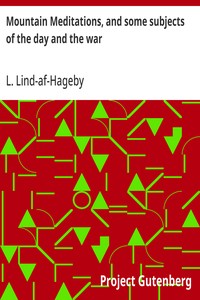
Mountain Meditations, and some subjects of the day and the war — A Reader’s Guide
(0 User reviews)
288
Project Gutenberg
2009
Not confirmed
Essays
Readers of public-domain and historical texts
Project Gutenberg digital edition
en
Edition facts
Words
46,370
Reading time
202 min
Text sections
8
Before opening Mountain Meditations, and some subjects of the day and the war — A Reader’s Guide, the edition data offers a quick orientation: 46,370 words, 3 hr 22 min estimated reading time, and 8 detected text sections.
The text analysis averages about 19.6 words per sentence, while the detected sections provide another way to judge how the source is divided.
Project Gutenberg metadata also associates the work with “Essays,” connecting these edition facts with the source record’s subject description.
Source:
Project Gutenberg record #29277
A 1917 essay collection that pairs alpine nature writing with wartime reflection, using mountain ascent as a lens to critique reform, nationalism, and religious transition. The author, a Swedish-British activist, blends personal observation with philosophical argument, often quoting Ruskin, Thoreau, and Victor Hugo.
Editorial Edition Score
4.7/5
★★★★★
★★★★★
Calculated from edition completeness, EPUB availability, text structure and catalogue metadata. Not a user rating.
How this score is calculated
- Description quality20 pts
- Title & short description10 pts
- Source metadata20 pts
- Text length15 pts
- Chapters / structure15 pts
- EPUB file integrity20 pts
Total of 100 points, scaled to a 2.5-5.0 range. Editions with an empty description or a missing EPUB file are not scored.
Edition quality
Read the Text
the sense of this irony in a solitude? Have I the right to believe that the landscape was designed for him--the cretin, and the irony for me--the chance visitor?"
The idiot and the mountain shared, no doubt, a supreme indifference to the commotion which their proximity had set up in the poet's mind. With his love of antithesis Hugo had seized the picture of the glories of the mountain wasting themselves before the gaze of the senseless idiot. Apart from geographical conditions and hygienic defects there is an interesting æsthetic problem connected with the presence of idiots in the mountains. It is not only the idiot who is indifferent to the beauties of the Alps; the sane and healthy peasant whose eyes wander over the glaciers and snow-fields as he rests for a few minutes from hoeing his potatoes is not moved by the sight to ecstatic delight.
I have many dear friends amongst peasants. They are richly endowed with common sense and kindness of heart; their brains can compete favourably with those of the folk of any other country. Their hard struggle with a rebellious soil has given them a quiet determination and tenacity of purpose which are the root of Alpine enterprise and resourcefulness. They possess character and independence in a high degree--mental reflexes of the peaks of freedom, ever before their eyes. But they, children of the mountain, born and bred amidst its beauties, are surprisingly insensitive to beauty.
I remember one exquisite sunset--one of those superlative sunsets that burn themselves into the consciousness with a joy akin to pain, and of which only a few are allotted to each human life. I stood watching the sinking sun throw a crimson net over the snow mountains as the shadow of night crept slowly up the hillside. The sky took on an opal light in which were merged and transcended all the colours of the day. Every pinnacle and rock was lit up as by a heavenly fire, the pines were outlined like black sentinels against the sky, guardians of that merciful green life from which we spring and to which we return. My old friend the goat-herd and daily messenger from the highest pastures stood beside me. "Beautiful, Pierre," I said, "and in this you have lived all your life."
"Yes," he said, slowly shifting the pipe from the left side of his mouth to the right; "the cheese is fat and good in the mountains, and the milk is not poisonous as it is in the plains, but it is hard work for the back to carry it down twice a day." He looked at me as if searching for better understanding. "But I will tell you something nice," he added, by way of stirring up my sluggish imagination; "the little brown cow has calved, and this autumn we are going to kill the old cow, and we shall have good meat all the winter."
Far be it from me to join in the thoughtless generalizations about the obtuseness of the Alpine peasant which have disfigured some of the literature of climbing. These climbers have shown infinitely greater obtuseness before Alpine realities than the peasants derided by them. True, a star may compete in vain with a cheese in suggesting visions of joy, but our supercilious climbers forget that their admiration of nature's marvels is generally built up on a substratum of cheese--or the equivalent of cheese--plentifully supplied by the labour of others. There is another class of climbers who idealize the peasant and the guide, and who write of Alpine peasant-life as if it were nothing but a series of perilous ascents nobly undertaken for the advancement of humanity.
I can understand the indifference of the peasant to the visions around him. After a hard day's scything or woodcutting on slopes so steep that the resistance of one's hob-nailed boots seems like that of soft soap, I have felt profoundly healthy and ready to go to bed without listening to any lyrics on the Alps. And even the thought of Tennyson's "awful rose of dawn" would not have roused me before the labour of the next day.
The opening essay, 'Mountain-Tops,' immediately establishes a dual register: the author declares herself a member of 'the great and mystic brotherhood of mountain worshippers,' then compares the climbing impulse to a terrier eyeing a rat. This blend of ecstatic and ironic tones recurs throughout the collection. The prose moves between first-person accounts of alpine solitude—'I plunged into the huge drifts of clean snow'—and broader arguments about society, war, and reform. The excerpts show a writer who treats the mountain as both a physical escape and a rhetorical vantage point from which to judge the 'artificialities' of modern life.
The Mountain as a Counterweight to Reform
The essay 'Reformers' sets up a pointed contrast between the nature-lover and the social reformer. The author, drawing on Thoreau, suggests that reformers often attack others' faults while ignoring their own: 'Every unordered spirit is its own punishment,' she quotes Augustine. The mountain worshipper, by contrast, turns deprivation into pleasure—'Take away his house and he shelters in a cave.' This is not a rejection of reform but a critique of its self-righteousness. The author implies that many reforms would be unnecessary if people abandoned artificial wants. The argument is deliberately provocative, even 'unpractical,' as she admits.
Nationality and the War's Shadow
Though the excerpts do not include the full 'Nationality' essay, the title and the book's 1917 publication date place it firmly within World War I. The earlier 'Mountain-Tops' section mentions leaving 'a conference in Geneva' and climbing through snow—a personal detail that hints at the author's pacifist or internationalist engagements. The collection's subtitle, 'some subjects of the day and the war,' signals that the mountain meditations are not escapist but a framework for addressing contemporary conflict. The author's insistence on self-culture and inner discipline reads as a response to wartime nationalism.
A Rhetoric of Contrasts
Lind-af-Hageby's prose relies on sharp antitheses: the mountain versus the plain, the hermit versus the crowd, the 'brazen self-sufficiency' of the nature-lover versus the 'joyless chase of success.' She invokes Antæus, who draws strength from the earth, to argue that contact with nature restores a 'mode of being, behind and beyond ordinary existence.' The style is aphoristic and quotable—'Give me a tree, a perfect tree, and you may keep your palaces'—but also self-aware, acknowledging that such views appear 'crotchety' to others. This tension between earnestness and irony gives the essays their distinctive voice.
Readers approaching Mountain Meditations should expect a hybrid work: part nature diary, part polemic. The author's voice is confident and occasionally combative, but the excerpts suggest a willingness to question her own positions. Pay attention to the epigraphs—Victor Hugo, Ruskin, Thoreau—as they signal the intellectual traditions she engages. The book rewards those who read slowly, letting the alpine descriptions and the wartime arguments unsettle each other.
The rain kept time with my reading of Mountain Meditations, how the author’s quiet unease about reform lingered long after I shut it. That afternoon, misplacing a bookmark, I stumbled upon another voice wrestling with similar doubts. He wasn’t climbing, just watching England change, and it felt like the same small, worried sigh. Last Essays of Maurice Hewlett — A Closer Reading sits beside it now, a gentler echo.
There are no reviews for this eBook.
There are no comments for this eBook.
Reader reflection
What was your reading experience?
Capture what you thought, learned, and would like to remember.
Your progress
0
/
10
2
How much did you enjoy the reading experience?
3
Would you pass this book on to a friend?
4
What was the reading difficulty like?
5
What was its emotional impact?
6
How did the reading compare with what you expected?
7
Would this book work well in a reading group?
8
Which element worked best for you?
9
Which lesson or insight stayed with you?
10