1

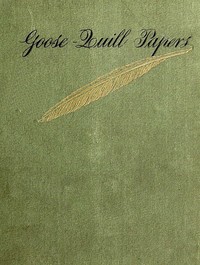
Goose-Quill Papers — A Reader’s Guide
(0 User reviews)
235
Project Gutenberg
2017
Not confirmed
American essays -- 19th century
Readers of public-domain and historical texts
Project Gutenberg digital edition
en
Edition facts
Words
38,611
Reading time
168 min
Text sections
25
The catalog record for Goose-Quill Papers — A Reader’s Guide provides practical reading context through 38,611 words, 2 hr 48 min estimated reading time, and 25 detected text sections.
The text analysis averages about 21.0 words per sentence, while the detected sections provide another way to judge how the source is divided.
Project Gutenberg metadata also associates the work with “American essays -- 19th century,” connecting these edition facts with the source record’s subject description.
Source:
Project Gutenberg record #55635
Louise Imogen Guiney's 1885 essay collection blends classical allusions with personal memoir, shifting from mythic apple lore to a child's Civil War recollections. The prose moves between learned wit and intimate observation, with a distinctive voice that treats serious subjects with playful gravity.
Editorial Edition Score
4.8/5
★★★★★
★★★★★
Calculated from edition completeness, EPUB availability, text structure and catalogue metadata. Not a user rating.
How this score is calculated
- Description quality20 pts
- Title & short description10 pts
- Source metadata20 pts
- Text length15 pts
- Chapters / structure15 pts
- EPUB file integrity20 pts
Total of 100 points, scaled to a 2.5-5.0 range. Editions with an empty description or a missing EPUB file are not scored.
Edition quality
Read the Text
Hercules was its captor. The renascent marbles of the Greeks are dug out of earth,--"Praxitelean shapes!"--with its rounded beauty yet in their outstretched hands. What a superb mythologic pedigree! What noble mention (each worth an immortality) from old poets, romancers, historians! All heterodoxy lauded thee, apple of mine eye. It was reserved for true-church traditions to belie thee.
Thou who art full of virtue, what is this rumor of thy defection in Eden, thy remote causing of all contemporaneous woe? Thou who art fair without as a cherub's cheek, how couldst thou be abettor to the treacherous spirit? Shall the fault of our frail ancestress rest upon thy rosy head? "That the forbidden fruit of Paradise was an apple," saith a grave and learned author, "is commonly believed, confirmed by tradition, perpetuated by writings, verses, pictures; and some are so bad prosodians as thence to derive the Latin word _malum_, because that fruit was the first occasion of evil: wherein, notwithstanding determinations are presumptuous, many, I perceive, are of another belief." Let the personal argument stand, in default of a bolder plea. Mephisto, who hath had no chance of reformation, and who may be supposed to keep his early leanings, is in modern times no frequenter of orchards. Not by farmer, nor wayside knight, nor loitering sweethearts at dusk, hath he ever been detected prowling about an innocent apple-tree.
It hath, on the other hand, been affirmed by an ingenious clerk, that apple-eating is a masculine passion, and that no woman hath a dominating natural relish for this hearty fruit; which, proven, would seem to indicate (as a burnt child dreads the fire, according to the proverb) that Eve's mindful daughters shun by instinct the immemorial enemy. If, indeed, it needs must be demonstrated by some unborn logician, that our primal happiness was forfeited by nought else, beyond the serpent's wiles, than a Gilliflower or a Greening, hanging on the representative tree, and criterion of obedience,--then there exist myriads of her descendants with the ancestral weakness, who shall look on our abused common mother with new and tender consideration, such as her disastrous connection with a plum, or a currant, or a quince, could never have evoked.
The apple is the only fruit which deserveth the name of genial. A peach is but a Capuan dish; the lime approacheth with cold infrequency; the amiable pear hath too little character; the grape is chiefly suggestive, anticipatory of its hereafter, as the larva of the gorgeous butterfly. But Apple standeth on her own merits. Tart, jelly, fritters, dumpling, enter not into the imagination of her possessor. Nay, nor even cider, that fretful disempurpled wine,--wine, as it were, with the bar sinister. Apple hath not the flippant gayety of the cherry; her glad humor is somewhat dashed with cynicism: she warmeth the heart, and trippeth up the tongue, and is, in the accepted phrase of artists, "a good fellow;" foe to unrighteous melancholy, as Laurentius writ, and frankly compassionate. She should have had Horace for her court-poet. One can conceive of poor, manly Fielding loving her at the modest ratio of three dozen a day; and of little Mr. Pope brushing her aside with fastidious petulance.
The friends of Apple, your sworn familiars, who offend not her sun-mottled exterior with barbaric divisions of the knife, may be known by their ready wit and their bright glances. Hath not the wholesome autumn light, which filtered into the fruit they affect, permeated their moral temperament? They must needs be sound, consolatory, humane, and fit to wrestle with every wind that blows. "Man is that he eats," we read among the bewilderments of German speculation. But of her chaste and subtle cup, rimmed with gold or crimson, as Nature willed, the elect drink invigoration.
"Encompass me about with apples," saith the Canticle, "for I am sick with love;" which, driven to its bare and literal sense, implies that apples are antidotes to languor and over-fondness. Apple, be it said, is a Platonist.
Louise Imogen Guiney opens Goose-Quill Papers with a mock-scholarly defense of the apple, tracing its mythic pedigree from Atalanta to Hercules before taking aim at the Eden tradition. The essay’s tone is arch and erudite, yet the argument is delivered with a wink: “All heterodoxy lauded thee, apple of mine eye.” This blend of learning and levity sets the pattern for the collection, where Guiney moves from classical allusion to personal anecdote without losing her distinctive voice.
The volume’s twenty-five pieces range from meditations on idleness and graveyards to a child’s-eye view of the Civil War. In the latter, the prose shifts abruptly from mythic grandeur to the concrete details of a Washington hotel sandwich and a waiter’s “exceeding blackness.” These juxtapositions reveal a writer who treats memory with the same playful seriousness she brings to mythology.
Mythology as a Rhetorical Weapon
Guiney’s opening essay demonstrates her method: she marshals a parade of classical and Norse references—Atalanta’s apple, the golden apple of discord, Bragi’s rejuvenating fruit—only to pivot into a mock-legal defense of the apple against “true-church traditions.” The prose is dense with allusion, yet the tone remains conversational, as when she quotes a “grave and learned author” who derives malum from the apple’s role in evil. Guiney undercuts the solemnity with a parenthetical aside: “wherein, notwithstanding determinations are presumptuous.” This is not dry scholarship but a performance of erudition, designed to amuse as much as instruct.
A Child’s War: Memory and Detail
The later essay on the Civil War abandons myth for memoir, yet the voice remains recognizably Guiney’s. She recalls a soldier returning home “terribly shattered with suffering and fatigue,” but the emotional weight is carried by small, precise details: the loss of a scabbard, a hole through a cap made by a sharp-shooter, the child’s refusal to recognize the wounded man. The prose slows to a crawl when describing her two-hour capitulation under the table, then quickens with the absurd wish to be shot “in the interests of my native land.” The shift in pace—from the war’s grand narrative to a child’s stubborn fear—creates a tension that is both comic and poignant.
The Essay as Performance
Throughout Goose-Quill Papers, Guiney treats the essay form as a stage for her voice. She moves between registers with ease: the opening essay’s mock-heroic defense of the apple gives way to a meditation on graveyards, then to a child’s recollection of a “genial holiday” amid war. The prose is studded with arch asides and learned quotations, but Guiney never loses her grip on the reader’s attention. Her sentences are long and sinuous, yet they never become opaque. The effect is that of a witty companion, not a lecturer. The collection’s variety—from “On the Good Repute of the Apple” to “De Mosquitone”—suggests a writer who delights in range, but the consistent intelligence of the voice unifies the whole.
Readers approaching Goose-Quill Papers should expect a companionable, unpredictable intelligence. Guiney’s essays reward attention to her shifts in tone and pace: the same writer who parodies scholarly pedantry can, in the next piece, render a child’s war memory with startling immediacy. The collection is best read not as a systematic argument but as a series of performances, each showcasing a different facet of a singular voice.
That rainy afternoon, Guiney’s blend of myth and childhood memory felt like watching someone sort old photographs—whimsy and ache side by side. Her gentle gravity lingered, and I found myself reaching for another voice with that same unhurried honesty: Set Down in Malice: A Book of Reminiscences — Story, Setting & Ideas. Its recollections felt like a quiet continuation, not a departure.
There are no reviews for this eBook.
There are no comments for this eBook.
Reader reflection
Before you leave, reflect on the book
Use these questions to collect your thoughts before moving on.
Your progress
0
/
10
2
What was your overall reaction to the book?
3
Is this a title you would suggest to others?
4
How demanding did the text feel?
5
What did you think about the pace?
6
What did you appreciate most?
7
Was the book easy to understand?
8
How distinctive were its ideas or approach?
9
Which lesson or insight stayed with you?
10