1

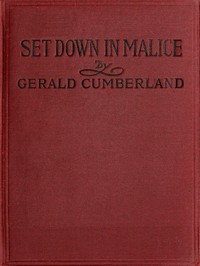
Set Down in Malice: A Book of Reminiscences — Story, Setting & Ideas
(0 User reviews)
928
Project Gutenberg
2020
Not confirmed
Authors, English -- 20th century -- Biography; Great Britain -- Intellectual life; Kenyon, C. Fred (Charles Frederick), 1879-1926; Musicians -- Great Britain -- Biography
Readers of public-domain and historical texts
Project Gutenberg digital edition
en
Edition facts
Words
89,791
Reading time
391 min
Text sections
12
The catalog record for Set Down in Malice: A Book of Reminiscences — Story, Setting & Ideas provides practical reading context through 89,791 words, 6 hr 31 min estimated reading time, and 12 detected text sections.
The text analysis averages about 18.5 words per sentence, while the detected sections provide another way to judge how the source is divided.
Project Gutenberg metadata also associates the work with “Authors, English -- 20th century -- Biography,” connecting these edition facts with the source record’s subject description.
Source:
Project Gutenberg record #61437
Gerald Cumberland's 1919 memoir blends sharp portraits of Edwardian cultural figures with a digressive, self-aware style. Written in military dugouts, it mixes malice, admiration, and irony across music, literature, and theatre.
Editorial Edition Score
4.8/5
★★★★★
★★★★★
Calculated from edition completeness, EPUB availability, text structure and catalogue metadata. Not a user rating.
How this score is calculated
- Description quality20 pts
- Title & short description10 pts
- Source metadata20 pts
- Text length15 pts
- Chapters / structure15 pts
- EPUB file integrity20 pts
Total of 100 points, scaled to a 2.5-5.0 range. Editions with an empty description or a missing EPUB file are not scored.
Edition quality
Read the Text
high regard of Janet Achurch.
“But she uses her voice wrongly. It is quite the finest voice on the stage and, perhaps because she knows it is so fine, she is always trying experiments with it. For a Shakespeare passage, for example, she will plan out what I may call a scheme of sound; sound that will rise and fall with the passion and decline of the words, that will intensify and grow dim as the mood waxes and wanes. But the scheme, the design—for it _is_ a kind of design—is nearly always too elaborate, too involved. It is full of detail, and the detail is apt to become more prominent than the general outline. She will start off most magnificently, lose herself a little, recover herself, lose herself again, and then abruptly strike a woefully wrong note. Perhaps her ear is wrong; perhaps excitement betrays her. But, with all her faults—and even her faults are more interesting than other people’s excellencies—she remains a superb actress.”
Of Mr Sidney Webb I remember nothing that he said, nor have any of the loving words he spoke of the Fabian Society remained in my memory. He spoke of it a great deal, both at lunch and during our subsequent walk, but somehow or other the Fabian Society has always seemed to me a bloodless and dull sort of institution, and while he talked about it my thoughts wandered, and I mused rather sadly over the psychology of this man whose moral earnestness was so much greater than my own.
But I pricked up my ears when the word “Morocco” fell from his lips, though in the event he said very little about it. I found he had no great belief in the value of travel as a means of education, an expander of the mind. He himself had never travelled; places and countries so precisely fulfilled all your expectations that, really, what was the use of going to see them? Facts, people and ideas: nothing else aroused his curiosity.
Of shorthand he said ... well, you don’t particularly want to know what he said of shorthand, do you? And in _The Perfect Wagnerite_ he has said all that it is necessary for him to say about Wagner. Last of all comes H. G. Wells.
Now, I have not the remotest idea what Shaw thinks of Wells in these days, yet I would give a good deal to know. But sixteen years ago the older man had for the younger an almost reverential admiration. At the time of my visit to Shaw one of Wells’ books was appearing serially in, I think, _The Fortnightly Review_. Wells was busy looking into the future, and the future that he saw seemed, in some respects, so disagreeable yet so likely that Shaw was dismayed at the prospect.
“A great man, Wells,” said Shaw; “do you know anything about him?”
I told him the little I knew and, as we had finished lunch, I asked Mrs Shaw’s permission to light a cigarette.
Almost immediately after, we started on our walk.
Never shall I forget that terrible walk. I believed then, as I believe now, that Shaw was deliberately pitting his powers of endurance against my own—the powers of endurance of a middle-aged vegetarian against those of a young meat-eater. He walked with a long, easy stride, swinging his arms, breathing deeply through his wide nostrils. His pace, which never for a moment did he attempt to accommodate to mine, was at least five miles an hour. He forgot, or he did not choose to remember, that I had that morning travelled by the slow midnight train from Manchester, that I had crossed London, that I had reached Guildford by a weary Sunday train from Waterloo, and that I had just eaten an enormous lunch. I panted and struggled half a pace behind him. I became stupendously hot. I made unexpected and unathletic sounds, like a man who is being smothered. Blissfully unconscious of all this was Shaw.... I wonder?... No; blissfully conscious of all this was Shaw.
He talked steadily the whole time, but I was suffering from an inhibition of all my mental faculties. Yet, at the back of my mind, I kept saying to myself: “You know, you have not yet told him that he is to share your book with George Moore.” And each time I told myself that, I shuddered somewhat.
It was not until we had neared Mr G. F. Watts’ house that Shaw moderated his pace a little.
“That,” said he, in a curiously low voice—the kind of voice one uses in churches—“that is where G. F. Watts lives.”
Gerald Cumberland wrote Set Down in Malice in the trenches and dug-outs of Greece and Serbia, adding chapters in Port Said, Alexandria, and Marseilles. The book's prefatory note admits possible factual inaccuracies but insists its spirit is as near the truth as he can bring it. This origin gives the reminiscences a peculiar urgency: they were composed to refresh a mind dulled by active service, far from books and documents. The result is a series of portraits that are less polished memoirs than immediate, opinionated sketches.
Cumberland's title, borrowed from a phrase implying deliberate harshness, sets the tone. He opens with George Bernard Shaw, describing his own first attack of Shaw as a young man. The book proceeds through chapters on Frank Harris, Manchester people, musical critics, and Chelsea figures, among others. A Whitman epigraph—'Do I contradict myself? Very well, then, I contradict myself'—signals the author's willingness to hold conflicting views.
A Self-Aware Contradictor
Cumberland's prefatory note and epigraph establish a deliberate tension. He admits the book was written without reference to documents, yet claims factual accuracy. The Whitman quotation licenses inconsistency, and Cumberland exercises that license freely. In the chapter on Manchester, he begins by agreeing that the city is ugly, conceited, and its public men aitchless and gross—then immediately praises it as glorious, vital, and romantic. This rhetorical pivot is not apologetic; it is performative. Cumberland seems to enjoy the contradiction, using it to keep readers off balance.
This pattern recurs in his treatment of individuals. He describes the conductor Fried as having undoubted genius, yet notes that Fried was never invited to become permanent conductor of the Hallé Concerts Society, speculating that his table manners may have been adversely reported. The malice of the title is often directed not at subjects but at the reader's expectations. Cumberland refuses to settle into a single judgment, preferring to complicate each portrait with a qualifying detail or a sudden shift in tone.
Manchester as a Case Study in Provincial Pride
The chapter on Manchester people is one of the book's most sustained performances. Cumberland addresses the reader directly, acknowledging that the ordinary person cannot endure hearing a Mancunian praise his own city. He then proceeds to praise Manchester extravagantly, while pretending to hold back. The city's intellectual centre, he argues, is not the University, the Cathedral, or the Gaiety Theatre, but The Manchester Guardian, which The Daily Mail Year Book called 'the best newspaper in the world.' Cumberland notes wryly that Lord Northcliffe knows better than to imitate it, because the best newspaper is not the best seller.
This passage reveals Cumberland's method: he uses a specific local example to make a broader point about culture and commerce. The digression on The Manchester Guardian is not merely a compliment; it is a critique of the newspaper industry and of public taste. Cumberland's Manchester is a place of vital intellectual energy, but also of rain, ugliness, and damnable politics. He refuses to idealize it, even as he celebrates it.
The Conductor Fried and the Limits of Testimony
In the chapter on George Bernard Shaw, Cumberland recounts an episode involving a conductor named Fried and a man named Purvis, who had written a long typewritten life of Fried. Cumberland describes Purvis's persistent visits and his own growing suspicion that the biography was a gigantic piece of bluff. He eventually cut both men adrift. When he heard Fried conduct, he recognised his great powers, but the conductor was never invited to lead the Hallé Concerts Society—perhaps because of adverse reports on his table manners.
This anecdote is characteristic of Cumberland's approach. He presents himself as a skeptical observer, willing to act on his doubts. Yet he also admits that his judgment of Fried's genius is based on a single hearing. The story is less about Fried than about the unreliability of intermediaries and the difficulty of separating fact from bluff. Cumberland does not resolve the ambiguity; he leaves it hanging, trusting the reader to draw conclusions.
Cumberland's reminiscences are best read as a series of provocations rather than a coherent narrative. The book's structure—short chapters, abrupt transitions, and a willingness to contradict—mirrors the conditions of its composition. Readers should expect sharp opinions, digressions, and a tone that shifts between malice and admiration. The index lists figures from Shaw to Pachmann, but the real subject is Cumberland's own restless intelligence, testing itself against the personalities of his time.
There is a certain kindness in digression, the way a book wanders from its own subject to find a truer one. Cumberland’s Set Down in Malice carries that restless spirit, though it masks its warmth with irony. I find myself remembering it whenever I return to Days Off, and Other Digressions — A Closer Reading, which whispers the same secret: the best companions are the ones who let you sit quietly beside them, unhurried, without needing to arrive anywhere.
There are no reviews for this eBook.
There are no comments for this eBook.
Reader reflection
How will you remember this book?
Save your reaction, strongest insight, and memorable passage.
Your progress
0
/
10
2
How much did you enjoy the reading experience?
3
Is this a title you would suggest to others?
4
Did the language feel accessible?
5
What was the strongest part of the book?
6
Would a second reading be valuable?
7
Did the book give you something worth debating?
8
Did any part of the book stay with you emotionally?
9
What did this book teach you most?
10