1

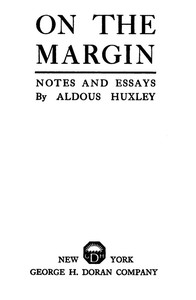
On the Margin: Notes and Essays — A Closer Reading
(0 User reviews)
285
Project Gutenberg
2019
Not confirmed
English essays -- 20th century
Readers of public-domain and historical texts
Project Gutenberg digital edition
en
Edition facts
Words
45,595
Reading time
199 min
Text sections
31
This digital edition of On the Margin: Notes and Essays — A Closer Reading is described by source-level measurements including 45,595 words, 3 hr 19 min estimated reading time, and 31 detected text sections.
The text analysis averages about 23.0 words per sentence, while the detected sections provide another way to judge how the source is divided.
Project Gutenberg metadata also associates the work with “English essays -- 20th century,” connecting these edition facts with the source record’s subject description.
Source:
Project Gutenberg record #60866
Aldous Huxley's 1923 essay collection, originally published as 'Marginalia' in The Athenaeum, examines centenaries, re-reading Candide, accidie, and modern folk poetry with a skeptical, witty voice that dissects national stereotypes and literary pretensions.
Editorial Edition Score
4.8/5
★★★★★
★★★★★
Calculated from edition completeness, EPUB availability, text structure and catalogue metadata. Not a user rating.
How this score is calculated
- Description quality20 pts
- Title & short description10 pts
- Source metadata20 pts
- Text length15 pts
- Chapters / structure15 pts
- EPUB file integrity20 pts
Total of 100 points, scaled to a 2.5-5.0 range. Editions with an empty description or a missing EPUB file are not scored.
Edition quality
Read the Text
ton’s _Anatomy of Melancholy_. The results of the midday demon’s machinations are now known as the vapours or the spleen. To the spleen amiable Mr. Matthew Green, of the Custom House, devoted those eight hundred octosyllables which are his claim to immortality. For him it is a mere disease to be healed by temperate diet:
Hail! water gruel, healing power, Of easy access to the poor;
by laughter, reading and the company of unaffected young ladies:
Mothers, and guardian aunts, forbear Your impious pains to form the fair, Nor lay out so much cost and art But to deflower the virgin heart;
by the avoidance of party passion, drink, Dissenters and missionaries, especially missionaries: to whose undertakings Mr. Green always declined to subscribe:
I laugh off spleen and keep my pence From spoiling Indian innocence;
by refraining from going to law, writing poetry and thinking about one’s future state.
_The Spleen_ was published in the thirties of the eighteenth century. Accidie was still, if not a sin, at least a disease. But a change was at hand. “The sin of worldly sorrow, such as is cleped _tristitia_,” became a literary virtue, a spiritual mode. The apostles of melancholy wound their faint horns, and the Men of Feeling wept. Then came the nineteenth century and romanticism; and with them the triumph of the meridian demon. Accidie in its most complicated and most deadly form, a mixture of boredom, sorrow and despair, was now an inspiration to the greatest poets and novelists, and it has remained so to this day. The Romantics called this horrible phenomenon the _mal du siècle_. But the name made no difference; the thing was still the same. The meridian demon had good cause to be satisfied during the nineteenth century, for it was then, as Baudelaire puts it, that
L’Ennui, fruit de la morne incuriosité, Prit les proportions de l’immortalité.
It is a very curious phenomenon, this progress of accidie from the position of being a deadly sin, deserving of damnation, to the position first of a disease and finally of an essentially lyrical emotion, fruitful in the inspiration of much of the most characteristic modern literature. The sense of universal futility, the feelings of boredom and despair, with the complementary desire to be “anywhere, anywhere out of the world,” or at least out of the place in which one happens at the moment to be, have been the inspiration of poetry and the novel for a century and more. It would have been inconceivable in Matthew Green’s day to have written a serious poem about ennui. By Baudelaire’s time ennui was as suitable a subject for lyric poetry as love; and accidie is still with us as an inspiration, one of the most serious and poignant of literary themes. What is the significance of this fact? For clearly the progress of accidie is a spiritual event of considerable importance. How is it to be explained?
It is not as though the nineteenth century invented accidie. Boredom, hopelessness and despair have always existed, and have been felt as poignantly in the past as we feel them now. Something has happened to make these emotions respectable and avowable; they are no longer sinful, no longer regarded as the mere symptoms of disease. That something that has happened is surely simply history since 1789. The failure of the French Revolution and the more spectacular downfall of Napoleon planted accidie in the heart of every youth of the Romantic generation—and not in France alone, but all over Europe—who believed in liberty or whose adolescence had been intoxicated by the ideas of glory and genius. Then came industrial progress with its prodigious multiplication of filth, misery, and ill-gotten wealth; the defilement of nature by modern industry was in itself enough to sadden many sensitive minds. The discovery that political enfranchisement, so long and stubbornly fought for, was the merest futility and vanity so long as industrial servitude remained in force was another of the century’s horrible disillusionments.
From the opening description of the Ligurian coast, where 'the landscape fairly quotes Shelley at you,' Aldous Huxley establishes a method of reading the world through literature. The essays in On the Margin, originally published as 'Marginalia' in The Athenaeum under the pseudonym Autolycus, move between travelogue, literary criticism, and cultural commentary. Huxley's voice is consistently skeptical, especially toward received wisdom: he dissects an anthology of 'Great Thoughts' only to find them boring, then juxtaposes them with Dadaist maxims from Tristan Tzara. The collection's title signals its position—observations from the edge rather than the center of discourse.
Landscape as Quotation
Huxley opens with a precise, almost painterly description of the Italian coast from Bocca di Magra to Bocca d'Arno, noting the 'flat as a slice of Holland' plain, the Apuan Alps 'streaked here and there with the white marble,' and the clouds that 'repose' over the summits. This landscape is not merely observed but immediately mediated by poetry: 'The landscape fairly quotes Shelley at you.' Huxley imagines Shelley sailing with his 'little volume of Aeschylus,' steering with one hand. The essay uses this scene to introduce a tension between direct experience and literary inheritance—a pattern that recurs throughout the collection. The coast becomes a stage where natural beauty and poetic memory are inseparable.
The Boredom of Great Thoughts
In the essay on centenaries, Huxley turns to Dr. Legat's anthology of maxims, which he initially takes as a livre de chevet but soon finds soporific. He quotes Lamennais, Montesquieu, Balzac, and the Goncourts making sweeping generalizations about national character—'La femme anglaise est une pauvre créature verteuse par force'—and notes how easily intelligent minds fall into such traps. His remedy comes from the Dadaist magazine Proverbe, where Tristan Tzara's six permuted maxims (e.g., 'Il faut violer les règles, oui, mais pour les violer il faut les connaître') reduce the Great Thought to absurdity. Huxley's own position emerges: he prefers the playful, self-aware nonsense of Dada to the pompous certainties of the anthologized wise.
The Pseudonymous Autolycus
Huxley originally published these essays under the name Autolycus, the 'snapper-up of unconsidered trifles' from Shakespeare's The Winter's Tale. This choice signals the collection's method: gathering oddments from high and low culture—a French anthology, a Dada review, a landscape, a folk song—and arranging them into patterns. The essays range from 'Accidie' to 'Modern Folk Poetry' to 'Nationality in Love,' but they share a tone of urbane detachment. Huxley rarely argues a thesis; instead, he presents evidence and lets the contradictions speak. The pseudonym also distances the author from his material, allowing him to mock without committing. This ironic stance is the collection's consistent voice, neither fully engaged nor fully aloof.
Readers approaching On the Margin should expect not a unified argument but a series of intellectual sketches, each turning on a specific observation or quotation. Huxley's method rewards attention to his sources: he expects familiarity with Shelley, Candide, and the Dadaists. The essays are best read singly, allowing each to establish its own tone. The collection's value lies in its refusal to settle into any single mode—it is at once travel writing, literary criticism, and cultural satire, held together by a voice that is consistently skeptical of all certainties.
There’s something about Huxley’s way of lingering on old texts—his skepticism, his quiet warmth for things others dismiss—that reminded me of opening The works of the Reverend George Whitefield, M.A., Vol. 2 (of 6) — Reading Companion afterwards. Not because they’re alike, but because both left me sitting still, thinking about how voices from another century can feel oddly like a friend’s.
There are no reviews for this eBook.
There are no comments for this eBook.
Reader reflection
Your personal reading reflection
Build a private reading journal entry for this title.
Your progress
0
/
10
2
How did the book work for you overall?
3
Would you encourage someone else to read it?
4
What was the reading difficulty like?
5
Did the book deliver what you hoped for?
6
Would a second reading be valuable?
7
Did the story or argument move comfortably?
8
How would you rate its originality?
9
What did this book teach you most?
10