1

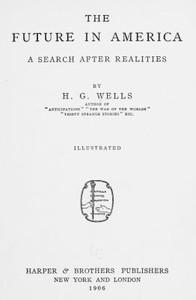
The Future in America: A Search After Realities — A Reader’s Guide
(0 User reviews)
1032
Project Gutenberg
2018
Not confirmed
United States -- Civilization -- 1865-1918; National characteristics, American; United States -- Social conditions -- 1865-1918
Readers of public-domain and historical texts
Project Gutenberg digital edition
en
Edition facts
Words
64,504
Reading time
281 min
Text sections
6
The catalog record for The Future in America: A Search After Realities — A Reader’s Guide provides practical reading context through 64,504 words, 4 hr 41 min estimated reading time, and 6 detected text sections.
The text analysis averages about 24.1 words per sentence, while the detected sections provide another way to judge how the source is divided.
Project Gutenberg metadata also associates the work with “United States -- Civilization -- 1865-1918,” connecting these edition facts with the source record’s subject description.
Source:
Project Gutenberg record #56484
H.G. Wells's 1906 travelogue blends social observation with speculative inquiry, examining American wealth, immigration, and civic character through a foreigner's lens, grounded in specific encounters and urban scenes.
Editorial Edition Score
4.7/5
★★★★★
★★★★★
Calculated from edition completeness, EPUB availability, text structure and catalogue metadata. Not a user rating.
How this score is calculated
- Description quality20 pts
- Title & short description10 pts
- Source metadata20 pts
- Text length15 pts
- Chapters / structure15 pts
- EPUB file integrity20 pts
Total of 100 points, scaled to a 2.5-5.0 range. Editions with an empty description or a missing EPUB file are not scored.
Edition quality
Read the Text
ver was anything of this sort before, never. Caligula's shipping it is true (unless it was Constantine's) did, as Mr. Cecil Torr testifies, hold a world record until the nineteenth century and he quotes Pliny for thirteen hundred tons--outdoing the _Britannia_--and Moschion for cabins and baths and covered vine-shaded walks and plants in pots. But from 1840 onward, we have broken away into a new scale for life. This _Carmania_ isn't the largest ship nor the finest, nor is it to be the last. Greater ships are to follow and greater. The scale of size, the scale of power, the speed and dimensions of things about us alter remorselessly--to some limit we cannot at present descry.
Is Progress Inevitable?
It is the development of such things as this, it is this dramatically abbreviated perspective from those pre-Reformation caravels to the larger, larger, larger of the present vessels, one must blame for one's illusions. One is led unawares to believe that this something called Progress is a natural and necessary and secular process, going on without the definite will of man, carrying us on quite independently of us; one is led unawares to forget that it is after all from the historical point of view only a sudden universal jolting forward in history, an affair of two centuries at most, a process for the continuance of which we have no sort of guarantee. Most western Europeans have this delusion of automatic progress in things badly enough, but with Americans it seems to be almost fundamental. It is their theory of the Cosmos and they no more think of inquiring into the sustaining causes of the progressive movement than they would into the character of the stokers hidden away from us in this great thing somewhere--the officers alone know where.
I am happy to find this blind confidence very well expressed for example in an illustrated magazine article by Mr. Edgar Saltus, "New York from the Flat-iron," that a friend has put in my hand to prepare me for the wonders to come. Mr. Saltus writes with an eloquent joy of his vision of Broadway below, Broadway that is now "barring trade-routes, the largest commercial stretch on this planet." So late as Dickens's visit it was scavenged by roving untended herds of gaunt, brown, black-blotched pigs. He writes of lower Fifth Avenue and upper Fifth Avenue, of Madison Square and its tower, of sky-scrapers and sky-scrapers and sky-scrapers round and about the horizon. (I am to have a tremendous view of them to-morrow as we steam up from the Narrows.) And thus Mr. Saltus proceeds,--
"As you lean and gaze from the toppest floors on houses below, which from those floors seem huts, it may occur to you that precisely as these huts were once regarded as supreme achievements, so, one of these days, from other and higher floors, the Flat-iron may seem a hut itself. Evolution has not halted. Undiscernibly but indefatigably, always it is progressing. Its final term is not existing buildings, nor in existing man. If humanity sprang from gorillas, from humanity gods shall proceed."
The rule of three in excelsis!
"The story of Olympus is merely a tale of what might have been. That which might have been may yet come to pass. Even now could the old divinities, hushed forevermore, awake, they would be perplexed enough to see how mortals have exceeded them.... In Fifth Avenue inns they could get fairer fare than ambrosia, and behold women beside whom Venus herself would look provincial and Juno a frump. The spectacle of electricity tamed and domesticated would surprise them not a little, the elevated quite as much, the Flat-iron still more. At sight of the latter they would recall the Titans with whom once they warred, and sink to their sun-red seas outfaced.
"In this same measure we have succeeded in exceeding them, so will posterity surpass what we have done. Evolution may be slow, it achieved an unrecognized advance when it devised buildings such as this. It is demonstrable that small rooms breed small thoughts. It will be demonstrable that, as buildings ascend, so do ideas. It is mental progress that sky-scrapers engender. From these parturitions gods may really proceed--beings, that is, who, could we remain long enough to see them, would regard us as we regard the apes...."
H.G. Wells opens The Future in America not with a panoramic view of the New World but with a bureaucratic form: the questionnaire that asks, “Are you a Polygamist?” and “Are you an Anarchist?” This mundane yet charged document frames his entire project as a search after realities, one that begins with the indignity of proving oneself a desirable alien. Wells’s voice is self-deprecating—he compares himself to an ant exploring an elephant—yet his curiosity is relentless. The book is a travelogue, a social diagnosis, and a speculative essay rolled into one, driven by a conviction that America’s visible surfaces conceal deeper, often troubling, currents.
The Ant and the Elephant
Wells’s self-portrait as an ant crawling over a vast unconscious carcass is more than a rhetorical flourish; it establishes the book’s epistemological modesty. He admits his equipment is inadequate for the task of understanding America, yet he proceeds anyway, trusting that even an ant’s observations may interest other ants. This framing recurs throughout the text: Wells is a foreigner acutely aware of his limitations, and he turns that limitation into a method. He does not claim omniscience but instead foregrounds his own perplexity, making the reader a companion in bewilderment. The opening chapter, “The Prophetic Habit of Mind,” signals that Wells intends to extrapolate from present symptoms to future possibilities, but he anchors those speculations in concrete details: the immigration form, the view from a writing desk in Sandgate, the names of streets and cities. The ant metaphor thus becomes a promise of honesty—Wells will not pretend to have mastered his subject.
Immigration as Invisible Transformation
One of the book’s most striking observations concerns the invisibility of immigrants to the native-born American. Wells notes that the immigrant “does not clamor for attention” and is “almost entirely inaudible, inarticulate, and underneath.” He borrows a passage from Henry James, who in Boston heard “no sound of English in a single instance” among Sunday strollers. Wells extends this: the immigrant adopts “protective mimicry,” acquiring cheap American clothes, a collar, a pocket-handkerchief, and the habit of chewing and spitting with “the proper meditative expression.” The process of Americanization, as Wells describes it, is a stripping away of visible difference—earrings vanish, native tongues are abandoned even in private—until the immigrant becomes a “dingy quick-eyed citizen” ripe for a vote. Yet Wells also records the counterargument: every American above forty, he claims, seems an “enthusiastic advocate of unrestricted immigration.” He rides with a Mr. Z. who sings “the song of American confidence,” and Wells’s own anxiety about “this huge dilution of the American people with profoundly ignorant foreign peasants” stands in unresolved tension with that boosterism. The excerpts do not reveal whether Wells resolves this tension, but they show him wrestling with it in real time.
The Texture of American Cities
Wells’s America is a place of abrupt juxtapositions. In one paragraph he describes Fifth Avenue; in the next, a “ramshackle factory” and a young man who answers in “some totally incomprehensible tongue.” The city is a palimpsest: beneath the surface of native American life lies a substratum of immigrant labor, visible only to those who look. Wells’s method is to move between social strata, dining with “original Americans” and then descending into neighborhoods where English is rarely heard. He is attentive to the built environment—the Brooklyn Bridge, the crowded East Side, the office buildings where immigrant children are Americanized—and to the human figures that populate it: the breaker boys at a Pennsylvania colliery, the “plump and pretty pupils of extravagance” on Fifth Avenue. These details are not merely decorative; they are evidence for Wells’s argument that American prosperity rests on a foundation of exploited and invisible labor. The illustrations listed in the contents—such as “New York’s Crowded, Littered East Side” and “Interior of a New York Office Building Where Immigrant Children Are Americanized”—suggest that the visual record reinforces this theme, though the excerpts do not include the images themselves.
Wells’s The Future in America is best approached as a document of its moment—a British novelist’s attempt to read the American future from its present symptoms. The excerpts reveal a writer who is skeptical of easy optimism, attentive to the material conditions of everyday life, and willing to let contradictions stand. Readers should expect a hybrid text: part travel diary, part social analysis, part prophecy. The book rewards those who follow Wells’s digressions and who share his willingness to be an ant on a very large elephant.
Reading Wells’s train-window glimpses of Chicago reminded me of my own first trip east, watching smoke-stacks blur into dusk. That same unsettled feeling—of bigness and hurry—returned when I later picked up Our business civilization — Edition Insights. It wasn’t argument so much as atmosphere; both books turn strangers’ streets into a mirror for what we’ve become, quietly.
There are no reviews for this eBook.
There are no comments for this eBook.
Reader reflection
Record your reading impressions
A brief reflection can help important ideas stay with you longer.
Your progress
0
/
10
2
How did the book work for you overall?
3
Would you recommend this book to another reader?
4
What was the reading difficulty like?
5
Did the book offer a fresh perspective?
6
How strong was your personal connection to the text?
7
Was the book moving at the right speed?
8
Did any part of the book stay with you emotionally?
9
Which lesson or insight stayed with you?
10