1

The sexagenarian; or, the recollections of a literary life (Volume 1 of 2) — Key Ideas to Explore
(0 User reviews)
461
Project Gutenberg
2023
Not confirmed
Authors, English; Beloe, William, 1756-1817; English literature -- Anecdotes
Readers of public-domain and historical texts
Project Gutenberg digital edition
en
Edition facts
Words
89,215
Reading time
388 min
Text sections
68
For The sexagenarian; or, the recollections of a literary life (Volume 1 of 2) — Key Ideas to Explore, the stored edition analysis reports 89,215 words, 6 hr 28 min estimated reading time, and 68 detected text sections.
The text analysis averages about 24.7 words per sentence, while the detected sections provide another way to judge how the source is divided.
Project Gutenberg metadata also associates the work with “Authors, English,” connecting these edition facts with the source record’s subject description.
Source:
Project Gutenberg record #72213
William Beloe's memoir, written under the pseudonym 'The Sexagenarian,' offers a collection of literary anecdotes and character sketches from late 18th-century England, with a distinctive conversational voice and a self-deprecating, playful tone.
Editorial Edition Score
4.9/5
★★★★★
★★★★★
Calculated from edition completeness, EPUB availability, text structure and catalogue metadata. Not a user rating.
How this score is calculated
- Description quality20 pts
- Title & short description10 pts
- Source metadata20 pts
- Text length15 pts
- Chapters / structure15 pts
- EPUB file integrity20 pts
Total of 100 points, scaled to a 2.5-5.0 range. Editions with an empty description or a missing EPUB file are not scored.
Edition quality
Read the Text
hapter XLII. No attempt has been made to renumber the chapters.
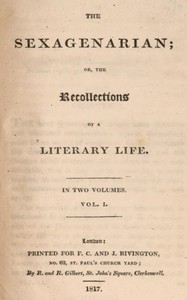
The Sexagenarian; or, the recollections of a literary life, in two volumes. Vol. I.
OR, THE RECOLLECTIONS OF A LITERARY LIFE.
London: PRINTED FOR F. C. AND J. RIVINGTON, NO. 62, ST. PAUL’S CHURCH-YARD; _By R. and R. Gilbert, St. John’s Square, Clerkenwell_ 1817.
Among various other particularities which marked the whimsicality of our Sexagenarian’s character, there were discovered in his manuscript, a great many specimens of DEDICATIONS, ready cut and dried.
Of these, some were inscribed with due solemnity to very great men, to Ministers, Prelates, Court Favourites, and so forth; others were written in a less formal style to individuals of known genius, talents, and learning; one or two were of a playful kind, and addressed to old college friends and acquaintance; one more particularly was of a facetious tendency in the character of Satan to Bonaparte. Oh! that the Sexagenarian had but lived to witness the catastrophe of that miscreant adventurer!
But of all these pieces, some composed with more and some with less care and circumspection, one more immediately forced itself upon the attention, inscribed
Something of an introduction seems indispensable on the present occasion, and perhaps nothing more to the purpose could easily be met with; so it is inserted _verbatim et literatim_ from the original document.
“Those were good old times for poor authors, when the usual accompaniment of an adulatory Dedication to some great personage, was ten pounds. Alas! there is no such thing _now-a-days_. It is well if when dismissed from the audience of the patron, you are bowed out with a little faint praise, and a civil leer. Yet such is the effect of habit, and so inconsistent is the character of man, that there are no authors of equal celebrity with myself, (hem!) who will condescend to place their works before the public, without a Dedication, or Inscription of one kind or other.
“But as ill luck would have it, my literary pilgrimage has been so long and so extended, that I have exhausted my catalogue of illustrious names, numerous as it was. I am compelled, as the French term it, “_jouer à coupe un_,” in other words, to play alone. I am reduced to the necessity of looking about for somebody who cannot in reason refuse the honour intended; from whom nothing is to be expected but a good-humoured acquiescence in whatever I may choose to say; whose vanity expects no flattery, whose pride can receive no wound.
“Where then can I look with more complacency, comfort, and confidence, than to
“Here I may expatiate without fear of interruption, and what is more, without suspicion of my sincerity upon those intellectual qualities, which I have witnessed for almost half a century, growing as it were from a grain of mustard-seed to a tree, beneath whose spreading branches children and grand-children have reposed in security and peace. I might enlarge upon the sagacity which foresaw the approach of human ill, on the discretion which encountered, and on the fortitude which endured it. Yes! the imagination might indulge itself in remembering the delight with which we traversed together, the gay and enlivening fields of youth, and the cheerfulness and composure with which the chilling winds of age were opposed.
“But on this subject it is time to pause, difficult as it is to forego the last opportunity of expatiating upon these fairy visions, the remembrance of which is still so dear.
Mirror of Life, the glories thus depart Of all that Love, and Youth, and Fancy frame, When painful Anguish speeds the piercing dart, Or Envy blasts the blooming flowers of Fame.
“To conclude in plain prose. Mayst thou with whom the various incidents of a perturbed life have been participated, the pressure of which has again and again been alleviated by thy sympathy, accept, in no adulatory terms of praise, but in those of sober gratitude and truth, my heartfelt acknowledgments of thy goodness.
“Well can I remember that when thou wast an object of admiration, not to the gay and thoughtless alone, but to the grave, the sedate, and the wise, that no external allurement could ever divert thee from the obligations of duty.
“Nor can I forget, that when our earlier career was obstructed by briars and thorns, thy sagacity found means to lessen their asperity, and thy unwearied exertions never failed to facilitate their removal. Surely too, amidst the sufferings and sorrows of repeated sickness, did thy tenderness assuage the pain, and impart the most delightful and salutary balm.
William Beloe's The Sexagenarian; or, the Recollections of a Literary Life opens not with a straightforward autobiography but with a playful preface: a collection of mock dedications, including one addressed 'To an Old Woman.' This whimsical choice immediately establishes the narrator's ironic, self-aware voice. The work is a series of anecdotes and character sketches drawn from Beloe's long career as a writer, translator, and editor. The narrative voice shifts between genial reminiscence and sharp, sometimes barbed, commentary on fellow literary figures. The excerpts reveal a writer who is both a participant in and observer of the London literary scene, offering glimpses of figures like Richard Porson and Gilbert Wakefield through a lens that is personal, opinionated, and deliberately informal.
A Self-Conscious Narrator and His Playful Frame
The introduction's mock dedications, especially the one 'To an Old Woman,' signal Beloe's narrative strategy: he presents himself as a slightly eccentric, self-mocking figure. He writes of being 'reduced to the necessity of looking about for somebody who cannot in reason refuse the honour intended.' This framing device allows him to adopt a conversational, even confiding tone throughout the memoir. The narrator frequently interjects with asides, such as the parenthetical '(hem!)' after claiming celebrity, which undercuts his own pretensions. This self-deprecating humor is a consistent feature, distinguishing the work from more solemn literary memoirs of the period. The reader is invited into a private, almost epistolary relationship with the Sexagenarian, who treats his recollections as a series of informal letters rather than a formal history.
Sharp Portraits and Anecdotal Evidence
Beloe's character sketches are built on specific, often unflattering anecdotes. His account of Richard Porson, the renowned Greek scholar, is particularly revealing. He recounts a moment when a 'venerable personage' (likely Samuel Parr) boasted to Porson about metaphysics, only to receive the retort, 'I presume you mean your metaphysics.' Beloe also includes a Porson epigram that lampoons this same figure as a '—monger.' The portrait of Gilbert Wakefield is more critical: Beloe claims Wakefield 'formed his opinions hastily' and 'never failed to vindicate them with peremptory decision.' He supports this with a specific instance: pointing out an error in Wakefield's New Testament translation, which Wakefield acknowledged but never corrected. These anecdotes are not neutral; they are chosen to illustrate character flaws and intellectual rivalries, giving the memoir a partisan, gossipy quality.
Pace and Structure: The Rhythm of Recollection
The narrative pace in the excerpts is uneven, mirroring the associative nature of memory. Beloe moves from the playful dedication to a detailed, almost scholarly defense of Porson against Wakefield's criticisms. The prose shifts from light, ironic asides to dense, argumentative passages. For instance, he devotes several paragraphs to refuting Wakefield's claim that Porson's edition of Heyne's Virgil contained 'nine hundred errors,' carefully distinguishing between errors in the text and those in the notes. This sudden change in register—from gossip to textual criticism—creates a rhythm that is both digressive and purposeful. The reader is never allowed to settle into a single mode; the Sexagenarian's mind jumps from jest to judgment, from personal recollection to scholarly debate. This structural restlessness is a deliberate reflection of a 'literary life' lived among books and personalities.
Beloe's Sexagenarian rewards readers who enjoy literary gossip leavened with erudition. The work's value lies not in a coherent narrative but in its vivid, opinionated snapshots of a bygone literary world. Pay attention to the narrator's shifts in tone—from the jocular to the combative—as they often signal his deepest loyalties and grudges. The memoir is best read in short bursts, savoring each anecdote as a self-contained vignette.
I have spent evenings with Beloe’s Sexagenarian, smiling at his sly, sideways glances at authorship, that odd blend of vanity and weariness. It made me think of another shelf-companion, a stranger’s private catalogue of unwritten books. Both whisper the same charming secret: a writer’s truest life often hides between the lines they never quite finish. An Author's Mind : The Book of Title-pages — Edition Insights feels like a gentle echo of that same quiet confession.
There are no reviews for this eBook.
There are no comments for this eBook.
Reader reflection
Your personal reading reflection
Build a private reading journal entry for this title.
Your progress
0
/
10
2
How much did you enjoy the reading experience?
3
Would you pass this book on to a friend?
4
How much effort did this book require?
5
Did any part of the book feel personally relevant?
6
Would a second reading be valuable?
7
How clear did the writing feel?
8
How useful did the reading feel?
9
What is the main idea you are taking away?
10