1

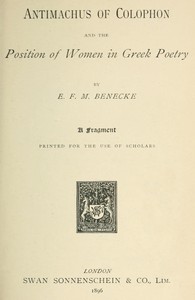
Antimachus of Colophon and the Position of Women in Greek Poetry A fragment printed for the use of scholars — Story, Setting & Ideas
(0 User reviews)
68
Project Gutenberg
2022
Not confirmed
Women in literature; Greek poetry -- History and criticism; Women and literature -- Greece; Antimachus, of Colophon -- Characters
Readers of public-domain and historical texts
Project Gutenberg digital edition
en
Edition facts
Words
68,271
Reading time
297 min
Text sections
26
Antimachus of Colophon and the Position of Women in Greek Poetry A fragment printed for the use of scholars — Story, Setting & Ideas can be approached with a clearer sense of reading commitment from its source measurements: 68,271 words, 4 hr 57 min estimated reading time, and 26 detected text sections.
The text analysis averages about 20.5 words per sentence, while the detected sections provide another way to judge how the source is divided.
Project Gutenberg metadata also associates the work with “Women in literature,” connecting these edition facts with the source record’s subject description.
Source:
Project Gutenberg record #67573
A posthumously published fragment by E. F. M. Benecke examining women's roles in Greek poetry, with a focus on Antimachus of Colophon. The surviving essays cover women in Greek poetry and comedy, drawing on ancient sources to argue for a shift toward romantic ideals in New Comedy.
Editorial Edition Score
4.8/5
★★★★★
★★★★★
Calculated from edition completeness, EPUB availability, text structure and catalogue metadata. Not a user rating.
How this score is calculated
- Description quality20 pts
- Title & short description10 pts
- Source metadata20 pts
- Text length15 pts
- Chapters / structure15 pts
- EPUB file integrity20 pts
Total of 100 points, scaled to a 2.5-5.0 range. Editions with an empty description or a missing EPUB file are not scored.
Edition quality
Read the Text
achus to unite the two streams of thought in one, and to show that woman, with her newly-awakened capabilities, was a worthy object of pure and chivalrous devotion.
The works of Antimachus are lost, and none of the few fragments which survive are of any importance. All discussion with reference to them must therefore be based on suppositions and an examination of relative probabilities. The risks of error in entering on such doubtful ground are manifestly infinite, and conclusions can be reached only through the accumulation of a mass of evidence, the separate particles of which are often in themselves of very little weight; the veil of darkness covering all such Greek literature as does not bear the hall-mark of Athens is so thick that it is perhaps no longer possible for the real truth about it ever to be known. _Ceterum, fiat justitia._ It is a bold claim, I know, that I am making for Antimachus; it is a claim which, if established, would give him right to rank among the greatest poets of the world: it would give him right to rank as the founder of modern literature. How great a poet he really was we do not know. Perhaps my estimation of his importance is altogether exaggerated. His contemporaries, we know, preferred Choerilus; perhaps they were right; for myself, _Malo cum Platone errare_.
It is generally agreed that in prehistoric times the position of women among the Greeks was a much higher one than was the case subsequently. There seems every reason to believe that the social conditions of the Lesbians and the Dorians and the other nations which did not come under the influence of the history-writing Ionians, were but the survivals of what was originally a more or less general state. It is of considerable assistance for a proper comprehension of the earliest literature, if one remembers that at the time of its production the enslavement of women had only comparatively recently taken place.
The reason of the influence of primitive woman over primitive man is probably not very far to seek. In early times women were regarded with superstitious reverence[3]—one need only watch a woman making lace, say, to be able nowadays still to quite appreciate the feeling—and with natural woman’s wit for a time kept up the illusion, the hard head of man taking some time to come to maturity. But when man did at last wake to the fact that he was physically, and therefore, for practical purposes, generally superior, an inevitable reaction set in, and the history of early Greece shows women as occupying on the whole a very low position—a position, too, which became lower still with advancing civilisation.[4]
That the original state of women was not one of slavery is clearly shown by the early epics. The _Iliad_ and the _Odyssey_ are pictures of an earlier state of society than that of the poet who describes them. A man living in a society in which women were despised, had to deal with legends belonging to an earlier social condition, in which women played a prominent part. Traces of this anomaly are easy to find in both poems. The Trojan war was the work of a woman, but how very little that woman appears in the _Iliad_! A woman has been managing the affairs of Odysseus for twenty years in an exemplary fashion; but the hero of the _Odyssey_ on his return prefers to associate with the swineherd. It is by this contradiction between the actual experiences of the poet and the social conditions which he was called upon to depict, that the many inconsistencies in the treatment of the Epic woman must be explained.
Another excellent illustration of this conflict between the primitive and the subsequent views of the nature and importance of women is furnished by the elaborate treatment of the Pandora legend in the _Opera et Dies_ of Hesiod. On the one hand is the early conviction of the power of women’s influence—it is only by the help of a woman that Zeus can outwit man: on the other the later conviction that this influence must be for evil—before Pandora came
ζώεσκεν ἐπὶ χθονὶ φῦλ’ ἀνθρώπων νόσφιν ἄτερ τε κακῶν καὶ ἄτερ χαλεποῖο πόνοιο. (l. 90)
And a like contradiction runs through all the details of the description. Woman will be man’s ruin, but he cannot fail to love her all the same—
τοῖς δ’ἐγὼ ἀντὶ πυρὸς δώσω κακὸν ᾧ κεν ἅπαντες τέρπωνται κατὰ θυμὸν ἑὸν κακὸν ἀμφαγαπῶντες. (l. 57)
Woman will gain man’s heart by her beauty, which is like that of the immortals—
ἀθανάταις δὲ θεαῖς εἰς ὦπα ἐΐσκειν παρθενικῆς καλὸν εἶδος ἐπήρατον (l. 62),
by her skill and by her charm; it is but as an afterthought that the poet adds—
ἐν δὲ θέμεν κύνεόν τε νόον καὶ ἐπίκλοπον ἦθος Ἑρμείαν ἤνωγε διάκτορον ἀργειφόντην. (l. 67)
This volume is a fragment. E. F. M. Benecke died at twenty-five in 1895, leaving behind two essays and several excursuses that were to form part of a larger work titled Women in Greek Poetry: being an Enquiry into the Origin of the Romantic Element in Literature. The extant text, printed for scholars, focuses on the portrayal of women in Greek lyric, tragedy, and especially comedy, with Antimachus of Colophon serving as a touchstone for earlier poetic traditions. The editor’s note cautions that Benecke might have recast the whole had he lived, and the material is published as is, with the hope it may aid similar studies.
A Scholarly Fragment, Not a Finished Argument
The book’s subtitle—A Fragment Printed for the Use of Scholars—is not a rhetorical gesture. The introductory note explains that Benecke’s death interrupted a planned three-part work; only the first two essays survive. The first essay, “Women in Greek Poetry,” likely incorporates material intended for the first division, but the editor notes it contains allusions to subjects that would have belonged to the third division on the Alexandrian ideal of woman. Readers should treat the arguments as provisional, especially where the text references topics not fully developed. The excursuses, such as those on Sophocles’ Phaedra and Euripides’ Andromeda, suggest the author was still assembling evidence.
Comedy as a Vehicle for New Marital Ideals
Benecke’s second essay, “Women in Greek Comedy,” argues that New Comedy, particularly Menander, revolutionized Greek attitudes by presenting marriage as a desirable state. He cites Plutarch’s testimony that Menander is suited for married men to read, and notes that seductions of maidens regularly end in marriage. The essay contrasts this with earlier Greek feeling, emphasizing that the Stichus and Hecyra depict wives remaining faithful to absent husbands, and that Menander’s fragments praise marital devotion. One quoted fragment calls marriage the closest relationship: “οἰκεῖον οὕτως οὐδέν ἐστιν, ὦ Λάχης, / ἐὰν σκοπῇ τις, ὡς ἀνήρ τε καὶ γυνή.” Benecke acknowledges the exception of hen-pecked husbands, but notes these are always elderly, suggesting ridicule of mariages de convenance rather than marriage itself.
Evidence from Ancient Testimony and Fragmentary Plays
Benecke builds his case on a combination of ancient critical judgments and surviving dramatic fragments. He quotes an epigram from the C. I. G. that calls Menander the “bright companion of Love” and says he “sweetened the stage with dramas all about marriage.” He also draws on Plutarch’s Symposiacs to argue that Menander’s works were considered proper for married people. The analysis of specific plays, though based on Latin adaptations (Plautus’ Stichus, Terence’s Hecyra), is used to infer the Greek originals’ treatment of marital fidelity. Benecke’s method is philological: he cites line numbers and compares fragments to support his thesis that New Comedy introduced a romantic element absent from earlier Greek literature.
Because the work is a fragment, readers should approach it as a collection of scholarly notes rather than a finished monograph. The essays are dense with Greek quotations and textual criticism, and the argument about the “romantic element” is only partially developed. Those interested in the history of gender in classical literature will find useful source references, but should verify Benecke’s claims against the original texts. The volume is best read alongside the plays and fragments it discusses.
Benecke's fragment about Antimachus makes me recall evenings spent puzzling over how Greek poets heard women's voices—so often just echoes. It reminded me of that quiet feeling I had reading Adventures in indigence, and other essays — Reading Companion last winter. Both books are incomplete in their own ways, yet that unfinished quality somehow made the searching feel more honest, more human.
There are no reviews for this eBook.
There are no comments for this eBook.
Reader reflection
Your personal reading reflection
Build a private reading journal entry for this title.
Your progress
0
/
10
2
Did this book hold your interest?
3
Would you pass this book on to a friend?
4
How much effort did this book require?
5
How strong was your personal connection to the text?
6
How useful did the reading feel?
7
What was the strongest part of the book?
8
Did the story or argument move comfortably?
9
What is the main idea you are taking away?
10