1

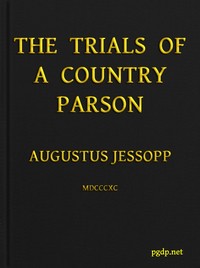
The Trials of a Country Parson — Edition Insights
(0 User reviews)
1331
Project Gutenberg
2018
Not confirmed
Church of England -- Clergy -- Biography; Jessopp, Augustus, 1823-1914; Rural churches -- England
Readers of public-domain and historical texts
Project Gutenberg digital edition
en
Edition facts
Words
76,676
Reading time
334 min
Text sections
18
The source record for The Trials of a Country Parson — Edition Insights measures this digital text at 76,676 words, 5 hr 34 min estimated reading time, and 18 detected text sections.
The text analysis averages about 26.7 words per sentence, while the detected sections provide another way to judge how the source is divided.
Project Gutenberg metadata also associates the work with “Church of England -- Clergy -- Biography,” connecting these edition facts with the source record’s subject description.
Source:
Project Gutenberg record #58451
Augustus Jessopp's account of rural clergy life blends personal observation with sharp commentary on church restoration, using a conversational yet pointed voice that shifts between anecdote and polemic.
Editorial Edition Score
4.8/5
★★★★★
★★★★★
Calculated from edition completeness, EPUB availability, text structure and catalogue metadata. Not a user rating.
How this score is calculated
- Description quality20 pts
- Title & short description10 pts
- Source metadata20 pts
- Text length15 pts
- Chapters / structure15 pts
- EPUB file integrity20 pts
Total of 100 points, scaled to a 2.5-5.0 range. Editions with an empty description or a missing EPUB file are not scored.
Edition quality
Read the Text
them, a new book to get up, a new code to study. Then there are the pupil teachers to look after, and returns to make up, and all the dull routine which has to be got through.
How _can_ an elementary schoolmaster in a remote country village be a reading-man, or what motive has he to get out of the narrow groove in which he has been brought up? The best teachers, as a rule, are they who know their work best and very little indeed outside it. “How is it that at Dumpfield they don’t get a larger grant?” I asked one day of an inspector noted for his shrewdness and good sense. “Surely Coxe is by far the ablest and most brilliant teacher for miles round; he is almost a man of genius?” “Precisely so,” was the reply, “the man’s out of place. These brilliant men with a touch of genius are a nuisance in an elementary school. My dear fellow, never let a _man of views_ come into your school. Keep him out. Beware of the being who is for revolutionizing spelling and grammar!”
Mr. Petticogge is not a man of genius, only a better sort of elementary schoolmaster, and entirely absorbed in his work. He, too, as all the members of his fraternity do, occupies a position of isolation, and between him and the parson there is just so much in common as to make each hold aloof from the other without making either of them congenial to their other neighbours. As for the rest of friend Burney’s neighbours, take them in the gross, and you may say of them what the ticket-of-leave man said of the Ten Commandments; “They’re rather a poor lot and you can’t make much out of ’em.” I know no class of men who are less sociable than the smaller farmers, as we reckon smallness in the East. I mean the men who hold a couple of hundred acres and under. It has often been laid to the charge of the great occupiers in West Norfolk and elsewhere that in the good times they were lavish beyond all reason in their hospitalities. I believe there never has been anything of the sort among the smaller men; they are not unfriendly, they are not wanting in cordiality, but they are not companionable.
It is my privilege to know some who are notable exceptions to the all but universal rule. I have not far to go from my own door to find one whom I never pay a visit to without pleasure and profit, one who has for many years been a great reader of Lord Tennyson’s poems, has strong opinions on politics and the questions of the day, a thoughtful, resolute, and true-hearted woman, who farms a hundred acres of land without a bailiff, and, among other evidences of her good taste and intelligence, is a diligent reader of the _Spectator_. But such are few and far between.
It is one of the trials of the country parson that, as soon as he passes out of the stratum to which the labourer belongs, he finds himself in a stratum where there is nothing that has any of the interest of originality, picturesqueness, or even passion. The people who live and move in that stratum are dismally like the ticket-of-leave man’s ten commandments. My neighbours hardly believe me when I tell them I can see, even among the smaller farmers, much to admire, much to respect, and something to love; but I do not wonder that many a country parson “can’t make much out of ’em.” These men are having rather a hard life just now, but they have _not_ to learn the most elementary lessons of thrift and frugality. As a class they have always practised these virtues, and as a class they are far less complaining than those who belong to the higher stratum; they bear their burdens silently, perhaps too silently, and they tell you that it’s no good grumbling--“that,” one of them said to me, “only makes things worse, ’cause it makes _you_ worse!” Take them all in all, they whom I have elsewhere called _the little ones_ are usually those of his parishioners with whom the parson seldom comes into unpleasant relations; they are usually very hard at work, very practical, very straightforward, and very seldom indeed prone to give themselves airs.
Augustus Jessopp opens The Trials of a Country Parson with a frank admission: his earlier book on rural life had been misunderstood, and he now writes to correct that impression. The preface immediately establishes a voice that is both personal and argumentative, as he describes returning to a country village after years in a large town and finding the folk unchanged in their sturdy virtues yet vulnerable to itinerant agitators. This is not a detached memoir; Jessopp engages directly with his readers, using rhetorical questions and sharp contrasts—between urban progress and rural stagnation, between patient study and crude theory—to frame his project. The prose is dense with specific grievances and a palpable sense of urgency, setting the stage for a work that is as much a polemic as a record of experience.
A Voice of Personal Witness
Jessopp’s narrative voice is that of a seasoned observer who has lived among his subjects, not a distant commentator. He speaks of “my people” and “my lot,” grounding his authority in firsthand experience. His sentences often begin with a personal stance: “I was surprised,” “I could not be blind,” “I for one hereby declare.” This directness gives the prose a conversational, even confrontational tone, as if he is addressing a skeptical audience. He uses the first person not for self-display but to anchor his judgments in specific encounters—for instance, his initial encounter with the “worst side” of his parishioners’ characters. The voice is that of a man who has earned the right to criticize because he has also suffered the trials he describes.
Polemical Rhythm and Rhetorical Devices
The writing is marked by a distinctive rhythm: Jessopp builds an argument through a series of contrasts and parallel constructions. He sets “criminal and indolent neglect” against “pretentious puffery,” “stupid do-nothingism” against “rash do-everythingism.” This habit of pairing opposites gives his prose a driving, almost sermonic quality. He also employs extended analogies—comparing church restorers to a lady who claimed to make women “beautiful for ever,” or to medical quacks who forbid setting broken bones. These analogies are not merely decorative; they are tools of persuasion, designed to make his point vivid and memorable. The effect is a text that moves between anecdote and abstraction, never letting the reader settle into passive reading.
Shifts in Pace: From Anecdote to Exhortation
Jessopp varies his pace markedly. The preface begins with measured, explanatory sentences, then accelerates into a cascade of complaints about “itinerant agitators” and “blatant demagogues.” Later, in the excerpt on church restoration, he slows to a deliberate, almost legalistic enumeration of positions: “If there are some crazy fanatics… I for one hereby declare… I look upon such people…” This shift from narrative to declaration gives the text a courtroom-like gravity. He also uses short, punchy clauses for emphasis: “they were instant in season and out of season; they reproved, rebuked, exhorted.” The rhythm mimics the urgency he feels, making the reader sense the pressure of a man who believes time is short and the issues are pressing.
Readers should approach The Trials of a Country Parson as a work of advocacy as much as memoir. Jessopp’s voice is the central instrument: he uses it to persuade, to lament, and to provoke. Pay attention to how he builds his arguments—through contrast, analogy, and personal testimony—and note the moments when his pace quickens or slows. These shifts are not accidental; they are the marks of a writer who knows exactly what effect he wants to achieve.
Over many evenings with Augustus Jessopp’s kindly, sharp-edged complaints about pews and parishes, I found myself thinking of another worn volume on my shelf, Set Down in Malice. Both authors knew that memory is a selective friend. Jessopp’s quiet fury at careless restorations whispers alongside that book’s gentler, wry forgiving of old wrongs—two voices, hushed, nodding to each other across decades. Set Down in Malice: A Book of Reminiscences — Story, Setting & Ideas holds that same unhurried truth.
There are no reviews for this eBook.
There are no comments for this eBook.
Reader reflection
What did you think of this book?
Answer a few questions and save a private reflection on this device.
Your progress
0
/
10
2
How did the book work for you overall?
3
Would you pass this book on to a friend?
4
Did the language feel accessible?
5
Did the book offer a fresh perspective?
6
How did the pace of the book feel?
7
Did it raise ideas you would like to talk about?
8
What did you appreciate most?
9
Which lesson or insight stayed with you?
10